Monday, August 28, 2017

Who Do You Say I Am?

In Nomine Iesu
St. Matt. 16:13-20
August 27, 2017
Proper 16A

Dear brothers and sisters in Christ Jesus~

Who . . .is . . . Jesus? That’s the question of the day. But do we really need to be asking that question here? I mean, this is a Christian church after all—a congregation of the Lutheran Church-Missouri Synod. Christ crucified is literally the focal point of this
sacred space. And yet, that question, Who is Jesus? Who do you say that I am? it has a way of getting our attention. There’s a lot riding on how you answer that question. That question is deeply personal (not private, but personal).

It’s easier to report on what other people think of Jesus. When Jesus asked, Who do the people say the Son of Man is? the answers He got were varied and predictable. Some say John the Baptizer, back from the dead. Some say Elijah, who was supposed to appear before the coming of the Messiah. Others say Jeremiah or one of the prophets. In so many words, a great man among religious men. Just like today when people say something complimentary about Jesus without confessing the big thing: He’s a great moral teacher. He’s an example on how to care for the poor and sick. He’s a true friend in times of trouble. That’s all very nice. But it’s not nearly enough.

But who do you say that I am? Now Jesus gets at the heart of the matter. Never mind what the polls say, what about you guys? Simon Peter speaks up, as he always does. Good old Simon Peter. He’s like that one annoying kid in the classroom who always has his hand up in the air—who always thinks he knows the answer—to whom attention must be paid. I always imagine the other eleven disciples trying not to roll their eyes as Peter cleared his throat and began to speak: You are the Christ, the Son of the living God.

But instead of the usual correction or condemnation from Jesus, Peter for once is commended! “Blessed are you, Simon bar-Jonah.” Peter got it right. Jesus IS the Christ, the Messiah, the very fulfillment of all God’s promises to Abraham, Isaac, and Jacob, Moses, David and all the prophets—the Son of the living God. You couldn’t get a more correct, orthodox answer than that.

Blessed are you, Simon . . . but. You didn’t think this up on your own. This confession of yours came straight from the Father in heaven. So, no gold star for Peter. No merit badge or trophy. To confess that Jesus is the Christ, the Son of the living God, is not something we can do by our own reason or strength or IQ or intelligence. No one can say “Jesus is Lord” except by the Holy Spirit. You, like Peter, can take no credit for confessing the divine truth about Jesus. All you can do is receive the blessing that comes from such a confession: Blessed are you!

Peter’s confession was rock solid. That’s why Jesus called him Petros, Peter, Rocky. Because on that rock-solid confession Jesus will build His church and the gates of hell will not prevail against it. This is important. Who builds the church? Jesus does! Who gives the church growth? Jesus does! And He does it all based on Peter’s rock-solid confession that Jesus is the Christ—not on the person of Peter. There’s nothing solid about the person of Peter at all. The church is not some personality cult of Peter or any other pastor. A church built on Peter would be on a slippery slope. The beauty of Peter’s confession is that he doesn’t point to himself, but to Jesus. And you can’t be more rock-solid than when you’re confessing a crucified and risen Christ. Even the gates of hell cannot compete with that!

This is the true, hidden strength of this (and every) congregation. Our strength lies not in the personality of our pastor, or in the beauty of our hymns, or in the simplicity of our sanctuary. Our strength is our foundation—the rock-solid confession that Jesus is the Christ, the Son of the living God—a truth we quietly and calmly assert before the whole world every time we unite our voices in the Creeds of the church.

Did Peter fully realize what his words meant that day? No, not fully—not yet. As we’ll hear next Sunday, the same Peter who could confess the Christ with clarity in one breath, could become a spokesman for Satan in the very next breath. Peter envisioned a conquering Christ, not a suffering servant.

But Peter came to learn what we also have come to know: To confess Jesus as Christ and Son of God is to confess Him as crucified and risen from the dead. There is no other Jesus—no other way to be the Christ than by dying and rising. This is how death is defeated. This is how our sin is atoned for. This is how all things will be made new—by Jesus’ death on a cross for the sins of the world. Those who would flatter Jesus by saying all sorts of nice things about Him, but refuse His bloody death and reject His resurrection—they are on very shaky ground.

Peter’s confession of Jesus also shows you the importance of your own confession of Christ. What you believe with your heart, you confess with your lips. In just a few minutes we will receive two new members into our fellowship—and we will receive them, not because they are very nice people who can bring a lot of good things to our life together. No, we receive them based upon their confession of the faith—a confession built squarely on the rock-solid foundation that Jesus is the Christ, the Son of God.

There’s really no middle ground where the Christ is concerned. Either He is Lord or He isn’t. Either He is the Messiah or He isn’t. Either He is the Son of God or He’s a lunatic. As C. S. Lewis famously wrote in Mere Christianity: Either this man was, and is, the Son of God; or else a madman or something worse. You can shut him up for a fool, you can spit at Him and kill Him as a demon; or you can fall at His feet and call Him Lord and God. But let us not come with any patronising nonsense about His being a great human teacher. He has not left that open to us. He did not intend to. (p.56)

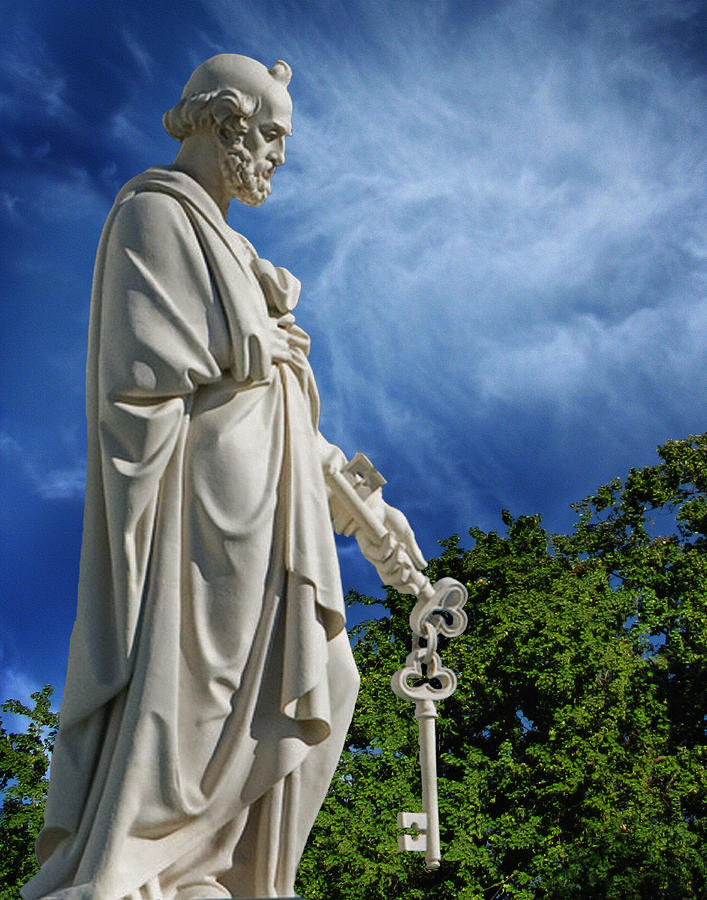
And we can’t forget the keys. Jesus said, “I will give you the keys of the kingdom of heaven, and whatever you bind on earth shall be bound in heaven, and whatever you loose on earth shall be loosed in heaven.” What does this mean? Keys equal authority—the authority to open and shut, to bind and to loose. It’s a huge thing to have keys. When I worked as a security guard in college I was entrusted with keys to everything on campus—women’s residence halls, faculty offices. I could use the college president’s private bathroom at three o’clock in the morning if the notion struck me.

But imagine having the keys of heaven. Jesus hands off those keys to Peter, and to His whole church. You don’t have to hunt for the keys to the kingdom of heaven like you do for your car keys sometimes. No, the keys of the kingdom of heaven are at work right here where Jesus Christ is confessed—right here where sins are confessed and absolved—right here where we preach Christ crucified. “The office of the keys is that special authority which Christ has given to His church on earth to forgive the sins of repentant sinners, but to withhold forgiveness from the unrepentant as long as they do not repent.” These keys are at work for you. Jesus gave them so that you might know for certain that heaven is open to you.

Jesus then warned Peter and the rest not to tell anyone that He was the Christ. But don’t worry. He’s not talking to you here. You can tell anyone and everyone that Jesus is the Christ, the Son of the living God. The disciples just had to wait until Jesus died and rose again. Then the world would have its rock solid proof—the hard evidence—that changes everything. Today it is our gift and our privilege to confess with Peter and with all the saints: Jesus is the Christ, the Son of the living God.

In the name of the Father and of the Son and of the Holy Spirit. Amen.

Monday, August 21, 2017

Man's Best Friend

In Nomine Iesu
St. Matthew 15:21-28
August 20, 2017
Proper 15A

Dear brothers and sisters in Christ Jesus~

It’s not right to take the children’s bread and throw it to the dogs. That’s one of the first and foremost rules of dog
ownership. You don’t take food from the table—pricey food, carefully prepared for human consumption—and hand it off to your little puppy. It’s not that your little puppy wouldn’t like what it is you’re eating. And it’s not that his little digestive tract might react unfavorably to your rich fare. No, the problem is that dogs fed from the table come to expect it—maybe even demand it. Sit down, say grace, pass the potatoes . . . but then prepare for the whining, the whimpering, the begging, the big sad eyes, and the little paw tapping you on the thigh. No, Jesus has definitely made the right call here. It’s not right to take the children’s bread and throw it to the dogs.

Of course, when Jesus first said this concerning canines, there wasn’t a single furry four-legged friend in sight. There was begging, and there was whining, along with big, sad eyes—but all that came not from a dog, but from a pesky Canaanite woman. She just wouldn’t take “no” for an answer. No matter what the Savior did or didn’t say, she just kept coming back like a bulldog. She latched onto the Lord like a terrier latches onto a soup bone. She pursued Jesus with a dogged faith that just wouldn’t let go no matter what. And even more amazing, she was an outsider—a gentile dog—a non-Israelite. But that’s what this text is ultimately all about: God’s grace to all people in Jesus Christ, the outsiders becoming insiders, and God’s house being a house of prayer for all nations. Oh, and there’s also a little something about man’s best friend.

Jesus was doing what a healthy percentage of our members are doing right now—He was taking time off up north. But “up north” for Jesus meant gentile country. One of the locals—a woman, no less—approached Jesus. Right away, she’s got two strikes against her: a woman didn’t approach a man in public, and a Canaanite wouldn’t dare approach a Jew—let alone a Rabbi. But this woman had good cause for her carelessness. She was desperate. Her little girl was being terrorized by a demon. And she was powerless to stop it. No one could help. For some unknown reason, this woman clearly knew and believed that Jesus was her last, best, and only hope.

What do you say? What do you pray when Jesus is your last and only hope? What words are the right words when you’re rendered helpless while demons have their way with your daughter—when life caves in, and crisis comes, and there’s not a doggone thing you can do about it? This woman found the perfect words to pray in her terrible time of trial: Lord, have mercy. Kyrie Eleison. For as long as Christians have been gathering together for worship, Christians have been praying those words—Lord, have mercy. To our ears it might not sound like much of a prayer. But those words speak volumes. Those words perfectly express our helplessness and our total dependence on the mercy of the Lord.

But as you probably noticed, even the perfect prayer is sometimes met with silence from the Savior. Jesus gave the woman no response at all—did not answer her a word. Jesus may have kept quiet but His disciples sure didn’t. Send her away, Lord. She won’t shut up. She keeps following us and begging. Get rid of her! Sound familiar? It’s the voice of exclusion—of prejudice, hatred, suspicion toward the outsider—an instinctive aversion for the unclean, the unwashed, the unsaved. It had been drilled into the disciples’ heads since they were little boys: “Don’t go near those people—those Canaanites. Don’t talk with them. Don’t eat with them. And for heaven’s sake, don’t marry them.”

Finally, Jesus says something, but not what you might expect. He reminds the woman that He was sent only to the lost sheep of Israel—reminds her that she’s not one of those sheep—that she’s just a dirty Canaanite dog. It’s not right to take the children’s bread and throw it to the dogs, He tells her. It was an insult to her ethnicity. Generally speaking, dogs in those days were not the pampered pets of today, but garbage-eating scavengers on the streets—beasts that had no business in the kitchen or at the table with the children. “Yes, Lord,” she said, “but even the dogs eat the crumbs that fall from their masters’ table.”

Wow! Beloved in the Lord, this is what faith sounds like and looks like. She refuses to be refused. She prays without ceasing. She endures the silence and sternness of the Savior. For her, crumbs from the Savior’s table are a feast for her famished soul and she won’t be denied. Oh, she may be a dirty Canaanite dog, but she clings in faith to Jesus, believing that His mercy is big enough to embrace even the likes of her. O woman, great is your faith! Be it done for you as you desire. And her daughter was healed instantly.

Boom! It’s a nice story, don’t you think? It doesn’t start out that way, but it ends in a happy place. A little girl is healed. A woman of great faith is praised. Jesus extends the mercy of God to include those who had always been excluded before. It must have left the disciples scratching their heads—wondering what on earth Jesus was up to. How can an outsider have even greater faith than insiders like them?

You and I have walked in those same sandals. We’ve done what the disciples did. We too have judged the outsider. We’ve excluded those who make us uncomfortable. We think we have a flair for figuring out who’s in good with God and who isn’t. O, we say and pray that Jesus is the Savior of the whole wide world. But we act differently. By our actions we too often say that Jesus is the Savior of the smart and salvageable—that He’s the redeemer of religious folks like us—the Shepherd of the special—the Lord of the Lutherans (make that the Lord of the conservative Lutherans!) But today Jesus shows us that He really is the Savior of the whole world—including the parts of the world and the people of the world that we aren’t particularly fond of.

We need to see just how inclusive our God really is—see Him as the one who welcomes even dirty dogs right into the kitchen for a feast from His table. Because if we can’t see that—that the grace of Jesus Christ is all-inclusive and designed for everyone—then we run the risk of taking pride in ourselves—pride in our purity, pride in our religion, our doctrine, our liturgy or whatever other credentials we think make us special and smart and (in some tiny way) deserving of God’s mercy.

But God’s mercy is the very thing that no one deserves. We’re all like that poor Canaanite woman. We don’t have single bargaining chip that we can lay on the table. We’re not purebreds. We have no pedigree. We’re all just mangy mutts—sorry scavengers who can offer God nothing greater than a simple prayer: Lord, have mercy. Kyrie Eleison. Each Sunday when we come here, the Lord’s liturgy puts us in the doghouse, as we confess, “I, a poor, miserable sinner.” The Law of God declares that we’re all dirty dogs. There are no tricks we can perform, and there are no treats we can earn with our good behavior. In fact, where the law of God is concerned, we’re not just dirty dogs, we’re dead dogs, cut off from the Master’s table.

But take heart. For with the Lord Jesus, dogs get the crumbs that fall generously from the Master’s table. And those crumbs for us turn out to be rich fare indeed: Take, eat; this is my body given for you. Drink of it all of you, this cup is the New Testament in my blood, shed for you for the forgiveness of sins. This is Jesus talking—the same Jesus who went to the dogs in His death on a hill outside Jerusalem. There on His crucifixion cross Jesus dealt with your sins and (yes) the sins of the whole wide world, once and for all. He was ostracized and crucified as an outsider; but the blood He shed that day is what makes all of us insiders—children of the heavenly Father, brothers and sisters in Christ. And three days later His resurrection brought life from the dead for all who follow Him in faith and hope.

It’s not right to take the children’s bread and throw it to the dogs. Because you know what will happen! Those dogs will keep coming back to the table—wagging their tails behind them—bellying up to the buffet—eager and excited to scarf down whatever the Master’s hands deliver in their direction. So picture yourself as one of those pooches. Place your paws on the path to the Master’s table. Come with the hope and expectation of a dog that gets fed right from the table. Whining and begging aren’t necessary. For the Lord is serving up something wonderful here at this table—the forgiveness of sins and life that lasts forever—and nothing would delight Him more than to share it with you. This is why! This is why the Son of Man . . . is man’s best friend.

In the name of the Father and of the Son and of the Holy Spirit. Amen.

Monday, August 14, 2017

Doubting Peter

In Nomine Iesu
St. Matthew 14:22-33
August 13, 2017
Proper 14A

Dear brothers and sisters in Christ Jesus~

It was one small step for man; but one giant leap for mankind. When Peter stepped out of the boat and set foot on the surface of the Sea of Galilee, he was boldly going where no man had gone before. Peter did what no mortal had done before or since. Peter walked on the water.

But that excursion on the H2O was a demonstration of foolishness, not faith. The moral of this account isn’t that we should all be bold and courageous like Peter. And I, for one, am glad. I’m glad that when it was all said and done, Jesus didn’t say, “Job well done,
Peter.” I’m glad Jesus didn’t say, “Way to show off your bold and courageous leadership skills to the other disciples—way to take the initiative and step out of your comfort zone—way to set an example of outside-the-box (boat) thinking for my other followers to emulate.” No, Jesus didn’t commend Peter. He condemned Peter: O you of little faith, why did you doubt? It’s not bold Peter. It’s not faithful Peter. It’s doubting Peter.

Jesus is the one who set into motion all the remarkable events that transpired that night on the sea. Jesus is in control of everything. Jesus had been trying to get some solitude for the entire day. He wanted time to pray—that’s all. Instead, He ended up healing hundreds and feeding a multitude of thousands. Finally, at the end of that long day, Jesus started giving orders. He “compelled” His disciples to get into the boat and head to the other side of the lake without Him. Meanwhile, Jesus dismissed the crowds and sent them all home. Finally, Jesus was able to pray alone.

Meanwhile, the disciples were out on the lake rowing their boat. But what should have been a nice sunset cruise had quickly turned into a dark night of struggle. A strong headwind suddenly picked up. White caps and choppy seas made progress nearly impossible. They were getting nowhere. The harder they dug in the oars and pulled, the more they seemed stuck in the same place. Ever feel that way about your life as a follower of Jesus? You’re trying to do the right thing—trying to lead a holy life—trying to do the very things that Jesus has compelled you to do—but the harder you try, the less progress you make.

Fatigue and exhaustion began to set in. Hands began to blister. Midnight turned into 1AM, then 2AM, then it’s three o’clock in the morning—the fourth watch of the night—when suddenly a figure—a phantom!—an apparition!—appears on the surface of the water softly illuminated by the moonlight. Now, these men were rational and sane. But under the stress of the situation, they assumed the worst.

But what they got was the best: Take heart; it is I. Stop being afraid. It was Jesus, walking on the water. But even better, it was Jesus speaking on the water—Jesus and His Word. And this should have changed everything. When you’ve got Jesus and His Word, doubt gives way to faith, and fear gives way to hope. As we heard from Romans chapter ten this morning, faith comes by hearing. And what the disciples were hearing was the voice of Jesus: “Take heart; it is I.”

Jesus said, “It is I,” but Peter said, “IF it is you, Lord, command me to come to you on the water.” Jesus speaks. And Peter doubts. Those words from Jesus should have been enough. But Jesus is patient. Jesus gives Peter one more word: Come. Even in the original Greek it’s just one word spoken into the ears of Peter: Come. But this one word is no ordinary word. It’s a Word from the Word made flesh. It is a Word from Him who laid the foundation of the earth and prescribed the limits for the sea. Faith comes by hearing. Faith came to Peter because He heard this one Word from Jesus, “Come.” And Peter proceeded to walk on the water. Witness the power of the Word!

The Word of God is powerful and faith-creating and faith-enlivening. The Word creates something out of nothing. The Word equips us to do the very things that Jesus commands. Jesus says the word, “Come” to Peter, and this doubtful disciple defies all the laws of hydrology and buoyancy and physics and actually walks on top of the water just like Jesus! And he did this not by his own will-power—not by the power of positive thinking—but in the power of a single word that had proceeded from the mouth of Jesus: Come. Faith comes by hearing, and hearing through the Word of Christ.

Beloved in the Lord, we don’t give the Word of Christ nearly enough credit. We don’t hear it for what it is. The Word of God isn’t just a historical report which we believe to be accurate. It’s not just a text to be discussed over coffee like the latest volume from the book-of-the-month club. The Word of God is faith-creating. It is sin-forgiving. It gives eternal life. If we really believed that then there would be next to nothing that would keep us from hearing that Word of God preached and proclaimed right here every Lord’s Day. There would be standing room only here today. If we really believed that about the Word then we would be reading and studying the Word every day of the week. But we close our ears and we shut our eyes. Jesus comes to us in the Word saying, “Take heart; it is I. Stop being afraid.” But we prefer the futility of our own words and thoughts. We prefer our own efforts at rowing in the dark and getting nowhere. We simply don’t believe that faith comes by hearing. Like Peter, we have our doubts.

O you of little faith. Repent, and look to the object of your faith. You don’t just have faith. Faith always has an object. You have faith in something. You trust in something. Peter didn’t walk on the water solely by the power of his faith. He walked on the water by faith in the Word of Jesus. It was that word “Come” that kept him afloat. And only when Peter allowed that word to be drowned out by the noise of the wind and the waves did he start to sink.

See what happens when you turn down the volume on God’s Word? See what happens when you let other priorities stop and silence your hearing of God’s Word? See what happens when you stake your life—not on the Word of God—but on the word of man? You sink. You sink into death itself. Faith weakens. Faith withers. Faith dies. As a pastor I see it happening all the time. And there’s nothing more tragic. Families who take the summer off from worship and the Word. Baptized Christians who just walk away from Christ and His church and His Word. And behind all the excuses and all the rationales, they are slipping away from real life—sinking into death—separated from Christ.

Keep your ears and eyes tuned into Jesus. That’s where Peter’s ears and eyes needed to be—on Jesus, not on the wind and waves. Nothing but Jesus. The same goes for you. Train your attention on the world—on the culture—look inside yourself, and doubts will take over. Fear will grow. You’ll sink like stone. That’s why we’re here every Sunday to hear the Word—to receive the Supper. If you lose this—if you walk away from this—when you tune out Jesus’ Words and starve yourself of His holy Supper—you will sink and drown. You will drown in despair, in guilt, in fear. We drown in our skepticisms, our failings and weaknesses. We drown in sin and death.

It’s worth remembering that you already died in the water once before. Like Peter, you too had your moment in the water with Jesus—when you were baptized. You didn’t walk on the water of your baptism; but you did die and rise to new life in that water. You were born again in that water. You became a child of God in that water. Your sins were forgiven in that water. In that water all the blessings and benefits of Jesus’ death and resurrection were applied to you. In that water the Lord placed His Word in your ears and into your heart. In that water Jesus said, “Come to me, and follow me.” Everything changed for you in the water of Holy Baptism.

Baptism leads us to pray with Peter, “Lord, save me.” When Peter began to be overwhelmed by the wind and waves, he started to sink. He prayed the same prayer that each of us has at our disposal: Lord, save me. It’s a prayer of faith. At that moment, Jesus was all that Peter had. And Jesus was all that Peter needed to save him. Peter’s prayer is our prayer too. Lord, save me. When we can’t tread water any longer and we’re about to go under. Because we are baptized we can pray: Lord, save me. St. Matthew tells us that “immediately” Jesus reached out His hand and took hold of Peter. In that split second Peter is sinking and praying, while Jesus is grabbing a hold and lifting Peter. Whose grip matters more at that moment? In whose grip does our salvation rest?

Beloved in the Lord, those sure, strong, nail-scarred hands are no less holding onto you. When your sin is pulling your down into the depths—when you are drowning in a sin-filled mess of your own making, there is one person who will save you. When your faith is little, Jesus will save you. You can trust Him. Don’t trust Jesus because He walked on the water. Trust Him because He walked right out of His own tomb—because He has defeated death for you. Stop doubting and believe.

This account ends with worship—with all of Jesus’ followers gathered around Him in the boat. In this hour we join them. We gather in the presence of Jesus who comes to us in His Word, and in His body and blood. As you receive this meal today hear the Savior say to you: Take heart, it is I. Stop being afraid. To this we can only confess: Truly, you are the Son of God. Lord, save me.
In the name of the Father and of the Son and of the Holy Spirit. Amen.

Monday, August 7, 2017

From Meager to Miraculous

In Nomine Iesu
St. Matthew 14:13-21
August 6, 2017
Proper 13A

Dear brothers and sisters in Christ Jesus~

Free food. Free food has a way of getting our attention. Especially if you’ve been to Miller Park this year, where a hotdog and a beer will run you about fifteen dollars, the idea of free food sounds especially appealing.

But free food is a myth. There’s no such thing as a free lunch. Someone always has to pay—somewhere, sometime, somehow—whether
it’s the father of the bride or the American tax payer. “Free food” is really a misnomer. Free food went out the door in Genesis chapter 3 and the fall into sin. Before that, food was indeed free—all the nuts and grains and fruits and veggies you could eat. But ever since then—in this fallen world we know so well—food is not free, but costly. Sweat and toil, thorns and thistles, dollars and cents—that’s what’s needed to put food on the table.

This is part of what makes the feeding of the five thousand so astonishing—free food, food in abundance, all you can eat and more—at no cost to you. But let’s take a moment to set the stage for this miracle: It was getting to be evening. Earlier in the day Jesus had been told about the execution of John the Baptizer. That solemn news had led Jesus to withdraw to the wilderness. But the crowds followed him. Five thousand men were there; but add in the women and children and you’ve got yourself a Whitefish Bay-sized crowd.

The problem was: no food. They were in the middle of nowhere, after all. The disciples were both concerned and probably tired. They proposed a sensible and logical solution to Jesus: Dismiss the crowds and send them into the nearby villages where they can buy food for themselves. The disciples knew that there was no such thing as a free lunch. Bread doesn’t just appear out of nowhere. In fact, you may recall how Jesus was tempted by Satan to turn stones into bread in the wilderness—at a time when Jesus was on a forty-day fast. But Jesus refused. That’s not the way Jesus does things.

“They need not go away,” Jesus told His disciples, “You give them something to eat.” They protested immediately that they had only five loaves of bread and two fish. Jesus must be joking. How can so little feed so many? But hear what Jesus says about that meager amount of bread and fish: He says, Bring them here to me. This is how Jesus operates. He receives our meager offering and does something miraculous with it.

This is a teaching moment, both for the disciples and for us. Jesus wants to work with what we have. Jesus wants to use us—our time, our talents, our treasure, our loaves and fish. Oh, He could have fed the crowd out of thin air. He could have raised His hands to heaven and conjured up a bounty of bread and a feast of fish—without involving the disciples and their meager, paltry provisions. Instead, Jesus received into His hands what His followers could scrounge up.

Jesus takes the five loaves and two fish. He raises His eyes to heaven from whence He came, where His Father is, and He thanks His Father for those loaves and fish. The eyes of all look to You, O Lord, and You give them their food at the proper time. You open Your hand and satisfy the desires of every living thing. Notice that even though the loaves and fish came from the disciples, Jesus thanks God, from whom all blessings flow. Then Jesus breaks the bread. He distributes the loaves and fish to the disciples, and His disciples distribute them to the people. And this distribution goes on and on and on.

Meager portions are miraculously multiplied. Jesus equipped His disciples to do the very thing that had minutes earlier seemed impossible. The disciples gave the people—all of them—something to eat—generous portions that fully satisfied every last man, woman, and child. In the hands of Jesus, what was very little—what was obviously insufficient—became more than enough. Paltry provisions became plentiful. Scarcity became abundance. The meager became miraculous. Who says there’s no such thing as a free lunch where Jesus is concerned?

Free food and drink are what the Lord seems to be talking about through the Prophet Isaiah this morning: Come, everyone who thirsts, come to the waters; and he who has no money, come, buy and eat! Come, buy wine and milk without money and without price. It sounds like the Lord announcing a really great deal for you. Free food and drink. Wine and milk without cost. Bread for nothing at all. Why, it sounds like if you play your cards right, your bread and fish will never run out, your wine and milk will overflow, not to mention your bank account and your stock portfolio. That’s where TV preachers like Joel Osteen would take a text like this—God as a vending machine dispensing favors to the favored, blessings to the blessed, prosperity to the prosperous.

But we need to hear a few more sentences from Isaiah: Listen diligently to me, and eat what is good, and delight yourselves in rich food. Incline your ear, and come to me; hear, that your soul may live. Listen diligently, incline your ear, and hear. This feast is one that you consume through your ears, not your mouth. This free feast is a feast of words—a Divine Service of Words—words received in the ears, but aimed at the heart. It’s good news of free forgiveness for all those who hunger and thirst for righteousness—all of it lovingly served up for us from the nail-scarred hands of our Savior.

By feeding the five thousand, Jesus wasn’t trying to launch a war on poverty or show us how to combat world hunger—or to reveal the hidden keys to a prosperous life of wealth and riches. But Jesus does want us to see that He comes to bring us something unimaginably wonderful. He’s bone of our bone and flesh of our flesh. And yet He comes as true God, bearing precious gifts that we neither desire nor deserve nor expect. But what is free for us was costly for Jesus. The forgiveness, life and salvation we enjoy as children of God came only at a great cost to Jesus. He laid down His life as our sacred substitute to satisfy our hunger and thirst for righteousness. Our greed, our selfishness, our lust to hoard and grab and accumulate all we can—Jesus carried these sins away on a Roman tool of torture, where He made Himself nothing and poured out His life blood for the forgiveness of your sins. Free forgiveness for us, but oh so costly to Jesus.

You can trust this Jesus. Even when you find yourself utterly alone in what seems like a desolate place—even when good news seems scarce and your own resources seem to be lacking. Jesus will provide. You can trust this Jesus when death draws near. If He could multiply morsels of bread and fish into feast for thousands, what can He do with our bodies—temples of the Holy Spirit, created by Him—and commended to Him until the day of resurrection?

You can trust this Jesus with your paltry possessions, with your measly monies, with your trivial talents. In faith we can place them joyfully into Jesus’ hands. We can trust that He will use the wealth we call our own to bless others in ways we could never do on our own. Every offering you give is kind of like those loaves and fishes placed into the hands of Jesus, where something miraculous happens. You can’t see it; you can only believe it. But unless you believe it—unless you believe that the offerings you give are given right into the Savior’s hands, you will never know what it means to be a joyful, thankful giver.

The disciples entrusted Jesus with the little bit they had—not as a scheme to enrich themselves—not as a strategy to enjoy the best life now—not even knowing what would happen next. But Jesus worked things in such a way that His followers were able to become generous givers—servants who could serve others with the abundance Jesus had placed into their hands. Jesus received their meager offering and then had them distribute to others the resulting abundance. The impossible became possible. What was out of the question one minute, was perfectly viable and doable in the next minute. That’s how it is for us—for us who have been baptized into Christ, for us who eat the bread that is His body and drink the wine that is His blood. We become His hands, His feet, His mouthpiece to a world that’s just starving for good news.

We have so much to learn and take to heart in the feeding of the five thousand. But an even greater miracle takes place here, now, for you. The feeding of the five thousand in the wilderness happened only once. But today and every Lord’s Day Jesus feeds millions, including you—serving up heaping helpings of good news from pulpit and altar. Without cost. All by His grace. Without even one of your works. Received simply by faith. Here He gives. Here you receive. Free for you. Costly for Him. And more than enough to satisfy.
In the name of the Father and of the Son and of the Holy Spirit. Amen.

Monday, July 31, 2017

A Sermon About Nothing

In Nomine Iesu
Romans 8:28-39
July 30, 2017
Proper 12A

Dear brothers and sisters in Christ Jesus~

This is a sermon about nothing. I think, if I could summarize this sermon for you in one word, that word would be “nothing.” Later on today if someone should happen to ask you, “What did the pastor preach about today?” I want you to say, “Nothing—the sermon was about nothing.” But if you are pressed and prodded to say more than that, then say, “It was a sermon about nothing . . . and it was a sermon about everything.”

Nothing and everything. There in a nutshell you have today’s epistle reading from Romans chapter 8. “Nothing” can separate us from the love of God that is in Christ Jesus our Lord. Nothing! Not tribulation, not distress, not persecution, not famine, not nakedness, not danger, not sword. Nothing. Not even death. Especially not death. Nothing can separate us from God’s love in Christ. And, attached to that “nothing” is an “everything.” Everything—all things—work together for good for God’s baptized believers. Everything: the good, the bad, the ugly. “Everything” ultimately works for good for those who love God. And “nothing” can separate us from God’s love. We’ve got everything and nothing—I think we may just have something.

Let’s start with everything. We know that for those who love God all things work together for good, for those who are called according to His purpose. Do you believe it? It’s that little word “all” that makes us skeptical. It would be a little easier to swallow if Paul had written, “We know that in most things God works for our good” or, perhaps, “We know that in a very high percentage of instances God is working for our good.” We could say “amen” to that. But it’s the word “all” that gives us pause. In a few minutes we’re going to sing the hymn, “What God Ordains Is ALWAYS Good.” Really? Always? In all things? In everything, good?

I’m sure you can think of many events in your own life which, on the surface, seem to contradict God’s claim that everything is working for your good. Consider the hapless hunter who was written up in a 1947 issue of The New Yorker magazine. It seems the guy went out and bagged himself a rabbit. But apparently the rabbit wasn’t quite dead. The rabbit managed to squirm its way out of the game bag, and somehow managed to press the trigger on the hunter’s gun, shooting the hunter in the foot. Does getting shot by a bunny fall under the “everything” of Romans 8—that in everything God is working for our good?

You probably won’t face those same circumstances anytime soon; but sooner or later a time comes in all of our lives when we’re just plain up against it—a time when, despite our best efforts and a stiff upper lip, we keep sliding deeper and deeper into doubt and despair—a time when darkness is all around us and there’s no relief in sight. Can we, then and there, confidently say that in everything we know that God is working for our good?

Believing this is much easier said than done—especially in the face of real tribulation, distress, persecution, famine, nakedness, danger, or sword. Do we actually believe that as the baptized children of God our sufferings will be vindicated—that our sufferings will be shown to have meaning—that the hardships of our lives won’t simply be erased and wiped away, but will all be eventually woven together into a tapestry of pure good? Do we actually believe that in what we suffer now, there is deep purpose, and rich meaning, and ultimately something unimaginably good? Do you believe this?

Admittedly, without Jesus, this all sounds little bit hollow. Without Jesus, we’re veering dangerously close to the kind of shallow sentiment you find on a lot of greeting cards. That’s why immediately, in the very next sentence, Paul takes us directly to Jesus, the Son of God. As soon as he tells us that God works for our good in EVERYTHING, He takes us to Jesus. He writes: For those whom [God] foreknew He also predestined to be conformed to the image of His Son. This is how it works. This is the only way it can work. The Father looks at His only-begotten Son; and He sees in His Son you and all believers. You through faith are being made and conformed and shaped into the image of Jesus. It’s the image of Jesus that you need. Because all you have by nature is the image of Adam.

Adam blew it. Adam rebelled. Adam completely lost the image of God by His rebellion and sin. Adam launched us all on a slippery downward slide that will eventually deposit us all six feet under. Adam’s sin and our sin provokes God’s wrath, and He’s plenty angry over it. Your sin deserves death and damnation, and don’t think for a minute that you can weasel out of it with your pious prayers and platitudes. No, you need Jesus. You can’t be a child of God without the Son of God. And this was God’s plan all along. The Father sent His one and only Son into our flesh. And this is the way God loves the world—the way God loves you, sinner though you are: He gives His only Son to die on the cross, so that whoever believes in Him will not perish but will have eternal life with God. And God’s great plan to save you has been in the works long before you came along. Before you had the chance to do even one good work—going back to the foundation of the world—you were predestined to take your place along with the all the other sinners who would wash their robes and make them white in the blood of the Lamb.

A verdict has been spoken over your head by the blood of the cross that took away your sin. God declares you innocent. And all you dare say in response to that verdict is “amen.” So be it. If God says it, that settles it. He who called you in the water of your baptism has now clothed you with the perfect life and death of Jesus. And that’s what it means to be justified. It means that we appear before God like Jacob appeared before his father, Isaac. Do you remember that story—how Isaac was old and blind—and how Jacob got disguised as his older brother Esau so that he could receive his brother’s blessing? We’re kind of like Jacob, for we appear before God like our older brother, Jesus—conformed to His image. We receive the blessing of Jesus as we are clothed in Jesus. Only there’s no deceit involved. Your heavenly Father is delighted to bless you, for He loves you in His Son. When God blesses you for Jesus’ sake, He knows exactly what He’s doing.

So, then, the big question: Since God has conformed you into the image of His Son—since He has predestined you and called you—since He has justified you and glorified you already in His Son—what is there on earth or in heaven that could possibly mess you up? What is there that could possibly undo all that God has done for you? NOTHING. That’s what this sermon is about. If God is for you (and He is in His Son), who can be against you? If God gave you His one and only Son, then what is there He will withhold from you? NOTHING. Since you are justified and cleansed by the holy and precious blood of Jesus, what transgression can you be charged with? NOTHING.

Who can condemn you before God? Jesus was condemned on the cross in your place. Cursed for you. Damned for you. And the same Jesus appears before the Father bearing the wounds of His sacrifice, interceding for you as your Defender and Priest. Jesus never lets the Father forget about those wounds of His through which we have life and forgiveness. And He never lets us forget those wounds either, for whenever we eat the bread that is His body and drink the cup that is His blood, we proclaim His death until He comes.

What can separate us from God’s love in Christ? NOTHING. Let the worst be unleashed against us—tribulation, distress, persecution, famine, nakedness, danger, sword (and by the way, when you hear “sword” think “execution”). Add to that your own personal hurricane of horribles: an abusive childhood, addictions, divorces, cancers, mental illness, chronic pain, you name it. Death, devils, angels, the past, the present, the future, nor anything else in all creation. In all these things we conquer. In all these things we are winning a glorious victory. In all these things we win. In literally EVERYTHING God is working for our good; so that literally NOTHING—NOTHING in all creation will be able to separate us from the love of God in Christ Jesus our Lord.

This truth—this victory—this incredible good news—is not something that we can always see and feel today. On this side of the grave, victory masquerades as defeat. The sheep who dwell under the care of the Good Shepherd often appear more like sheep being led to the slaughter—hardly a victorious image. We can’t see this victory with our eyes, and we can’t understand it perfectly with our brains. But we can trust it. We can believe it for Jesus’ sake. Christ has conquered: He died, He rose, He reigns. And in Him you conquer too. Believe that.

It’s simple, really—as simple as a sermon about nothing . . . and everything. Nothing can separate you from the love of God in Christ. And in everything, God is at work for your eternal good. In the name of the Father and of the Son and of the Holy Spirit. Amen.

Monday, July 24, 2017

Seeds & Weeds

In Nomine Iesu
St. Matt. 13:24-30, 36-43
July 23, 2017
Pentecost 7/ Proper 11A

Dear brothers and sisters in Christ Jesus~

We can send spacecraft beyond the limits of our solar system. We can tinker with and rearrange DNA. We can make powerful computers that you wear on your wrist. But we cannot eradicate weeds. And when it comes to weeds, there’s a great variety: You’ve got your classic dandelions, your Canadian Thistle, chickweed and ragweed. And then there’s clover and crab grass, and you’d better hope that
creeping Jenny and creeping Charlie don’t’ get together in your backyard. There’s lambsquarter, broad-leaved buckhorn, and there’s even a weed called the Devil’s Paintbrush. And in your garage you’ve probably got a collection of herbicides, both pre-emergent and post-emergent. And still, inevitably, eventually, undoubtedly, the weeds just keep coming.

Weeds are pernicious and insidious—a perennial problem. There are no vegetable gardens with only vegetables—no flower gardens with only flowers—no amber waves of grain with only grain. The weeds are always there too. And they’re sneaky, those weeds. If we walked over to my garden this morning, you’d find that the weeds are thriving right next to the romaine—right beside the beets. They’ve cleverly confined themselves just inside the tomato cages. There, in closest proximity to my most productive produce, are weeds. And I can’t whack those weeds without also risking damage to the precious plants next to them. And so I have learned to live with those weeds. I tolerate them so as not to damage the nearby vegetables.

In today’s Holy Gospel Jesus spins out a parable based on the perennial problem of weeds. In this parable, “all the world is God’s own field.” And in this field the Son of Man goes about sowing His good seed. But this very same field—the very same furrows—are tainted, defiled, and contaminated by a weed-sowing enemy. This enemy is the devil, and he’s bold and brazen in his ability to sow weeds in God’s good field.

The first point of the parable is this: wherever the good seed of God’s Word is preached and planted, right there the devil is lurking in the shadows, waiting to work over the very same soil with a noxious array of bad seed. Always, without fail, right alongside the Word of God something else—something undesirable—is also growing up. The seeds of sin and unbelief are being mixed and mingled and planted right alongside the good, faith-producing seed of God’s Word.

Do you realize what this means? It means that even right here and right now—among those who offer here their worship and praise—the devil is also hard at work. You are delusional if you think the demonic enemies of God only scatter their seeds in bars and brothels and adult bookstores. Oh, no. They would much rather sow their sinful mayhem in the fertile soil between pulpit and pew, nave and narthex, balcony and baptismal font, in stately seminaries and in synodical conventions. Whenever and wherever the good seed of God’s Word is being sown, there you can be sure the enemy is sowing his seed too.

This is why the Scriptures teach us that while the church is made up of all those who believe in Jesus Christ, yet on this side of heaven, there are always hypocrites and evil persons sprinkled in among the saints (AC VIII). Martin Luther saw this sad truth at work throughout the whole history of the church. Wherever the pure gospel was preached and sown, there the devil raised up wicked men to oppose it. Luther laid out his evidence for this in a sermon based on this very parable. He said, “Angels become devils. One of the apostles betrayed Christ. Christians become heretics. Out of the OT people of God came the wicked men who nailed Christ to the cross. So it happens still [today]” (Day by Day, p.83). What happens? Weeds happen. Wherever God’s garden grows, the devil is also cultivating a crop of corruption.

Now, so far in this parable, there aren’t many surprises. Our own experience bears out the truth that there’s always an orchestrated opposition to God’s good work in this world. But the surprise of this parable—the thing that shocks the gardener in me—is that God tolerates the weeds—for now. When the indignant servants in the parable ask permission to pull up the weeds, the Master says, “No—No, lest in gathering the weeds you root up the wheat along with them. Let both grow together until the harvest.”

The weeds in God’s field will not be pulled. No herbicides will be applied. The weeds are tolerated for now. They are allowed to grow until the harvest. What kind of gardener—what kind of farmer—could ever have such a high degree of weed tolerance? Why does God permit the ungodly and the wicked to grow and thrive right next to and among the righteous? Why is the Garden of our God NOT neatly manicured, but littered and blighted with weeds?

Beloved in the Lord, this is how God’s garden grows: It grows with the devil’s weeds and the Savior’s fruitful vines intermingled and tangled up. And sometimes, you can’t tell what’s what or who’s who. If nothing else, this shows our God’s incredible patience for sinners—that He wants all to be saved and come to the knowledge of the truth. Unlike some other religions of the world which have no toleration—which teach and preach hatred and death to the infidels—your God is patient, not wanting anyone to perish—but for all to come to repentance and faith.

Jesus Christ Himself is the reason for God’s weed-friendly ways. For in Jesus alone there is power to transform the world of weeds into the most fruitful branches of the living vine. In Jesus, what is the vilest weed today could be the saintliest child of God tomorrow. Because Jesus Christ has died for all—no exceptions. In Him, God was reconciling the whole world of weeds to Himself, not counting our sins against us. Instead, the Savior bore those sins in His body on the cross. Jesus, the sinless Son of God, became like a giant weed Himself, carrying the sins of the entire weed-infested world. And God the Father cut down that sin-bearing weed. He was put to death for our trespasses and was raised again for our justification. He was put to death and raised again so that sinners and unbelievers and the worst of all weeds might have the opportunity for repentance and faith—the opportunity one day to shine like the sun in the Father’s glorious kingdom.

This just leaves one question: What should we do with the weeds for now? What should we do about the people who by all appearances have separated themselves from Jesus and His church—or are actively working against Jesus and His church? It’s clear that God tolerates them. It’s clear that it’s not our job to consign some to hell and others to heaven. God and His angels will handle that at the end of the age. Nor is it right for us to condone their sin in any way. For now, God simply calls us to throw the doors of the church wide open, to give all men and women the chance to hear the Word of the Gospel and take it to heart—to speak the truth in love. Because in hearing that Word is the power to transform the worst of weeds into living branches of the true vine, Jesus Christ.

Before you leave here today, I want you to think of the weeds in your life—the people you know who for all intents and purposes are not growing in the grace of Jesus Christ—people who manifest a spirit that is not the Holy Spirit. There are certainly weeds among your co-workers, among your friends, among your family. The message of the Scriptures concerning these souls is not just a message of toleration, but of love. God calls us not just to live with the weeds—not only to tolerate them—but also to love them. The great writer Dostoevsky said this about love: “to love a person means to see him as God intended him to be.” Don’t see the weeds for what they are today; see them as what God intends them to be—see them for what they can be in Christ. In the garden of our God, there is not one living soul for whom we cannot hope and pray. There is not one soul in whom the grace of our Lord Jesus Christ cannot do miraculous, life-changing things. We ourselves can testify to that.

Today you and I—we’re growing in the garden of our gracious God. The seed of His Word has taken root in you. You’ve been watered in the gentle splash of Holy Baptism. There are weeds all around. But the day will come when there will be a separation—when those who reject God’s free grace in Jesus Christ will be cast into eternal fire, and when those covered in the righteousness of Christ will shine like the sun in the Father’s eternal kingdom. Regarding that final separation, the German theologian Helmut Thielicke wrote this: “The last judgment is full of surprises. The separation of the sheep and the goats, of wheat and weeds will be made in a way completely different from that which we permit ourselves to imagine. For God is more merciful than we are, [God is] more strict than we are, and [God is] more knowing than we are. And, in every case, God is greater than our hearts” (p.82). He who has ears, let him hear.
In the name of the Father and of the Son and of the Holy Spirit. Amen.

Monday, June 26, 2017

Shout It From the Rooftops!

In Nomine Iesu
St. Matthew 10:21-33
June 25, 2017
Pentecost 3/Proper 7A

Dear brothers and sisters in Christ Jesus~

When was the last time you were up on your rooftop? Hanging out on the roof isn’t something that most of us do very often—if we can help it. In fact, if you are on your rooftop, it usually means that something bad has happened: the roof is leaking, shingles have blown away, the chimney is collapsing, or the birds have come home to roost above your resting place. As for me, I’ve never once been on the
parsonage roof. And that’s a streak I intend to keep alive.

So it sounds a little strange to our ears when we hear Jesus telling His disciples to proclaim things from the housetops. We automatically assume that Jesus is just giving us another of His famous figures of speech—perhaps dabbling happily in a little hyperbole—exaggerating to make a point. Jesus doesn’t literally want us climbing our ladders and shouting things from our rooftops, does He? Well, don’t write off those rooftops too quickly!

Back in the day when and where Jesus first spoke these words, He was being more literal than you might imagine. Back then people proclaimed things from the rooftops all the time—every day. How so? Well, first of all, most rooftops in Israel and in other arid places are flat—and therefore not nearly so dangerous to navigate. What’s more, at a time before there was air conditioning, the rooftop was a great place to hang out to catch a cool evening breeze when the house itself was uncomfortably warm. In this way, rooftops became a place of socialization, where neighbors would converse and kibitz and pass along the latest scuttlebutt. Rooftops in Jesus’ day served a purpose much like the front porches of small town America back in the last century.

In Matthew chapter 10 it’s the Twelve apostles that Jesus has directed up to the rooftops. He was sending out the Twelve on their first missionary journey. They were being sent only to the lost sheep of Israel—only to fellow Jews. (Gentiles would be targeted later.) Jesus was sending them up to the rooftops so as to give maximum publicity to His teachings. What Jesus had been teaching them in private, was now to be proclaimed and preached in public. The Twelve were now to seek out those rooftops and other venues which would afford the maximum exposure. That makes perfect sense, right? It’s like something from a marketing strategies textbook.

But here’s my question: What about when the message we’re given to shout and share from the rooftops is unpopular? What about when the message we shout and share will be mocked by most people? What about when the messengers are setting themselves up for rejection, or persecution, or worse? What about when the God-given message we share seems to drive away more people than it attracts?

These questions aren’t hypothetical. In fact, Jesus told the Twelve that they would be “hated by all” for His name’s sake. This was also the situation faced by the prophet Jeremiah in today’s Old Testament reading. Jeremiah was called by God to proclaim from the rooftops an unpopular message of death and destruction—of doom and gloom—of wrath and judgment—for God’s people. Meanwhile, there was a multitude of false prophets who were busy shouting peace and prosperity from the rooftops—that God would never allow His chosen people to be chewed up and spit out by the Babylonians. It comes as no surprise to learn that the pews in Jeremiah’s church were collecting a lot of dust.

What do you do? What do you do when God gives you an unpopular message to shout from the rooftops? What do you say when God’s gift of marriage—when natural marriage—is rejected in favor of a cleverly legalized arrangement called “gay marriage?” What do you say when God’s gift of identity—when God’s bodily gift of maleness and femaleness—is rejected in favor of a self-chosen gender identity? Or what about the heterosexual couple you know that’s living together—but doing so without the blessing of marriage? Or what about when God’s gift of life in the womb is being massacred daily by abortionists right in our own backyards?

It’s easy to say and do nothing. It’s easy just to keep your head down. It’s easy just to go with the flow. It’s far more difficult to proclaim that the wages of sin is death—that those who choose to reject God and His Word will one day face eternal punishment (if they do not repent). And no matter how lovingly and how patiently you choose to speak the truth in these matters, you will never earn a round of applause or a standing ovation.

What do you do personally when God gives you a hard message to speak—when as part of your vocation as a parent, a friend, a family member—you are called to confront sin—to call someone to correction—to lead them to repentance—to say the unpopular thing? By nature, we have no desire to say such things, let alone proclaim them from the rooftops or anywhere else, for that matter. Rather than heading upstairs for the rooftop, we by nature make a beeline for the basement—deep down to where it’s easy to stay silent, to be safe, to keep comfortable, to make no waves, to do what’s convenient and easy. And even if you do decide to head up to the “rooftop,” Jesus doesn’t promise that it will be easy. Nor does He promise that the words you speak in love will always achieve their intended purpose.

But for every disciple who dares to dash up to the rooftop—to faithfully bear witness to the teachings of Jesus—Jesus does say this: Do not be afraid. In fact, in today’s Gospel reading He says it three times: Have no fear of them. . . . Do not fear those who kill the body but cannot kill the soul. . . . Fear not for you are of more value than a multitude of sparrows and even the hairs of your head are numbered. The fear that controls us and keeps us quiet and muzzled most of the time—Jesus wants us to leave that fear behind. Trust Him. Follow Him in faith. What you hear whispered from the pages of your Bible, proclaim from the housetops. Because—come hell or high water—your body and soul are in His holy care. The God who knows when a single sparrow falls to the ground—the One who knows the number of hairs on your head—He knows just the help you need.

The wages of sin is death. It’s true. But the free gift of God is eternal life in Christ Jesus our Lord. He was killed on Good Friday—nailed to a cross. But by that death your sin was done away with. By that death He destroyed death and opened the kingdom of heaven to all believers. And that free gift of salvation is offered to all people—to every son and daughter of Adam. No one is excluded. The forgiveness of sins and the resurrection of the body and the life everlasting—that’s God’s free gift for you and for all who believe.

But some people—perhaps someone in your life—may only come to know and receive that gift because you cared enough to leave the basement behind and head up to the rooftop to speak the truth in love. Christ Jesus died to save sinners, of whom we are the worst. We are not perfect, but we are forgiven in Jesus, and that makes all the difference. That’s the good news that we are privileged to proclaim from the rooftops—to neighbors, family, co-workers, and friends. God has reconciled the world to Himself in Jesus.

That’s what we call the gospel. God Himself has proclaimed it from the top of Mount Calvary. God Himself has proclaimed it from the empty tomb of the resurrected Jesus. God still proclaims it today from this pulpit, from that font, and from this altar. His loving care for you reaches into eternity. That’s what He Himself is proclaiming today—loud and clear—for all to hear.
In the name of the Father and of the Son and of the Holy Spirit. Amen.