Monday, July 5, 2021

Hidden Strength

Jesu Juva

2 Corinthians 12:1-10                                                              

July 4, 2021

Proper 9B                                  

 Dear saints of our Savior~

          If you read the bulletin carefully every Sunday (as I’m sure you all do), then you are no doubt familiar with the phrase “for blessings received.”  As in, “The chancel flowers are given to the glory of God by so-and-so with thanksgiving for blessings received.  It is good, right, and salutary that we should, indeed, give thanks to God for blessings received. 

          But I’m still waiting for someone to give flowers to the glory of God with thanksgiving for blessings NOT received—for prayers denied—for requests not granted—for hopes and dreams unfulfilled.  In fact, when was the last time you heard a Christian boasting about how God denied his prayer for relief?  For it’s one thing to accept that God sometimes says “no;” but it’s something quite different to boast about that “no.”

          This is why today’s epistle from 2 Corinthians 12 is so precious and valuable.  For it teaches us about the hidden strength available to every Christian—hidden strength for those times when we are at our absolute weakest—for all those times when God says “no,” or “not now,” or “wait.” 

To teach this important lesson Saint Paul drew from his own personal experience.  “A thorn was given me in the flesh,” he wrote, “a messenger of Satan to harass me.”  He’s speaking metaphorically, of course.  There was something or someone who punctured Paul’s life with pain.  Gallons of ink have been spilled by theologians speculating as to the exact affliction which Paul might have had in mind:  Migraines and malaria, epilepsy and a speech impediment are just a few of the educated guesses that scholars have made over the years. 


The Greek word Paul chose for “thorn” can also be translated as a “sharpened stake” or a “spike.”  From this we can sadly assume that this thorn was no minor abrasion.  Paul needed much more than a band-aid to bring healing and relief.  Paul’s thorn was painful.  More importantly, it hindered the crucial, critical work Paul had been given to do—or so it seemed.

          Now, you would figure that if Paul—a chosen apostle of the Lord Jesus—a man planting new congregations all over Asia and Europe—if he was suffering with an affliction that hindered his ability to function, then a simple prayer should have taken care of the problem.  If the prayers of a righteous man availeth much, then the prayers of Paul should have availed all the more.  Paul was extending the church of Jesus Christ into uncharted territory, boldly taking the gospel where no man had taken it before.  He was the tip of the gospel spear.  Surely, the Lord would be at His most responsive when someone like Paul came before the throne of grace asking for relief.

          Three times Paul the Apostle—the man who was called by the glorified Christ on the road to Damascus—three times he got down on his knees and prayed for relief.  And three times the Lord did not do as Paul requested.  The Lord did not remove the thorn in Paul’s flesh.  Instead, the Lord gave Paul the strength to bear it—hidden strength—grace to carry on despite the thorn in his flesh.  For even as the Lord Jesus denied Paul’s prayer, He gave him a wonderful promise.  It’s a promise from which Christians down through the centuries have drawn this hidden strength for themselves.  Jesus said, “My grace is sufficient for you, for my power is made perfect in weakness.”

          Jesus said “no.”  But this is no ordinary “no.”  This “no” is full of meaning.  This “no” is full of hidden strength for Paul—and for you.  This is the hidden strength of Jesus.  The grace that flows from His cross to you is sufficient.  The grace that flows from His resurrection to you is sufficient.  What Jesus Christ does for you—what Jesus Christ gives to you by His grace—is more than enough to sustain and support you when your life is punctured by pain and loss.  “Therefore,” Paul writes, “I will boast all the more gladly of my weaknesses, so that the power of Christ may rest upon me.  For the sake of Christ, then, I am content with weaknesses, insults, hardships, persecutions, and calamities.  For when I am weak, then I am strong.” 

          This isn’t the kind of Christianity you hear about from the TV preachers.  Nor is this the kind of Christianity you’re accustomed to hearing about from church bureaucrats with their programs and their slick Powerpoint presentations designed to ensure success and growth and profit.  Real Christianity is about loss—about being a loser—about being weak.  For, as Paul expressed it, “When I am weak, then I am strong,” strong with the hidden strength of Jesus.

          What about you?  What about your life?  What are the thorns in your flesh?  What is it that causes you such pain that it threatens to prevent you from carrying out your callings and vocations in this life?  What is it that brings you to your knees in prayer time and time again because God isn’t giving you the relief you long for?  As I survey even our little congregation this morning I know there are big thorns that need removing:  the thorn of unemployment, the thorn of cancer, the thorn of addiction, the thorn of chronic pain—things that seem to suck all the joy and hope out of life—burdens for which there appears to be no silver lining—obstacles that seem to hinder even your faith in Jesus at times.  Why can’t the Lord Jesus see how much better things would be if only those thorns were miraculously removed?

          You must not forget that the Lord is at work in you for eternity—not just for the next few months or years.  He is at work in your life for all eternity.  And today He makes it absolutely clear that He does some of His very best work in your weakness—when you are flat on your back, with tears in your eyes, all alone, with no choice except to “be still and know that He is God.”  Do you have thorns?  Do you feel weak?  Are you praying for blessings but not receiving them?  Then give thanks to the God whose grace alone is sufficient—the God whose power is made perfect in weakness.  In unemployment, in cancer, in addiction, in depression and every other affliction, the power of God is made perfect. When through fiery trials your pathway will lie, [His] grace, all-sufficient, will be your supply.

          Jesus says, “My power is made perfect in weakness.”  And coming from Jesus, those words aren’t just a lecture on suffering.  Those words point us to His cross.  For in Jesus’ bloody death, God’s power was made perfect.  Jesus’ crucifixion for the sin of the world was God’s most powerful act—by which He forgives your sins and swallows up your death.  When Paul wrote about the thorn in his flesh, he was using a metaphor.  He didn’t literally have a thorn sticking in his flesh.  But Jesus?  He did!  For Jesus thorns are no metaphor.  The thorns in His head and the sharpened spikes in His flesh were the very real payment for your very real sins.  His love for you knows no limits.

          When we are at our weakest, the Savior’s hidden strength takes over.  And allow me to let you in on a little secret:  the Savior’s hidden strength is given away for free, right here in the divine service week after week.  As you confess your sins and receive the absolution, the hidden strength of Jesus is given to you.  As you faithfully eat and drink the bread that is His body and the wine that is His blood, the hidden strength of Jesus flows into your weak and weary body.  As the promises of Jesus are proclaimed from this pulpit, God’s power is perfected in your life.  That power allows you to be content in any and all circumstances, to believe with all your heart that God’s grace in Jesus truly is sufficient for you, that even at your weakest, you are “more than conquerors through Him who loves you.”

          This is the Christian life.  You don’t have to be strong . . . because Jesus is your strength.  Our prayers don’t always get answered in the way we desire.  Not every blessing is a blessing received.  It’s not that we don’t have troubles.  It’s not that we don’t fail.  It’s not that we don’t suffer and die.  We do.  But through it all we have the hidden strength that Jesus gives—strength that will ultimately be expressed in the resurrection of the body and the life everlasting. For blessings received—and for blessings not yet received—thanks be to God. 

          In the name of the Father and of the Son and of the Holy Spirit.  Amen.


Monday, June 28, 2021

Why Trouble the Teacher?

Jesu Juva

St. Mark 5:21-43                                                                    

June 27, 2021

Proper 8B                  

 Dear saints of our Savior~

          Interruptions are a part of life.  Most of us begin each day with some kind of a plan—a to-do list, a schedule of appointments, a carefully crafted calendar.  But we all know what happens with our best-laid plans.  Interruptions are inevitable:  A child gets sick.  An appliance stops working.  The phone rings.  Some unexpected emergency forces us to abandon our schedule and start improvising.

          Because Jesus fully shared in our humanity—because He had to be like us in every way—His daily schedule was also subject to interruption.  I suppose that according to His divine foreknowledge He knew exactly what each day would bring.  But to hear Saint Mark tell of the events in today’s Holy Gospel, it certainly seems like even the Savior’s schedule was also subject to change.

          St. Mark introduces us to two minor characters in today’s reading:  Jairus, a synagogue official, and a woman who had suffered with a discharge of blood for twelve years.  I call them “minor” characters because Mark mentions them only briefly.  But in Mark’s gospel these minor characters have a major role in showing us what faith looks like.  These “bit players” are actually the true disciples in whom faith trumps fear—who are saved by faith.

          You can be sure that Jairus had tried everything to save his dying daughter.  The synagogue prayer chain was no doubt praying for the sick child.  The best medical help had been consulted.  By the time Jairus falls at the feet of Jesus, he’s a father filled with fear.  When you’re a dad, and your little girl is dying, the helplessness is unbearable.  My little daughter is at the point of death.  Come and lay your hands on her, so that she may be made well and live.  That was an interruption Jesus could not refuse.  Without hesitation Jesus goes with Jairus.

          But along the way there’s a traffic delay.  Crowds press in on Jesus.  He can barely navigate the narrow city streets.  The woman with the discharge of blood sneaks up behind him.  She’s suffered for twelve long years, as long as Jairus’ daughter had been alive.  Physicians had done nothing except empty her bank account.  Her uncleanness had left her isolated and alone, cut off from the synagogue’s sacred space.  She was hoping for a drive-by miracle:  If I touch even his garments, I will be made well.  And, with one touch, she felt healing come into her body.  Jesus, too, felt that power had gone out from Him.  But Jesus doesn’t do anonymous, drive-by healings.  He stops to connect with the woman—to see her, look her in the eye, and to hear her confession of faith.

          Lots of people had probably touched the robe of Jesus—jostled Jesus, or bumped into Him.  Personal space was at a premium for a celebrity like the Savior.  The disciples were incredulous when Jesus stopped to find out who had touched Him in that sea of humanity. Everyone is touching you!  But not everyone had faith.  This woman did.  She believed that simply touching His garment would bring healing.  She had faith.  That’s what made her different.  That’s why power went out from Jesus.  Faith receives what Jesus has to give.  She knew she was considered unclean.  No one would ever want to touch her.  But she trusted that if she could only touch Jesus it would all be better.  Jesus says as much:  Your faith has made you well.  By faith she received the healing power of Jesus.  A happy ending.

          But that happy moment was interrupted by devastating news from Jairus’ house:  Your daughter is dead.  Why trouble the teacher any further?  Those words must have pierced the soul of Jairus.  They had been so close, but now it was too late.  Why trouble the teacher?  After all, dead is dead.  No one can change that.  Why trouble the teacher?  Because Jesus Christ came to be troubled with this very thing.  Because Jesus came to be bothered by our death.  Jesus came to do something about it.

          This entire account pivots on what Jesus says next.  He looks at the devastated father and says, “Do not fear, only believe.”  You trusted me with her illness, when she was sick.  Now trust me with her death.  Do not fear, only believe.

          Jesus says that for your benefit too.  To you, here and now, this morning Jesus breathes faith into your troubled heart.  Do not fear, only believe.  Your prayers may seem unanswered.  Like Jairus, you might feel that you’ve been put “on hold” while the Lord deals with problems more pressing than yours.  Do not fear, only believe.  You may be in despair, trapped by your own besetting sins or harmed by the sins of others.  You may have lost all faith in institutions, in your fellow man, in your government.  You may be grieving the death of a child.  Don’t be afraid, only believe.

          Jesus came to save all—the woman with the discharge of blood, Jairus and his little girl.  He came for them and for you too.  He came to bring healing from the sickness of sin, to bring order to your disordered life, to make you clean, to give you light in your darkness.  For the joy of your salvation, He endured the cross and scorned its shame. 

          In Holy Baptism He reached out to touch you just as He did with the two dear “daughters” of today’s text.  No, you didn’t touch His garment.  No, He didn’t take you by the hand.  For you He did much more.  He baptized you.  He gives you His body and blood to eat and drink.  Jesus doesn’t get any closer or more personal than that.  The hem of His robe is nothing compared with His life-giving, sin-forgiving body and blood.  This is the body and blood that went to death for you—that was raised to life again—that conquered death and the grave—that is glorified at the right hand of the Father—now given and shed for you.  Take and eat.  Drink of it all of you.  Do not fear, only believe.

          Loud lamentation and weeping were already underway by the time Jesus and Jairus got to the house.  Still today in the Middle East there’s no quiet, stoic sobbing, but only loud weeping and wailing.  It was a swelling chorus of despair.  Jesus surveyed the scene and asked, “Why all the weeping?  The child is not dead but sleeping.”  And they laughed at Him—not the laughter of joy, but the sneering, scoffing of unbelief.  Still today the world laughs at the notion that Jesus can do anything about death.

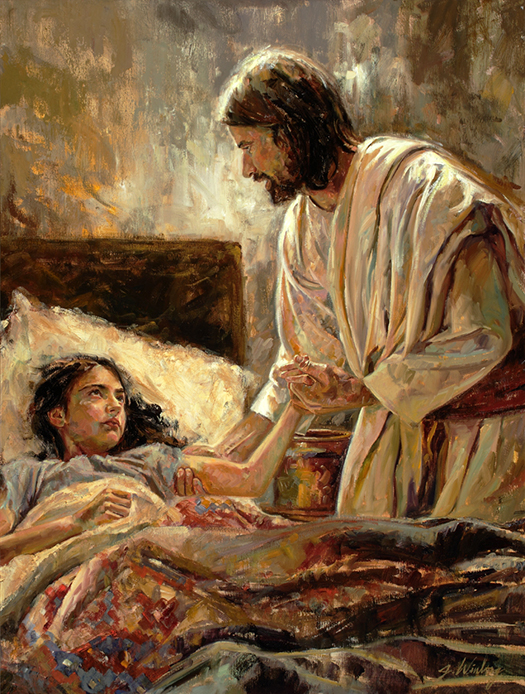
          Jesus said the girl was sleeping—not because she wasn’t dead, but because waking her from death was, for Jesus, no more difficult than waking her up from a nap.  Why trouble the teacher?  Here’s why:  Jesus went to the bedside and took


her cold little hand into His.  He gently says to her, “Talitha, cumi.”  Little girl, arise.  (Just like a dad waking up his daughter for school.)  With those words from Jesus, life and breath and beauty returned to that precious child.  Her ashen face became pink and rosy.  Sullen, staring eyes once again sparkled with life and light.  Lifeless lips smiled.  This is exactly why Jairus dared to bother Jesus—why you should dare to bother Jesus—to trouble the teacher with death.

          You too can trust this Jesus.  You too can bother Jesus, and pour out your petitions like Jairus did.  You can trouble the Savior when you’re troubled by death.  Jesus knows all about it.  He’s tasted death for you.  Jesus came to be bothered by your sin and death.  That sin He came to absolve.  That death He came to destroy.  Christ is risen, and in Him you too will rise.

          When it was all said and done, Jesus strangely told everyone to keep quiet about it—that no one should know what He had done for the daughter of Jairus.  Why?  Because this is not how Jesus is going to deal with sickness and death—not just one at a time—not just a widow’s son here, a synagogue ruler’s daughter there, an old friend named Lazarus.  Jesus didn’t come to save only a few, but the world.  He came to die and rise for the sin of the whole world—to invite the whole world to believe in Him.  That’s the Jesus we look to in faith—the one hanging from the cross whose wounds bring us healing, whose death is our life, whose shame is our glory, whose weakness is our strength.  On the cross, power went out from Him.  On the cross, life and forgiveness went out from Him.  Strength and healing went out from Him.  And today, by faith, all that went out from Jesus on the cross—these all come into you—rich blessings received by faith.

          When you are desperate.  When death draws near.  When you feel most helpless.  Trouble the Teacher.  Bother the Savior.  Lay it on the line before the Lord of Life.  Do not fear, only believe.

          In the name of the Father and of the Son and of the Holy Spirit.  Amen.
 

Monday, June 21, 2021

Jesus, Savior, Pilot Me

 Jesu Juva

St. Mark 4:35-41                                                                   

June 20, 2021

Proper 7B                                       

 Dear saints of our Savior~

          Today’s topic is a wet and wild miracle from Mark chapter four:  Jesus calms the storm.  Miracles in Mark are always concise, always rich with meaning, always filled with possibilities for proclamation.  You may think you know this story.  You may think you’ve heard it all before.  But set aside what you think you know; and listen again to how Jesus stilled a storm on the Sea of Galilee with just two little words.

          It had been a long day of teaching on the seashore for Jesus.  In fact, the crowds were so large that Jesus had to do His teaching from a boat so that He could be seen and heard by all.  But when evening came, Jesus gave the order:  Let us go across to the other side.  Note well that Jesus gave the order to set sail.  Jesus set in motion a chain of events that would soon cause the twelve disciples to fear for their very lives.  Jesus, who is the chief meteorologist of the world’s weather, gave the order for a handful of boats to set sail into the growing darkness and into a gathering storm.

          Because Jesus is God in the flesh, we have to assume He could forecast the weather with perfect accuracy.  In fact, I think that would have been one of the main drawing cards for being a disciple of Jesus—instant, accurate weather forecasts.  Jesus, what’s the high temperature going to be, and what time is the rain moving in?  The Sea of Galilee was notoriously known as a place where the weather could get wild in a hurry—where severe storms could develop without warning.  So just be aware that if Jesus is charting your course, you shouldn’t expect any quick and easy detours around dangerous situations.  Don’t follow Jesus expecting only sunny, blue skies for every leg of your life’s journey.

          The fact is Jesus led His most faithful followers into a situation that was ripe for tragedy.  Of course, to say that Jesus “led” them isn’t perfectly accurate either.  Jesus wasn’t exactly leaning out over the bow like Leonardo DiCaprio on the


Titanic—not even like George Washington crossing the Delaware.  No, Jesus wasn’t acting very god-like at all.  In fact, He was engaged in that most human of activities.  He was sleeping!  As the weather started getting rough—as the boat began to fill with water, losing buoyancy and sinking down deeper and deeper—Jesus was snoozing on a pillow in the back of the boat.  Just when they needed Jesus most, He was unresponsive and snoring in the stern. 

          As always, Saint Mark is only concerned with giving us the facts—no matter how awkward they may be.  He’s not writing fiction; He is truth-telling.  And the truth is that when the weather started getting rough, Jesus wasn’t barking out orders from the bridge.  And the disciples weren’t calmly trusting Jesus as King of kings and Lord of Lords.  No, the Savior of the world was snoozing; and His hand-picked, elite apostles were panicking like faithless cowards.

          The Holy Spirit inspired St. Mark to record all of these unflattering details for your sake—so that you might have hope—so that you might be encouraged, even when you are feeling faithless and fearful.  I think I can detect a bit of faithlessness in the question the disciples used to wake Jesus up and prod Him to take action:  Teacher, don’t you care?  They didn’t say Deliver us from evil, or even Thy will be done.  They say:  Teacher, don’t you care?

          Perhaps that question—or one like it—has passed through your prayers a time or two.  It’s easy to trust Jesus when your life is smooth sailing, when your health is good, and the wind is at your back.  But it’s not so easy to trust Him when the weather starts getting rough and your tiny ship is tossed.  Jesus, don’t you care?  When you’re up to your neck in stress and conflict and worry—when it seems like your life is out of control, and hope is all gone—even the faithful sometimes ask:  Jesus, don’t you care?  Do you trust this Jesus who sleeps through the storm—this Jesus who seems just a little too comfortable with chaos?

          But it’s precisely in the chaos that Jesus teaches us who’s in control.  It’s precisely when Jesus seems most distant that we discover Him to be right by our side—a very present help in trouble.  While we crave quick fixes and spectacular special effects, Jesus simply speaks:  Peace!  Be still!  It’s only two words in the Greek.  It was nothing more than what you or I might yell at a barking dog in the middle of the night.  Be still.  But as soon as those words left His lips, the wind ceased and there was a great calm.  Within seconds, roaring, foamy waters became as smooth as glass.

          In this miracle the power of God is bound up tightly with the Word of God.  Everything hinges on the words that Jesus speaks.  His Words get results.  His Words accomplish what He desires.  And those powerful words of His are preserved right on the very pages of your Bible.  Those words of His are preached and proclaimed by pastors right from this very pulpit.  When you feel like you are sinking in a sea of chaos, listen to Jesus.  Trust what He says.  Don’t despise preaching and His Word.  Don’t ignore it—but hold it sacred and gladly hear and learn it.

          What are you so afraid of?  Don’t you trust me?  That’s what Jesus asked the Twelve as they marveled at how the Sea of Galilee had become the sea of tranquility.  Those are good questions for us too:  Why are you so afraid?  Why do you live each day in fear and anxiety?  Why do act like your Savior is sleeping and distant?    Why do you live as if a Jesus you can’t see is a Jesus who can’t help you?  If Jesus single-handedly conquered sin and death and Satan by dying on the cross and rising again—if Jesus chose the whip and the thorns and the nails for you—if He was willing to suffer as your substitute under God’s wrath against sin—don’t you think that He also has a plan and a purpose for your life—that He will supply the help you need? 

          It takes faith to believe that.  And that’s why we’re here this morning—to hear the Words and eat the meal designed to strengthen our faith and to forgive our faithlessness.  The same powerful Word that stills the storm is also the Word that forgives all your sins and declares you to be justified before God.  In that Word is your safety—in life and in death—when storms are raging, and when all is calm.

          As that great calm settled over the waters, the disciples were no longer asking, “Teacher, don’t you care?”  That question had now been replaced by a different question:  Who is this guy?  Who is this that even the wind and the sea obey Him?  You know the answer.  He is Jesus the Christ, true God begotten of the Father from eternity, and true man, born of the Virgin Mary—your Lord, our Savior.  No one else can still the storm.  No one else can order around the wind and the sea and have them obey.  Jesus is one of a kind.  Salvation is found in no one else.

          This miracle, like all miracles, is the exception rather than the rule.  There are plenty of ships that go down in the storm—some of them not too far east of here.  Airplanes crash, even with plenty of Christians on board.  Tornados and hurricanes typically don’t skip over churches as they do their destructive work.  So where is Jesus when all this happens?  Is He asleep at the wheel?  Does He care?

          Beloved in the Lord, today’s miracle teaches that Jesus is right here in the middle of it all.  He is God; and we are not.  But He is not just God; He is God-with- Us—Emmanuel.  God-with-us in the preaching and proclamation of His promises.  God-with-us in the wet, watery waves of Holy Baptism.  God-with-us in the bread that is His body and the wine that is His blood.  Jesus is an ever-present help in times of trouble. 

          The Sea of Galilee was a perilous and unpredictable place.  But as the disciples set sail into those evening waters, they were not alone.  Jesus was with them, in the boat with them.  And right here, in this sacred space, is where Jesus joins you on your earthly journey.  The fact that you’re sitting in the “nave” this morning is no accident.  By design most churches have a “nave.”  And “nave,” well, it’s just the Latin word for “boat.”  Beloved in the Lord, you are in the boat with Jesus.  Jesus is in the boat with you. And there’s just no better place to be.  Bon Voyage!

          In the name of the Father and of the Son and of the Holy Spirit.  Amen.