Monday, November 9, 2020

Here Comes the Bridegroom


Jesu Juva

Matthew 25:1-13                                                           

 November 8, 2020

Proper 27A             

 Dear saints of our Savior,

          The parable of the Ten Virgins is filled with interesting details.  You’ve got drowsy virgins, lamps and oil, and a wedding which is way behind schedule.  But let’s begin with what this parable makes perfectly clear.  Let’s start today with what is obvious—with what is so apparent that you just might miss it:  The Bridegroom is coming!

          The Lord Jesus Christ will come with glory to judge both the living and the dead.  The Bridegroom—our Bridegroom—will one day come again.  Our wise and faithful waiting is not in vain.  All that we hope for and long for will be


realized.  Resurrection, realized.  Heavenly reunion, realized.  Every promise of God, fulfilled.  As today’s epistle expressed it:  The Lord himself will descend from heaven with a cry of command, with the voice of an archangel, and with the sound of the trumpet of God.  And you will be there.  Your heart will experience unimaginable joy in the presence of Jesus as all His holy ones are led into the marriage feast of the Lamb in His kingdom which has no end.  Let there be no doubt:  The Bridegroom is coming; and for that coming we wait more than watchmen wait for the morning.

          But not everyone is waiting; and not everyone will be ushered in to the marriage feast.  There are some who will be shut out—some to whom the Lord will say, “I do not know you.”  So that you might never hear those horrifying words, Jesus tells us this magnificent parable.

          The ten virgins are virgins; but we might do well to think of them as bridesmaids.  It was the job of these bridesmaids to accompany the Groom on His joyful procession into the wedding hall.  But apparently, weddings in the First Century didn’t start promptly at four o’clock in the afternoon.  Instead, the festivities would start whenever the groom decided to show up.  He could be early; or he could be late.  The virgins simply had to be ready and waiting.

          Now, ever so important to this parable is the fact that five virgins were wise and five were foolish.  And the wisdom of the wise has nothing to do with IQ or SAT scores.  In the Scriptures, to be “wise” ultimately means to have faith—to believe—to trust in the promises of God.  And to be “foolish” means to be unbelieving, to have no faith.

          Now, if you were looking at those ten virgins from a distance, you really wouldn’t notice too much of a difference between them.  Whether they all wore matching dresses or had matching flowers or matching manicured fingernails—we just don’t know.  But all ten took their little lamps along to wait for the Bridegroom.  Only the wise, however, brought along extra flasks of oil.  The foolish virgins brought no oil.

          This detail about the oil is damning.  Would you set out for a camping trip in the woods without packing food and a tent?  Would you set out on a drive to Door County with your car’s fuel gauge on empty?  Would you set off on vacation with your cell phone, but intentionally leave your charging cord at home?  Of course not.  Then why did the five foolish virgins go out to meet the Bridegroom with no oil for their lamps?  They didn’t forget.  It wasn’t an oversight.  Could it be that they simply stopped waiting, stopped hoping, stopped believing and trusting that the Bridegroom would come?

          Back in seminary, I had an Old Testament professor who would randomly pick a student at the beginning of every class to provide an in-depth translation for a passage from the Hebrew OT.  Every student knew what Hebrew passage had been assigned; but none of us knew which one of us would be called on.  Every student had to be ready, with nouns and verbs declined and diagrammed—case, gender, number, tense, voice.  You had to know what every dot was doing in that text—and Hebrew has lots of dots.  And “Woe!” to that student who was unready and unprepared to give the translation.  Some tried to fake it.  Others pleaded for mercy right away.  Others claimed a sudden onset of influenza and fled to the nurse’s office.  But for those exposed as unprepared, it never ended well.

          Now, I can only speak for myself, but on those days when some of us were not prepared, it wasn’t that we were shirking the work intentionally.  “Life” just got in the way.  Maybe there were big tests or big papers due in other classes that day.  Many students had wives and children that needed tending.  Most students had jobs.  There were simply other priorities that kept us from being always ready and always prepared to give a level 3 Hebrew translation.

          I suspect that’s maybe how it was for the five foolish virgins.  “Life” just got in the way of their being prepared.  For them, this wedding was just one more thing on their to-do list.  They had other priorities.  Other things needed tending.  Go to the mall.  Pick up the dress.  Get your hair done.  Try on the shoes.  Who’s got time to worry about an extra flask of oil?  Who knows when—or even if—the Bridegroom is ever going to show up?  For those foolish five, the Bridegroom and the marriage feast just faded into the future—just simply stopped being the main thing.  (And for that there would be hell to pay.)

          But for the five wise virgins?  They were ready!  They were prepared at all times.  They had their extra oil.  They could even go to sleep full of faith and joyful expectation.  Why?  Because they knew and believed that the Bridegroom was coming.  For the wise ones, the Bridegroom and the marriage feast are what they lived for.  They believed beyond all doubt that the Bridegroom was coming.  And for them, that faith—that belief—was everything.

          The Bridegroom is coming.  That is sure and certain.  But just as sure and certain is that Satan seeks every opportunity to interrupt your faithful watching and waiting.  He uses the most innocuous events of life to rob you of your wisdom and strip you of your faith:  Every item on your to-do list becomes increasingly important and radically relevant to your well-being.  Meanwhile your oil supply dwindles.  The things that fuel your faith and make you wise unto salvation dwindle to dangerous new lows:  repentance, confession, prayer, and worship all falter.  You hear the Word, but don’t take it to heart, because you’ve got other things to worry about.  And so that heart becomes cold and unresponsive.  Sin becomes so ordinary, so commonplace.  Anger and rage are your closest companions.  And in our busyness we foolishly forget:  The Bridegroom is coming.  The procession will begin.  The party will start.  The door will be shut.  And those who have become foolishly unprepared will grieve to hear the Bridegroom say, “I do not know you.”

          In the end, when the Bridegroom comes on the last day, when the Lord Himself comes down from heaven—when that happens those who looked like fools in this world will turn out to be wise, while those who appeared to be so wise in this world will turn out to be damned fools.  This is why Jesus says, at the end of the parable, “Keep watch.”  Jesus wants you, His church, to be expectant and watchful, repentant and ready, listening for the trumpet call of God with a rich supply of the fuel of faith.

          Why watch for Jesus?  Why fix your heart and mind on the day of His return?  Because He’s the one who has taken all your sin upon Himself.  He’s the one who suffered and died on a Roman tool of torture as your sacred substitute.  He’s the One who crowns you with His righteousness and His holiness and His wisdom.  He’s the One who rose from the dead to give you resurrection life.  He’s the One who honors you and treasures you, who will never leave you nor forsake you, who loves you more than a groom loves his bride.

          Our Lord who will come on the Last Day—He also comes today, supplying you with all the fuel your faith will ever need.  All the forgiveness, life and salvation that Jesus hung on the cross to win for the world—He gives it all away here and now in His holy absolution, in holy baptism, in His holy Word as it’s preached and proclaimed, and in His holy supper.  In these precious means is more than enough “Jesus” to keep our little gospel lights burning and shining brightly until the Last Day.  Only a fool would say, “No thanks.  Too busy.  I can do without that.”

          The wise bridesmaids knew the One in whom they hoped and the One for whom they waited.  They lived and slept in the confidence of their Bridegroom’s coming.  That’s your confidence, too.  Your Jesus is coming.  He is your hope and expectation.  You can live and work and sleep and die in the glad confidence that your Bridegroom is coming.

          In the name of the Father and of the Son and of the Holy Spirit.  Amen.

Monday, October 26, 2020

Reformation Day Every Day

Jesu Juva

St. John 8:31-36                                                            

 October 25, 2020

Reformation Sunday                                   

 Dear saints of our Savior~

          Back when I was a seminary student in St. Louis, I spent one summer working for the grounds crew.  If you’ve been there, you know that the seminary property is filled with beautifully maintained trees, shrubs and flower beds.  One day the supervisor sent a few of us out with chainsaws.  Our orders were to cut down some overgrown juniper bushes and trim off a few low-hanging tree branches.  One of my fellow students got a little carried away.  Apparently, the power of the chain saw went to his head because, by the time the lunch hour rolled around, this guy had practically deforested the entire campus.  Everywhere he looked, he saw something that needed cutting.  He just couldn’t stop.  To this day, the old timers still refer to it as “The Seminary Chain Saw Massacre.”

          I have no proof, but I suspect that the big statue of Martin Luther on the seminary campus just might have shed a few tears that day.  For the Reformation that Luther began 503 years ago this week was always intended to be limited, focused, and conservative—a reformation, not a revolution.  Luther wanted to conserve what was good in the church and to fix what was bad.  Luther was


working with a scalpel, not a chainsaw.  He didn’t want to slash and burn, but only to prune and trim away those teachings that were impure and un-Biblical.  He didn’t want to split the church or even start a “new” church.  He merely wanted to start a debate about reform.  So he printed up 95 theses, posted them on the doors of the castle church in Wittenberg, and so began what we now call “the Reformation.”

          And in many ways the Reformation continues to this day.  The church of Jesus Christ is always in need of reform.  In the church it’s never a “once and done” deal where we can finally sit back on our laurels and say, “All done.  Now we can just coast along until Judgment Day.”  Unfortunately, not so.  In the church there is always error, always drift, always a little undercurrent or wind that blows the church slightly off course.  Though with a scornful wonder The world sees her oppressed, By schisms rent asunder, By heresies distressed.

          And what’s true for the church is also true for each of the church’s members—for you and me.  Every baptized child of God is always in need of reformation.  Not a one of us can just coast our way into heaven.  You can’t put your faith life on automatic pilot.  There’s no “once saved always saved.”  There’s no “once confirmed always a Lutheran.”  Your baptism is not a magical ticket to heaven which allows you to live life by your own rules.  Your baptism is power—power for daily living in Christ and daily dying to sin and error.  Your baptism means that reformation day for you is every day.  Every day is a day of repentance.  Every day is a day of battle against the world, the devil, and your own sinful flesh.  For the Christian, every day is Reformation Day.

          In today’s Holy Gospel, many of the Jews had begun to believe in Jesus; but many of those who had believed were just as quickly turning away from Jesus.  They used to believe in Jesus; but not anymore.  God’s gift of faith in Christ can be lost.  Those who once confessed “Jesus is Lord,” can also turn their backs on Jesus and reject the gift of faith.  It wasn’t that God failed them.  It wasn’t that the preaching of Jesus lost its power and luster.  Instead, Jesus’ listeners stopped listening.  They refused.  They turned from the Word.  And without the Word of God, faith dies.

          There’s a warning here for us, to be sure.  Separate yourself from the preaching and proclamation of God’s Word, and you’ll starve yourself right out of the faith.  Let the dust start to collect on your Bible, and then watch your faith weaken, wither, and die.  The Word of God is what fuels the fire of faith.  Turn from the Word—stop listening to the Word—refuse to let the Word have its way with you—and the flame of faith burns out faster than that tiny, little candle inside your jack-o-lantern. 

          Of course, no child of God wakes up one morning and simply decides to disconnect from the Word.  It happens gradually, slowly, imperceptibly.  It may start with a Sunday morning sporting event.  It may start because of a conflict with another church member.  It may start with a move away from home to college.  It may start because of a pandemic.  People begin to wander away from God’s Word in these ways all the time; and with each step away from the Word, faith is further weakened and the distance from the Savior grows.

          Lest there be any doubt about this, Jesus makes this connection crystal clear:  If you abide in my Word,” He says, “you are truly my disciples.  Being a disciple of Jesus isn’t like being a member of a club or a union or a political party.  We can name and claim for ourselves nearly any affiliation we want.  We can call ourselves Christians or even Lutherans.  But to be a disciple—to be a disciple of Jesus is to abide in the Word of Jesus—that is, to be connected to Jesus by holding His Word sacred and gladly hearing and learning it, and allowing those words to have their way with you.  Faith that’s cut off from the Word is like a severed vine.  It will produce no fruit, and will eventually wither and die.

          But for those disciples who abide in the Word of Jesus, there is a wonderful promise:  You will know the truth, and the truth will set you free.  Contrary to what you hear these days, there is such a thing as truth—absolute truth that holds true and applies to all people.  There is truth and there is error.  There is right and there is wrong.  There is good and there is evil.  And it is God who determines which is which. 

          The truth is a good thing, but sometimes painful.  The truth that Jesus preached is that we are all sinners.  And by “sinners” Jesus didn’t mean that we occasionally do bad things or say bad words.  It goes much deeper.  Jesus declared that we are all slaves to sin.  The good things that we want to do we cannot do.  And the bad things we hope to avoid doing—well, those are the very things we end up doing.  We are born into this world as slaves—captive to sin and death.  Worst of all, we can’t change that.  We’re stuck.  And sadly, we need a lot more than just a little reforming.  Some nipping and tucking and pruning and trimming and sculpting isn’t enough to free us from our slavery to sin.

          But Jesus says, If the Son sets you free, you will be free indeed.  Only the Son can free slaves like us.  And so God sent His Son, Jesus, into this world full of slaves.  The Son stood shoulder-to-shoulder with slaves like us.  The Son of God paid the price to make you free—not with gold or silver, but with His holy, precious blood and His innocent suffering and death.  On Good Friday, the Son of God became the slave of all.  He did this so that slaves like us might become sons—sons and daughters of God.  And if the Son of God sets you free, then you are free indeed—forgiven indeed.

          That freedom is what Martin Luther discovered when He looked at the cross of Jesus and, for the first time in his life, saw mercy and love and undeserved kindness.  Luther re-discovered the blessed exchange—the sweet swap—which is the beating heart of the faith we confess.  Jesus takes our sin and, in exchange, gives us His righteousness as a free gift through faith in Him.  He who knew no sin became sin for us, so that in Him we might become the righteousness of God.

          You need to remember this on those days when you feel like a slave to sin.  That’s no longer who you are!  You need to remember this when you’ve lived more like the devil’s child than like a child of God.  That’s not who you are!  When you are weak, His grace is strong.  When you are tempted, He will provide a way out.  When your sin and guilt threaten to crush you, He can carry it all away in the cleansing words of absolution. 

          Abide in the Word, and you have life and forgiveness.  Abide in the Word, and you are a disciple of Jesus.  Abide in the Word, and you are free indeed.  This is the honest-to-God truth.  The death and resurrection of Jesus means that you are free—free from the condemnation of your sin, free from the pain of the past, and free from worry about tomorrow.  In Jesus, every day is a new day of reformation—a day to begin anew in the love and life of our Savior. 

          In the name of the Father and of the Son and of the Holy Spirit.  Amen.
 

Monday, October 19, 2020

Seeking Saving, Sending


Jesu Juva

St. Luke 10:1-9                                                                 

October 18, 2020

St. Luke, Evangelist                

 Dear saints of our Savior~

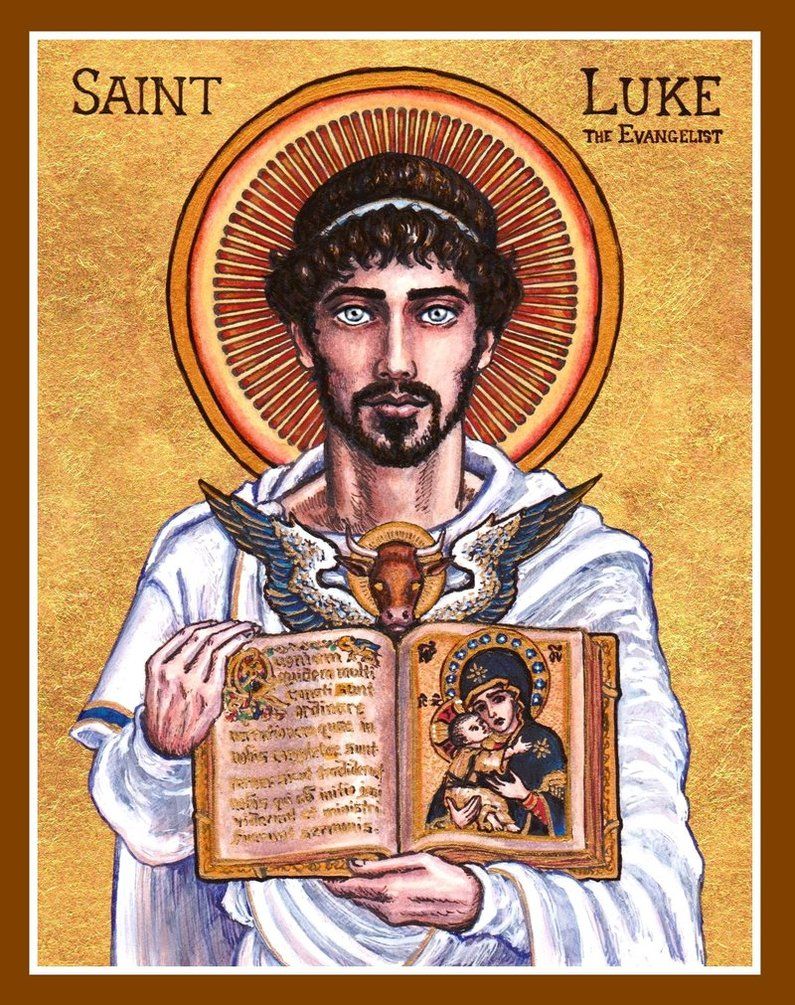
          A quick check of the calendar reveals that Christmas is only about two months away.  If you’re one of those people who just can’t wait to unpack your Nativity scene with the holy family, the shepherds, the stable, and the angel—or if you find it heartwarming to hear a group of little children singing, “Away in a manger,”—or if you yourself become a vocal virtuoso while singing Gloria in Excelsis Deo or Hark! The herald angels sing—then let’s join the holy Church throughout the world today in giving thanks to God for the man who made all that possible: Saint Luke, the Evangelist.

          The Holy Spirit inspired Saint Luke to write one third of the entire New Testament, including his detailed account of the Nativity of our Lord.  It is


exclusively in the Gospel according to St. Luke that we hear angels singing, “Glory to God in the highest and peace on earth good will to men.”  It’s only from Luke’s pen that we know about the shepherds, the manger, the inn, and that Quirinius was governor of Syria when Jesus was born.  Luke alone gives us Mary’s Magnificat and Simeon’s Song about departing in peace.  Christmas would be quite different—in fact, the entire Christian faith would be poor and impoverished—without the “good news” written down by the historian—the physician—the disciple—the author—the Evangelist named Luke.

          If you study up on Luke’s gospel, you’ll discover a consensus concerning the gospel’s main theme.  That theme was spoken by Jesus at the home of Zacchaeus the tax collector:  The Son of Man came to seek and to save what was lost” (Luke 19:10).  Seeking and saving the lost—that’s the beating heart of the good news according to St. Luke.  Luke makes clear that’s why Jesus was born in Bethlehem—that’s why angels sang at His birth.  That’s why Jesus was crucified, died and was buried—why He rose again on the third day—why He ascended to the Father’s right hand.  Jesus came to seek and to save sinners.

          That seeking and saving continue today.  You and I are proof of it.  For wherever there are sinners—wherever there are sheep without a shepherd—wherever there are prodigal sons and daughters—there you can be sure that Jesus is seeking, Jesus is saving.

          But today’s Holy Gospel reminds us that, before there can be a seeking and saving, there has got to be a sending.  Sinners aren’t able to stumble and grope their way to God by their own reason or strength.  Someone has to be sent to them.  There must be a sending of men to preach and proclaim the good news about Jesus.  All Scripture is breathed-out by God and is useful.  But all Scripture must also be preached and applied to the hearts of men and women everywhere.  This is why the Savior who seeks and saves the lost is also in the sending business—sending pastors and preachers to proclaim:  The kingdom of God has come near to you.

          About this time every year I remember how the Lord sent me—how He sent me to you, here at Our Savior.  For it was right around Columbus Day that I accepted the call and came here to visit with my family for the first time.  Fall colors were blazing.  Leaves were falling like big, colorful snowflakes as we walked down the block to Richards school to get our kindergartener and our 1st grader enrolled.  It was exciting and scary and overwhelming.  But in, with, and under all that, the Lord Jesus was sending—sending me to you, so that His work of seeking and saving the lost might continue in this place.

          When Jesus sent out the seventy-two, He told them, “I am sending you out as lambs in the midst of wolves.  You have to wonder what the seventy-two thought when they heard that.  Note the danger.  For we all know what can happen to lambs among wolves.  And Jesus sends them out practically empty-handed—no moneybag, no knapsack, no sandals, no wolf repellent, nothing.  Like lambs among wolves—like kibble for carnivores.

          But because the wolves will be watching those sent by the Lord, He sends them out two by two.  There’s some safety and security in numbers.  That’s why you shouldn’t be a solitary Christian.  Never separate yourself from the Communion of saints.  Believers who think they can get by on their own—privately, apart from the church—are like a lone lamb.  That’s what the wolves look for.  You don’t have to watch too many nature shows to know what the outcome will be for the defenseless, solitary, little lamb.  That’s why in His sending of the seventy-two, Jesus sends them in a fellowship, a team, a communion with one another.  That’s why He’s called you into this congregation.

          St. Luke tells us that when Jesus was born, the angels sang about peace—peace on earth, good will to men.  That’s also the message Jesus gave to the seventy-two to proclaim:  Whatever house you enter, first say, “Peace be to this house.”  These sent-ones are ambassadors of the Prince of Peace.  This is so much more than just a fond wish or a sappy Hallmark greeting.  This peace comes from the cross of the Crucified One, a peace the world cannot give—resurrection peace—a peace that surpasses our understanding. 

          You yourself have received that peace.  You are receiving that peace today as the one God has sent to serve you places God’s Word in your ears and places the body and blood of God’s Son on your lips, saying:  The peace of the Lord be with you always.  The peace you receive here is the peace of sin forgiven and heaven opened.  With the peace of Christ reigning in your heart, you (like Paul) can fight the good fight.  You can finish the race.  You can keep the faith and claim the crown that awaits all who trust in God’s beloved Son.

          Jesus told the seventy-two He sent to say these nine words:  The Kingdom of God has come near to you.  That sentence probably summarizes every sermon I and my fellow “sent ones” have ever preached.  The kingdom of God has come near to you in God’s Son, Jesus Christ—in the words of His promises, in the splash of His baptism, in His holy absolution, and in His precious body and blood.  That’s how God’s kingdom comes to you.

          And take note of this too:  God’s kingdom comes.  We don’t build the kingdom of God.  We don’t make it succeed or fail.  We proclaim it.  We preach the kingdom and God Himself gets the results.  We proclaim, but God builds.  The kingdom of God is not built on our efforts but on God’s efforts, not on our works, but on Christ’s works, not with our blood, sweat, and tears, but with Jesus’ blood, sweat, and tears.  He does the work.  Those He sends announce, “It is finished.” And you—you simply believe it.  The Lord Jesus has sought you and saved you.  And He has sent me to tell you that good news.

          The Lord Jesus has not specifically called and sent you to preach the gospel.  But He has called and sent you to do other important work.  You have your own callings, your own vocations as parent or grandparent, son or daughter, citizen, neighbor, worker, or friend.  These callings also require risk and sacrifice.  You may sometimes feel like a lamb among wolves.  And sometimes we’d rather not do what God has sent us to do.  But know this:  Wherever Jesus sends you, there He will bless you.

          That’s how it was for Saint Luke.  Luke wasn’t a preacher like Paul.  He was a historian and a physician.  As Paul’s execution drew near, Luke was there, attending him.  Luke was by his side as a physician of body and soul.  The Lord used Luke in mighty ways that have enriched our lives and strengthened our faith.  Because of Luke, you know for sure:  The kingdom of God has come near to you.


          In the name of the Father and of the Son and of the Holy Spirit.  Amen.