Monday, February 27, 2017

Something More Sure

In Nomine Iesu
2 Peter 1:16-21
February 26, 2017
Transfiguration-A

Dear brothers and sisters in Christ Jesus~

Do you have witnesses? Did anybody else see what you saw? Is there someone who can corroborate the details of what transpired? Can they provide an accurate description? If you’ve ever witnessed something extraordinary—something paranormal or supernatural or otherwise inexplicable—it really helps to have someone standing right next to you, seeing what you see and hearing what you hear, ready to verify and testify and corroborate every last detail.

So it was that when Jesus ascended to the top of a very high mountain, He didn’t go alone. Nor did He only bring along one
disciple. But He took with Him Peter and James and John. And that trio of disciples beheld with their own eyes and ears something paranormal, supernatural, and inexplicable. They saw Jesus in all His dazzling glory—or, at least as much glory as they could handle. They saw the Savior shining like the sun—God of God, light of light, very God of very God—Godhead, humanity, union supernal—shining brighter than all the angels in the sky. And not only that: They saw Moses and Elijah, key Old Testament figures who had been dead for centuries, but who are apparently alive and well in the presence of Jesus. And they heard the Father’s voice thundering from the cloud of glory: This is my beloved Son, with whom I am well pleased; listen to him.

There on the mountain Peter, James and John came to know that there’s much more to Jesus than meets the eye. They saw it. They heard it. And they wrote about it. John wrote about it in the prologue to the Gospel that bears his name: “We have seen His glory, glory as of the only Son from the Father, full of grace and truth” (1:14). Peter also wrote about it in today’s epistle from 2nd Peter: “We were eyewitnesses of His majesty. For when He received honor and glory from God the Father, and the voice was borne to Him by the Majestic Glory, ‘This is my beloved Son, with whom I am well pleased,’ we ourselves heard this very voice from heaven, for we were with Him on the holy mountain.” John wrote about it. Peter wrote about it. We don’t hear from James, but only because he didn’t live long enough to write much, thanks to the sword of Herod.

What Peter, James and John saw on the mountain was unlike anything else, before or after. It was nothing at all like the so-called visions of Jesus or of the Virgin Mary people sometimes see in the clouds or in water stains on the wall. The jury is permanently “out” on that kind of thing. But to have three otherwise sane, sensible, rational men see exactly the same vision—to have two of the three write about it years later—it tells you that they actually saw what they claimed to have seen: Jesus’ face shining like the sun, His clothes shining with dazzling light, and special guest appearances by Moses and Elijah.

What happened that day on the mountain was literally the high point of Jesus earthly ministry. Jesus was preparing the disciples for the road ahead. For the next mountain would be Calvary, and it would be anything but glorious. Instead of light, there would be darkness. Instead of life, there would be death. Instead of glory, there would be defeat. Instead of a voice from heaven, there would be stone-cold silence. Immediately after the Transfiguration, after descending from the holy mountain, Jesus began to teach that He must suffer, die, and rise again. The glory of the Transfiguration pointed ahead to the hidden glory of the cross—where Jesus would defeat sin by becoming sin, where He would conquer death by dying.

Wouldn’t it be grand if we could have been there to see Jesus shining? Don’t you kind of wish you could have been standing shoulder-to-shoulder with Peter, James and John so that you yourself could see the glory of God in the face of Jesus? Don’t you think that if you could hear and see what happened on the mountain that day that your faith would be strengthened? Wouldn’t it give you hope and encouragement when doubt threatens to derail you, and when life threatens to overwhelm you? Peter seemed to think so. Peter wanted to linger as long as possible: Lord, it’s good to be here. I can make three tents if you’d like, one for you, one for Moses and one for Elijah. But to this God the Father essentially said, “Be quite and listen—listen to my Son.”

Yes, there’s no doubt—it would have been nice to be there on the mount of Transfiguration; but it’s better to be here. Good to be there; better to be here. This is your “mountain.” This is the holy place where Jesus reveals Himself to you—where your faith is strengthened, where your sins are forgiven, where you receive hope and encouragement. This is where Jesus changes your heart. It’s good to be here—here in the Divine Service—here where heaven and earth intersect. Here the very Son of God draws near to you personally in the water of your baptism, in the bread that is His body and the wine that is His blood, in the absolution that follows your confession—where two or three are gathered in His name and around His Word.

So, which would you choose? Being here this morning, or seeing Jesus’ glory on the mountain with Peter, James, and John? Honestly, if given the option, I think these pews would be empty. Why? Because we view what goes on here as purely predictable, as monotonously mundane, as utterly ordinary, unworthy of our absolute attention. We despise preaching and God’s Word as surely as we fail to hold it sacred and gladly hear and learn it. Here the glory is hidden—hidden like it was on Good Friday—hidden, but nonetheless certain and sure—in fact, MORE certain and MORE SURE than Jesus shining on the mountain. And if you won’t take my word for it, then listen to Peter.

Decades after Peter saw the Transfiguration, he wrote the words of today’s epistle. And hidden away in that paragraph is a remarkable phrase that makes it clear that you have something better—something even MORE SURE than a front row seat for the Transfiguration: We were eyewitnesses of His majesty, Peter writes, We ourselves heard the voice from heaven, for we were with Him on the holy mountain. AND we have something more sure, the prophetic word, to which you will do well to pay attention as to a lamp shining in a dark place. Peter points us to the Word. He tells us that the “prophetic word” is “something more sure” than what he saw on the mountain with James and John.

Now, a lot of Bible translators and theologians struggle with what Peter wrote. He wrote that the “prophetic word” is “something (even) more sure” than the Transfiguration! He’s telling us that what scribes have scribbled on scrolls—including the dry dusty words of our Bibles—these printed pages are something more sure—more beneficial—more powerful—than what transpired at the Transfiguration. Bible scholars admit that’s what Peter wrote, but add that he couldn’t possible mean that. Let’s assume that Peter and the Holy Spirit mean what they say . . . and say what they mean.

Beloved in the Lord, you—YOU—have something more sure than what Peter saw on the mountain of transfiguration. It may have been “good” for Peter to be there; but it is “better” by far to be here, where the Word of God is preached and proclaimed. “This” is even “more sure” than “that.” It is “more sure” to hear the word of forgiveness proclaimed by your pastor than to see Jesus shining on a mountaintop. It is “more sure” to remember your baptism into Christ than to see Moses and Elijah conversing with Jesus. It is “more sure” to eat and drink His body and blood in His Holy Supper than to see His face shining like the sun—more sure to seek Christ in the Scriptures than to fly to Israel and stand on the exact mountain where the Transfiguration took place.

You have something more sure—something better. You have the power and presence of Jesus the Christ here and now to bring you life that lasts forever. It’s good to be here! And, part of what we do here is listen, as we are invited to do by the Father: This is my beloved Son, with whom I am well pleased; listen to Him. Listen to Him when life overwhelms you. Listen to Him when sin has you entangled. Listen to Him when your hope is almost gone. Listen to Him. He has the words of eternal life. Only Jesus can save you. Only Jesus bears your sin, your death, the punishment you deserve. Only Jesus can mediate between God and man . . . because He is BOTH God and man.

That’s what the transfiguration tells us: Jesus is both Son of God and son of man. But His crucifixion and resurrection tell us more. Jesus’ dying and rising tell us who Jesus is for you—your Lord, your Redeemer, your Savior, God’s sacrificial Lamb who dies for the sin of the world. You will see it all for yourself one day. You will see Jesus shining soon enough. For He has promised to appear again in glory and to raise you from the dead. You will see Moses and Elijah and all the saints of God.

This week the mountain of transfiguration gives way to Mount Calvary. Alleluias will give way to ashes. But year in and year out, through every month and every season of life, it’s good to be here. For here we have the Word. And something more sure you will not find anywhere else. Amen.

Monday, February 13, 2017

Leveled by the Law

In Nomine Iesu

St. Matthew 5:21-37
February 12, 2017
Epiphany 6A

Dear brothers and sisters in Christ Jesus~

Today we are three Sundays into the Sermon on the Mount. And what started off with blessing and benediction has taken a turn into troubling territory. The Sermon on the Mount began with such good news for sinners: Blessed are the poor in spirit. But today we learn just how “poor” we are. Today Jesus unleashes the Law of God in its full fury; and no one is left standing.

The Law of God can make for interesting discussion. To talk about the Law isn’t so bad. We like to engage in all
kinds of discussion and debate about what’s right and what’s wrong—about how the fine print might apply in various circumstances and situations. A Bible study on the Ten Commandments is usually much more titillating than a study on Baptism. Why? Because the Commandments highlight who’s naughty and who’s nice (and all the different ways to be naughty and nice). And besides that, studying the Law of God at arm’s length is safe. It’s like encountering a labradoodle on a leash—yeah, sure, she’s got teeth and claws, but she’s not dangerous and she certainly won’t bite you (especially if you’re willing to give her some belly scratches).

This morning Jesus unleashes not a doodle, but a Doberman—a fearsome, fanged beast who just might chew off your right hand or pluck out your right eye, or whatever body parts might be causing you to sin. The Law of God that Jesus lets loose this morning pursues you relentlessly. It always accuses you. It always amplifies and magnifies your sin. It always shatters your excuses and exposes your evil. It uncovers your corruption. It trumpets your transgressions. It never quits picking away at your iniquity. Jesus unleashes the Law this morning in order to drive you to despair of your own goodness and righteousness. And, ultimately, He unleashes His law because He loves you.

“You have heard that it was said.” That’s how Jesus introduces each new topic in this section of His sermon. “You have heard that it was said to those of old, but I say to you.” Here Jesus interprets and proclaims the Law on the basis of His own authority. He doesn’t need footnotes with sources cited. He doesn’t need to list His references. It’s His law and this is how He applies it. He amplifies the Law—turns the volume way up. He takes the focus off of actions and, instead, puts our inner attitudes under the microscope. He gives us the true intention of the Law which, in most cases, was quite different from what the Scribes and Pharisees of Jesus’ day had been teaching.

Take the fifth commandment, for example: You shall not murder. Do you think you’ve kept this commandment because you haven’t plunged a knife into someone, or sent a bullet sailing in someone’s direction, or laced someone’s supper with poison? Think again. You can murder someone in your heart and with your words. Unchecked anger and indulging in bitter insults can just as easily lead you down the road to eternal damnation as can strangling someone with your own bare hands. And it’s an especially serious matter when a disciple of Jesus treats a fellow disciple (a “brother”) in these murderous ways. Repent!

To pretend that you can be in a good relationship with God while, at the same time, refusing to be reconciled with a brother or sister in Christ, is just that—pretending. You cannot love God AND hate your brother. You can’t engage in anger or hatred against someone and think it’s no big deal. And by the way, these rules against hate and insults also do apply to the comments you leave and post on all forms of social media. If anger is your idol—if hatred has hemmed you in—then repent of your idolatry and, yes, your murder. Jesus says, first drop everything, leave your gift in front of the altar, go and be reconciled to your brother; then come and offer your gift to the Lord.

Jesus knows all about the hurt and harm that gets exchanged between brothers. For Jesus came to be your brother. Even as He preached so eloquently against hatred and bitter insults, so did He Himself endure hatred and hear bitter insults hurled at Him. He heard the angry shouts of those who called for His crucifixion. He willingly submitted to the hurt and harm that pierced and lacerated His flesh on Good Friday. Such violence was the payment for your sin. It was the cost that had to be paid to reconcile you with the Father. He did it so that sinners like us could be received and welcomed into the family of God, where all are brothers and sisters—forgiven and forgiving.

Jesus quickly moves on to the sixth commandment: You shall not commit adultery. At first blush that doesn’t sound too difficult. I love my spouse. I haven’t been unfaithful. And then comes Jesus’ “but I say to you.” “Everyone who looks at a woman with lustful intent has already committed adultery with her in his heart.” One stray look will nail you—whether you’re online, or on the beach with bikinis as far as the eye can see. Do you think you’ve kept God’s law because you haven’t taken into your arms someone other than your spouse? Think again. You can commit adultery with your eyes, your brain, your heart. Lust and fantasizing—imagining and envisioning and considering and desiring directed at anyone other than your God-given marriage partner—these all can lead down the road to eternal damnation.

Lust is not identical to the physical act of adultery, in every respect. True enough. But lustful leering at someone other than a spouse always dishonors marriage—always dishonors your spouse—always dishonors God’s gifts of marriage and sex. Divorce, too, always dishonors marriage. Divorce always separates what God has joined together. Even when one spouse has been unfaithful—even when divorce is “allowed” and “permitted”—even then divorce is not God’s desire or God’s intention.

Sins against the sixth commandment have much to do with our bodies—with our eyes, our brains, our hands, our hearts. The dangers of these bodily sins are so great that Jesus uses hyperbole to suggest that a better option might be to cut off our hands or gouge out our eyes. But such an extreme approach forgets something very important: your body is not your own. Your body is a temple of the Holy Spirit—paid for and redeemed with the blood of Jesus, claimed and inhabited by the Holy Spirit in the splash of Holy Baptism, destined for resurrection. As one who follows Jesus in faith, your body is designed to glorify God—to lead a sexually pure and decent life in what you say and do. Living by that Spirit, you can confess your sixth-commandment sins and receive full forgiveness. Jesus bore our every sin in His body, when He suffered on the cross. He refused to divorce His bride, the church, despite our unfaithfulness. He died to rescue us from all the ways we have taken His gift of marriage and used it for our own selfish purposes.

The final topic Jesus takes up today involves swearing and oath-taking. In Jesus’ day the Jews had constructed an elaborate system for taking oaths and making promises. We don’t do so much oath-taking nowadays; but we’re still very good at evading the truth and shading the truth and spinning the truth to our advantage. We’re very good at casting ourselves as the heroes of our narratives. We’re not afraid to re-write and edit the historical record to vindicate ourselves. We’re much more likely to tell half the truth, than to tell the whole truth and nothing but the truth. But Jesus cuts through our hazy cloud of half-truths. He says, “let your ‘yes’ be ‘yes,’ and let your ‘no’ be ‘no.’” Say what you mean. Mean what you say. Keep your promises. Let honesty be your policy.

In this area you can learn much from the God who loves you. He means what He says and says what He means—law and gospel, threats and promises. He tells you the truth in love. His Word is truth. God’s “yes” and God’s “no” are clear and definite. But before this sermon concludes, you need to hear the “yes” of Jesus, spoken to you. For Jesus is God’s ultimate “yes.” In Jesus and His cross God has said yes—yes to your forgiveness, yes to your resurrection. In Jesus, God has said “yes” to your adoption into His family.

The cross of Jesus tells the ultimate truth about us. The cross shows how serious our sin is—how the Law of God levels us all, and leaves no one standing. But even more, the cross shows the magnitude of God’s love for sinners like us. While we were still sinners, Christ died for us. Because of Jesus, because of His suffering, death and resurrection, God says “yes” to you. In your baptism, in the Supper of His body and blood, in holy absolution, God’s yes means yes. In His Law He levels us all. Were He to keep a record of sin no one could stand. But in Jesus God raises those who are knocked down. He lifts those who’ve been leveled. He gives eternal life to all who believe. Amen.

Tuesday, February 7, 2017

Salt & Light

In Nomine Iesu
St. Matthew 5:13-20
February 5, 2017
Epiphany 5A

Dear brothers and sisters in Christ Jesus~

I wrote the first draft of this sermon on Thursday, which was Ground Hog Day. AMC was running the movie, “Ground Hog Day,” featuring Bill Murray. You’ve probably seen it. He plays a TV weatherman who gets sent to Puxatawney, PA to cover the annual Ground Hog Day festivities there. But somehow every morning he awakens there . . . it’s Ground Hog Day all over again—the very same day, the very same people and places, the very same situations, over and over again. Same ol’ same ol’. Been there, done that. No surprises. Each day just a replay of the day before.

Sometimes in real life we begin to feel just a bit like the Bill Murray character. The days of our lives become utterly predictable. The people, the places, the predicaments don’t change much from day to day. “I’m in a rut,” you hear people say. And when that happens, you begin to ask yourself some questions: Do I matter? Do I make a difference? Am I doing any good for anyone? Does my all-too-predictable life have purpose and meaning? Today Jesus weighs in with an answer to questions like these. And the answer He gives to every disciple—to all who follow Him in faith—is a resounding “yes.”

You are the salt of the earth, Jesus says. Salt seasons and preserves. Salt melts snow and ice off our streets and sidewalks. And it really doesn’t take much salt to do the trick, either. If you do much cooking, then you know that many recipes call for salt—but usually only a half-teaspoon or just a dash. How often have you taken that first sip of soup from the stovetop only to realize, “This needs salt?” And just a tiny bit of salt transforms your soup from something bland and flavorless into a savory, tasty, zesty, explosion of flavor. Behold the power of salt!

Jesus says you are salt. You are the special seasoning that Jesus has scattered around this world to make a positive difference for the benefit of those around you. As you go about your daily business at work, at school, at home, at church—as you live out your faith in Jesus, doing the important vocations He has called you to do—you are making a huge difference. Now, your difference-making is largely unseen and unnoticed. That’s how it is with salt. When salt is doing its job, no one notices. No one takes a bite of a chocolate chip cookie and says, “Mmmmm. What type of salt is in this cookie?” Salty saints of Our Savior, you season the world with the good news of Jesus Christ—baptized into His name, forgiven by the blood He shed, confessing your faith in word and deed.

If you still need convincing that you make a difference in this world, then hear what Jesus says next: You are the light of the world. Present indicative. You are light. He doesn’t say you should aspire to be light. It’s no achievement on your
part. It’s a done deal according to Jesus. As you follow Him in faith, you are the light of the world. The great difference made by light is impossible to miss. On one of these dark winter nights take a drive from the well-lit streets of Whitefish Bay into darkness of Fox Point where, apparently, street lights are an unaffordable luxury. Or just think about that long stretch of dreary, cloudy days a few weeks ago, and what a welcome sight it was when bright sunshine finally returned. Behold the power of light! Light is inherently beneficial; and so are you, dear baptized believer.

You are light shining in the darkness of this world. You light the way. You illuminate the truth. You send the deeds of darkness skittering away. You shine; and in your shining, the life of Jesus is revealed to the world. Let your light shine before others, Jesus says, so that they may see your good works and give glory to your Father who is in heaven. Note that last part carefully. The goal is not to do good works so that we get recognition and admiration and applause. The goal isn’t that people sit up and take notice of us and of how good we are. God forbid! But rather, as your light shines, people will see the Source of that light and give praise to God. As salt and light, our attitude should be like that of St. Paul when he first went to Corinth. He said, “I resolved to know nothing among you except Jesus Christ and him crucified.” It’s all about Jesus for us. In Him we are absolved of every sin. In Him we have the promise of resurrection life. In Him already today we are salt and light, making an eternal difference with our words and actions.

Of course, we can easily botch up the work we have been given to do. We can lose our saltiness. We can dim our light. We can stop being difference-makers and just slide right into the sinful status quo. Jesus warns against one of the ways this happens. It happens with how we handle the Law of God. Therefore whoever relaxes one of the least of these commandments and teaches others to do the same will be called least in the kingdom of heaven. To “relax” one of the Lord’s commandments—to “loosen” the burden of the Law—to water down God’s Word of Law—is to contribute to the darkness.

It’s tempting to relax the commandments, especially when we want to ease the burden for someone else. It’s always tempting to water-down God’s commands to keep from hurting people’s feelings. It’s always tempting to tell people that it doesn’t matter what they say or do or think because God loves them. But it does matter. God’s commandments should always shape our words, thoughts, and actions. Part of being the light of the world is being a beacon of truth.

Back in my seminary days, I shared with a brother in Christ something that was troubling my conscience—a commandment of God that I had not kept. It bothered me greatly. So, when I confessed my sin to him, I was disappointed that his response was to tell me that he had been guilty of the same thing also. He was trying to comfort me—to let me know that I wasn’t alone in my guilt. I needed to hear that my sin was forgiven in Jesus. But he, unintentionally, watered down the law of God—in effect saying, everybody does it. Don’t worry about it. What he should have said was, “Yes, your sin is very great; but you have an even greater Savior who bears your sin away.” But he relaxed and loosened the Law of God so that I wouldn’t be so troubled. We’re all tempted to do that—to relax and water down God’s commands concerning marriage and adultery and homosexuality and you name it. It might be for the best of intentions, but it’s not living as the salt of the earth or as the light of the world.

Jesus didn’t relax the commandments. No, as you’ll hear in Bible class this morning, Jesus amplified the commandments. He made them even harder to keep. The Law said, “Don’t murder,” but Jesus said that even the one who hates is guilty of murder. The Law said, “Don’t commit adultery,” but Jesus said that even he who imagines committing adultery is an adulterer. The Law said, “Love your neighbor,” but Jesus said, “While you’re at it, love your enemies too.”

To relax the Law—to water down the commandments—is to diminish the work of Jesus Christ. He came to fulfill the Law with His perfect obedience and His death on the cross. When we write-off the commandments we are, in effect, writing off and watering down the work that Jesus came to do for us. If you water down the commandments enough—erasing dots and iotas here and there—sooner or later you don’t really need a Savior from sin. Why do you need a Savior if you have no sin? Why do you need a Redeemer if the Law doesn’t convict you of anything in particular? Let the Law do what it’s intended to do—to show you your sin. Why? Because Christ Jesus came into the world to save sinners.

Jesus has redeemed you, a lost and condemned person, purchased and won you from all sins, from death and the power of the devil, not with gold or silver, but with His holy, precious blood and His innocent suffering and death that you might be His own and live under Him in His kingdom and serve Him in everlasting righteousness, innocence and blessedness—so that you can live each day as the salt of the earth, as the light of the world.

All that you are is a gift from Jesus—God of God, light of light. For us and for our salvation He came down from heaven. For us and for our salvation He became man—was crucified, died, and was buried. For us He lived a perfect life of obedience. His righteousness exceeded even that of the Scribes and Pharisees. He kept the Law perfectly, every last iota—even the fine print. He was the righteousness of God. And wonder of wonders, He gives that righteousness to you. He gives you the credit for something He did. That’s how you’ve become salt and light. It’s not by what you do; it’s by what He did (and still does) for you. As you eat and drink His body and blood, He puts His life in your life. You are baptized to live each day beneath the umbrella of God’s grace, through faith in Jesus. Under that grace, you are a city set on a hill. You are the light of the world. You are the salt of the earth. You are doing good for all people, making an eternal difference, living a life filled with purpose and meaning. Amen.

Monday, January 23, 2017

Wanted: Followers

In Nomine Iesu
St. Matthew 4:18-22
January 22, 2017
Epiphany 3A

Dear brothers and sisters in Christ Jesus~

When someone assumes a new position, or lands a new job, those first few days can be critically important. The strategic choices and symbolic steps taken right on day one will often set the stage for years to come. We see this going on right now in
our nation’s capital. Our newly inaugurated president has given a few speeches and issued some executive orders—hoping to lay out an agenda for the next four years.

When I first came to Our Savior as your new pastor, I didn’t issue any executive orders; but I do remember the critical importance of those first few weeks—how we began a year-long study of Luther’s Small Catechism, how I made as many home visits as I possibly could, and how I prepared to preach my very first sermon from this pulpit—a sermon entitled, “Let’s Run,” based on the words of Hebrews chapter 12: Let us run with endurance the race that is set before us. I’ve preached quite a few sermons since then . . . and led quite a few Bible studies, as well. But what happened on day one and week one—how we kicked things off—was very, very important.

This morning Jesus kicks things off. This morning St. Matthew lays out for us the significant steps Jesus took right as He began His public ministry. These first steps are not random or accidental. No, they lay out the Savior’s strategy from that day forward. And what we see more clearly than anything else—what emerges as priority number one for this new preacher is His great desire for followers. His very first official act—the first order of business—is to acquire followers. His first executive order consisted of two words: Follow me. Before the miracles and before the healings—before casting out even one unclean spirit—Jesus called people—ordinary people—to follow Him.

Jesus left His home in Nazareth—the place where He grew up—and moved into the region of Galilee. Seven centuries before this happened, the Prophet Isaiah had foretold how the Messiah would begin His ministry in Galilee—like a light dawning on those living in the land of the shadow of death. The geography of Galilee is dominated by the Sea of Galilee. And as the Savior walked that shoreline, He encountered two sets of brothers—fishermen one and all. First it was Peter and Andrew, followed by the sons of Zebedee, James and John. Jesus went to where they were. He called them and immediately they followed Him. Boom! What Jesus really wants are followers.

Now, on this particular Sunday, it seems like a good time to point out the difference between being a follower and being a fan. A lot of my fellow pastors have lamented how today’s Packer game will be a bit of a distraction for many people in the pews today—how visions of the Super Bowl are filling up all your available brain cells. I’m under no illusion that the sense of electric anticipation in the air this morning probably has less to do with my sermon than with what will transpire between the goal posts at the Georgia Dome this afternoon. So, in an effort to preach the hand I’ve been dealt, let me emphasize again that what Jesus wants are followers, not fans.

There’s a big difference between the two. Fans choose to be fans; but followers must be called. That’s why Jesus personally went to Peter, Andrew, James, and John. “Follow me,” He said, “and I will make you fishers of men.” That call—that invitation—was almost unheard of in those days. Back then it was customary for disciples to choose which rabbi they would follow. The student picked the teacher. But Jesus—as He began His new mission—He turned tradition on its head. Jesus did the choosing. Jesus took the initiative. Jesus called men to be His followers.

Fans are different than followers. Fans choose to be fans. I’m a Packer fan because I choose to be a Packer backer. I have made my decision to direct my football loyalties to the green and gold (although it’s just a happy coincidence that I’m wearing those colors right now). Jesus has a lot of fans. Lots of people routinely say nice things about Him. They cheer Him as a champion for the poor. They invoke Him as a man of peace. They try to model His morals. But Jesus doesn’t want any of that. Jesus doesn’t want fans; He wants followers. He wants YOU to follow Him in faith.

This is the best of news! In your baptism Jesus called you and saved you, and each day He guides your steps to follow Him. Jesus once told His disciples, “You did not choose me, but I chose you and appointed you to go and bear fruit—fruit that will last” (John 15:16). Jesus has chosen you. Jesus wants you—your faithful, fruit-bearing life. Oh, your life might not seem so important or exceptional. You may never be chose as MVP. But the reality is that you have been called by Jesus, saved by Jesus, chosen to follow Him all the way to Paradise. Whatever glory may be generated on the football field today is nothing compared to the glory that will be revealed in you—in the life of the world to come.

But you should know that it’s not easy being a follower of Jesus. You are being changed and used. Jesus has plans for you. Not many of you are called to be fishers of men. Most of you are not pastors or preachers. But Jesus is using you in whatever your vocations may be—as accountants of men, or mechanics of men, teachers of men, managers of men, or whatever. What matters is . . . Jesus has called you. He is shaping you for service to others in His name.

Following Jesus isn’t easy. We like to be fans; and fans like to win. But the followers of Jesus are called to lose in this life—to lose your life in Jesus. You are called to confess the worst about yourself—to repent of your sin. He wants us to deny ourselves and put the needs of others ahead of our own. He wants us to lose our lives in His life. Being a follower of Jesus means taking a stand on His Word—even when taking a stand is unpopular.

For instance, followers of Jesus are called to stand up for God’s gift of human life—and to decry the traumatic, life-terminating act of abortion. In these latter weeks of January we often pause to ponder the gift of life in the womb—and to mourn how abortion rejects that gift—and rejects God Himself. Since Jesus really does change and use those He calls to follow, then we need to be open for how He might use us to take a stand for the protection of the unborn. A Place of Refuge, The Blessed Again Re-Sale Shop, Eyewitness for Life, Lutherans for Life—there are so many ways and so many places right here in Milwaukee where followers of Jesus can be used by Jesus to bring light and life to those trapped in the darkness of sin and death. Will you follow where He leads?

Jesus wants followers—people like you to follow Him in this life, through death, to the life of the world to come. And so deeply does He desire that, that He laid down His life for the sin of the world. Jesus demonstrated His greatest power in the weakness of the cross. He shed His blood to cleanse you of every sin. Through Holy Baptism He has made your body to be a temple of the Holy Spirit—a sacred place which He uses to accomplish His holy purposes in this world.

It seems so simple, but it’s so true: The key to following Jesus in a life of discipleship is being with Jesus—being connected to Jesus—being a branch of that holy Vine. One of the most remarkable features of today’s Gospel reading is how those four disciples immediately left their nets and their boats and followed Jesus. Following Jesus meant being where Jesus was. For us, following Jesus means being here in the Divine Service, where Jesus gives Himself for us. Here His promises are proclaimed for you. Here His body and blood are given for you, for the forgiveness of sins. Here is the primary place where God chooses His people, changes His people, and uses His people for the life of the whole world. It all begins here.

So, where will it end? Well, Jesus will continue calling people to follow Him until the Last Day. You who have heard that invitation in faith will also hear it again. You will hear it spoken again for the last and final time on the day of resurrection. Then and there you will hear these grace-filled words of Jesus as you leave your grave behind: “Follow me,” He will say. For that is what Jesus really, really wants. Amen.

Monday, January 9, 2017

The Eye-Opening Power of Baptism

In Nomine Iesu
Matt. 3:13-17; Rom. 6
January 8, 2017
Baptism of Our Lord-A

Dear brothers and sisters in Christ Jesus~

Christmas is over. All twelve days have come and gone. The nativity is history. From my perspective as a pastor, Christmas always arrives too soon . . .and then disappears too soon, as well. Sometimes it seems like I missed it. But it’s my
own fault, really. During Advent, when I should have been repenting and preparing the way for the Lord, I was worried about whether our sidewalks would be icy and what our Wednesday night attendance would be. When I drove to Notre Dame on December 15th to bring my daughter, Mary, home for Christmas after a successful first semester of college, I should have embraced the joy and pride and happiness of that journey; but instead I was concerned about lake-effect snow and staying ahead of the Chicago traffic. When we gathered here on Christmas Eve for lessons and carols and candlelight, I was thinking of lights and logistics and timing. Looking back at December now, it was all so extraordinarily beautiful and wonderful. Those moments were so rich and meaningful. But while it was happening—as it was all going on in real time—I missed it. I failed to see it for what it was.

We rarely see the significance of events while they are happening. Whether you’re standing at the altar preparing to say, “I do,” or kneeling at the altar for the Lord’s Supper, or singing “Silent Night” by candlelight, we rarely recognize those extraordinary moments while those extraordinary moments are happening. Only later—only in retrospect—do we begin to see what we missed at first.

The Baptism of Jesus is like that. Looking back today, soaking up all that the Scriptures tell us about this event on the banks of the Jordan River, we can easily see how extraordinarily rich with meaning it is. Here Jesus takes the first steps of His public ministry. Here He begins to identify with sinners like us. Here the heavens are opened. Here His identity as the eternal Son of God is enunciated clearly by the Father’s voice from heaven. Here all three persons of the Holy Trinity make a joint appearance as the Holy Spirit descends like a dove. Here God is at work to show us what a grand and glorious thing baptism is. Looking back now, we see that and celebrate that. We teach that and preach that and believe that about the Baptism of Our Lord.

But, as it was unfolding, as it was actually happening in real time—well, it was messy. It was awkward and unexpected. Things did not play out according to the script by which John had been operating. John had been preaching a Jesus who would burn the chaff with unquenchable fire—a Jesus whose sandals John wasn’t even worthy to stoop down and untie—a Jesus whose axe was razor-sharp and ready to cut down every tree that did not produce good fruit. And then Jesus showed up at the Jordan one day—an ordinary-looking guy from Galilee, standing shoulder-to-shoulder with sinners, seeking a sinners’ baptism. John wanted nothing to do with it. John objected. All the color must have drained from John’s face as Jesus stated plainly, “Let it be so now, for thus it is fitting for us to fulfill all righteousness.” It wasn’t nice and neat and well-orchestrated. Nobody (except for Jesus) truly saw the incredible, extraordinary, eternal significance of that moment.

The same thing is true where your own baptism is concerned. As it was happening, no one could truly see and believe the marvelous miracle that was unfolding. No one could see the Holy Spirit making your body His temple. No one could see that you were being born again. I’ve done enough baptisms to know what’s really going on in the minds of those who gather around the font: hoping that the baby doesn’t start screaming, wondering whether the diaper will stay dry, and trying to remember where to stand and what to say. Most baptisms are just as messy and just as awkward as was the baptism of Jesus by John. And to top it all off, if you were baptized as an infant, you don’t even remember it! That moment—the event of your own baptism into Christ—you can’t recall it no matter how hard you try. We rarely see the extraordinary importance of events while they are happening—including your own baptism.

Your enemy uses that fact to his advantage. Satan works hard to keep the extraordinary details of your baptism buried deep down in the pages of your life’s history. He wants to minimize, reduce and abbreviate whatever significance you attach to your baptism. He’s hoping that you’ll forget (or never take to heart) how that splash of water and the Word transformed you forever—how in that moment you were born again—that then and there God made you dead to sin but alive to Him in Christ Jesus. The devil hates those details. The devil is ever-so-diligent in deadening you to the glorious truth of what your baptism means—that you are now God’s own child, called not to continue in sin, but to turn from it in faith and repentance—to walk in newness of life.

For what is true of the grand and glorious moments of our lives is also true of our worst moments—our most sinful moments: We do not see the significance of our sins while we are sinning. In fact, while we are sinning, our minds are filled with justifications and rationalizations and perfectly crafted excuses. Only later on—only after our transgressions have transpired—only as Satan’s awful accusations begin to rain down upon us—do we begin to realize the wretched reality we have wrought. Our conscience is crushed as our sin sinks in. But precisely then, when the enemy whispers, “You’re no child of God. You’re not holy. How can you call yourself a Christian?,” when all you can do is admit the worst about yourself—precisely then you can draw upon the most extraordinary, significant, miraculous event that ever happened to you. Fully, freely, joyfully you can declare, “I am baptized.”

Jesus came for sinners—to redeem sinners. He came for sick and broken people. As the Prophet Isaiah looked ahead to the coming of the Christ, he wrote, “a bruised reed he will not break, and a faintly burning wick he will not snuff out.” In the ancient world a bruised reed was a rather useless thing. A modern equivalent might be a pen that has run out of ink. What’s left to do with such a pen but throw it away? Likewise in the ancient world a smoldering wick was a rather useless thing. A smoldering wick meant that the darkness was soon to descend upon you. A modern equivalent might be a burned-out light bulb. What’s left to do with a burned-out bulb but throw it away? But Jesus, the Servant of the Lord, He won’t do it. A bruised reed He will not break. A faintly burning wick He will not snuff out. He comes not to condemn sinners, but to stand with them shoulder-to-shoulder. He comes to bear your sins—to suffer for your sins—to be your sacred substitute in the face of God’s righteous wrath.

We rarely see the extraordinary significance of events while they are happening. Never was that more true than on Good Friday when Jesus was crucified as a common criminal. In real time He appeared to be a good man who just happened to get on the wrong side of powerful people. He appeared to be a miracle-worker who died for what He believed in. But looking back, we know better. For our eyes have been opened by the power of our baptism. We can see clearly. This is God’s beloved Son! The death He died—He died for you. The sins that condemned Him that day were your sins. And this awful assignment as your sin-bearing substitute—Jesus undertook it willingly and freely for your sake. And the acceptance of this assignment—His first steps to save you—were taken on the muddy banks of the Jordan River. There He began to fulfill all righteousness . . . to make you righteous. That was a gift you received in your own baptism.

We rarely see the significance of events while they are happening—even here in the divine service. Here—in real time—things just don’t seem very practical or efficient. Sermons seem like such an old-fashioned way to communicate. Confessing our sins doesn’t seem like the path to holiness. The music isn’t what’s popular or trending at the top of the charts. The Holy Supper of our Lord’s body and blood doesn’t seem all that holy at the time, but meager and insignificant. But your eyes have been opened wide in baptism. Through the lenses of faith you can see things as they really are. You know that right here the gifts of heaven come to earth—that angels tend this altar and this pulpit—that Jesus Himself comes here in the flesh to give you life that lasts forever.

In this New Year, God grant us the ability to see God’s blessings as they come—as they are happening—in real time—with no worries about tomorrow and no regrets about yesterday. God grant us to see our family members as gifts from God, not just while the Christmas tree is up, but also on Monday mornings at 7:30 or whenever challenges seem to loom the largest. God grant us to see the space between these four walls as sacred space, where God is at work in real time, deserving every ounce of reverence and all the awe we can muster.

You are baptized. And that baptism is everything. It tells you who you are. It tells you whose you are. And it becomes more meaningful with every passing year. In the name of the Father and of the Son and of the Holy Spirit. Amen.

Wednesday, December 28, 2016

No Empty Manger

In Nomine Iesu
St. Luke 2:1-20
December 24, 2016
Christmas Eve

Dear brothers and sisters in Christ Jesus~

And she brought forth her firstborn son, and wrapped him in swaddling clothes, and laid him in a manger; because there was no room for them in the inn. What would Christmas be without the manger? Most of us wouldn’t even know what a manger is
if our Lord hadn’t been laid in one. Most of us have miniature mangers in our homes—one piece among many that gets carefully placed in the crèche every December. And inevitably there’s a baby Jesus who fits nicely into that little manger.

Here at Our Savior we have a real manger—a life-size manger—a manger from which real livestock could very possibly eat (although we’ve never actually tested it out with real livestock). Instead, we pull it out for nearly every children’s Christmas program. Many years ago, I recall, there was a bit of a dust-up regarding the manger. I was directing the program that year. And after our first rehearsal one little girl came up to me with a rather grave and grim look on her face. She reported her concern to me: “Pastor, there’s no baby in the manger. The manger is empty!”

Of course, I knew that. In my mind, there were thousands of other problems that needed addressing—costumes needed altering, lines needed memorizing, music needed practicing. I quickly offered an explanation to my concerned little girl: (Although I sounded a bit like the Grinch trying to get Cindy-Lou-Hoo to be quiet and go back to bed,) I told her that the manger was just a prop—that it was just there for “effect,” that even though she could see it was empty as she stood next to it, the people in the pews wouldn’t know the difference. So, let’s not worry about it, okay? “Pastor,” she said, “I have a doll at home and I could bring that to put in the manger.” Oh, that’s okay; you don’t have to do that. “I’ll bring my doll, Pastor, so that we can have a baby in the manger.” Well, by this point it was pretty clear to me that there was not going to not be a baby in the manger for that year’s Christmas program. And sure enough, for that year’s program, the manger was not empty, but occupied. There was a baby in the manger, and everything was right in the world.

As I look back now, that little girl was right to be concerned. An empty manger just won’t do. The fact that Jesus was once a baby like us is what Christmas is all about. The fact that God has a human body in Jesus—that Jesus was born of a woman—that Jesus wore diapers just like all of us once did—these things aren’t just insignificant details or theological trivia. This is the essence of the whole story. God in Christ was born like you—suffered like you—got hungry, sleepy and thirsty—was tempted like you in every way, but did not sin—was crucified, died and was buried, all for you. Your Savior became what you are, so that you can be what He is. This is the message of the manger; this is why we need babies in our mangers.

I regret the fact that, in my role as director of the Christmas program, I overlooked something very important. I had reduced and relegated the manger to nothing more than a prop—a prop designed to produce the intended effect—to conjure up the Christmas spirit and make a memorable Christmas program for everyone. Perhaps you’ve never directed a Christmas program; and perhaps you never will. But we all aspire to be award-winning directors. We all desire to manage and script how life plays out for us. We often see ourselves as both the star of the show and the director. And in our sinful quest for control over our supporting cast members, we are fond of using Jesus as our favorite prop.

Jesus becomes a prop in our lives when we use Him to achieve a desired effect. When we use our faith in Christ to make ourselves look good in front of others. When we portray ourselves as good and respectable and religious so that others will look up to us and admire us and say good things about us—then Jesus is nothing more than a shiny prop that helps us get what we want. When we piously promise other people, “I will pray for you,” but never actually get around to praying for them, we have used our faith as a prop—to make ourselves look good. Or when we use our faith as an excuse to sin—when we say, “Since I know that God will forgive me anyway, there’s no harm in crossing the line occasionally,” then too our faith in Jesus becomes just a prop to help us stage and direct our lives according to our own whims and desires. The always-quotable Shakespeare once wrote that “all the world’s a stage.” But one day this world will come to a halt for each of us. At that moment each of us will stand before the Christ and there will be no stage, no applause, no supporting cast, no props, no costuming, no make-up, and no script—just you and your sin and Jesus.

The only hope that you will have is the baby in the manger—who became the man on the cross. In the same way that we need the baby in the manger, we need the Christ on the cross. For the Christ on the cross—like the baby in the manger—isn’t just an insignificant detail or theological trivia—it is the essence of the story. This is why the Christ was born in Bethlehem—to save us from our sins—to pay for those sins with the offering of His own life. Both the manger and the cross are reminders of reality—the reality of our sin and the reality of God’s great love for sinners.

We spend so much time trying to direct and control and stage and script and pretend. But tonight, on Christmas Eve, reality breaks in—truth breaks in—God breaks in and He rearranges everything according to His grand and glorious script: Fear not: for behold I bring you good tidings of great joy, which shall be to all people. For unto you is born this day in the city of David a Savior, which is Christ the Lord. And in this show, written and directed by God, sinners are born again, death is destroyed, and everyone lives (by faith) joyfully ever after.

But in the Lord’s production, there are no props. You are not a prop or a minor player or a tiny pawn in God’s great plan. You are the object of His love and affection. The baby in the manger and the Christ of the cross are the essence of God’s great plan for you—to save you, and to have you as the apple of His eye, and to give your life eternal significance. You don’t have to be an actor when you come here to church. You don’t have to pretend to be something you are not. For Christ Jesus came into the world to save sinners. He came to seek and save the lost and the least and the lowly. His power is made perfect in your weakness. He meets you where you are—bringing you forgiveness for your sins and resurrection life.

Jesus is no longer in the manger; although that was critically important for your salvation. Jesus is no longer on the cross; although that was critically important for your salvation. And we don’t hesitate to portray Him in the manger or on the cross—because the Word became flesh and dwelt among us. Here in the church is where the Christ is to be found. Here in the church where His promises are proclaimed—this is where the Savior’s arms are opened wide to receive you. Here in His church He claims sinners as His own family in the splash of baptism. Here the Christ of Christmas feeds us with the bread that is His body and the wine that is His blood. Here Christ comes whenever two or three gather in His name.

The manger and the cross tell the whole story tonight. They tell your story on this Christmas Eve—that you are loved and forgiven—that you are not alone. God has a plan for you. The scenes that come and go in your life are not random or haphazard. They are not meaningless. Your days and your deeds have been lovingly sketched and scripted and blocked-out by the God who knit you together in your mother’s womb. When you leave here tonight it won’t be to go home and direct the world’s most perfect Christmas. No, when you leave here you step onto God’s stage, where there are no minor parts, no bit players—but sinners redeemed by Christ the crucified—men and women who are the light of the world. So ponder that in your heart this Christmas. Glorify and praise God for all that you have seen and heard. The baby in the manger is the Christ on the cross—a Savior, who is Christ the Lord.

In the name of the Father and of the Son and of the Holy Spirit. Amen.

Monday, December 19, 2016

A Bad News Christmas

In Nomine Iesu
St. Matthew 1:18-25
December 18, 2016
Advent 4A

Dear brothers and sisters in Christ Jesus~

Pregnancy, as we know it, is usually greeted as good news. Those nine months are precious times—usually filled with
excitement, anticipation, and even a few baby showers. Back in the day, baby showers were purely feminine affairs. Men were not invited and were thankful not to be. The delicate desserts, the dainty decorations, the silly games—it’s not the kind of afternoon that most men aspire to. Let the dad assemble the crib or rip out the carpeting in the new nursery and he’ll be happy with that. Because most pregnancies are meant to be happy occasions in life.

But not every pregnancy is a happy occasion in life—or so it seems. Not every child conceived seems like good news, at first. Your teenage son or daughter manages to master the skill of making a baby—even though they haven’t managed to acquire a high school diploma quite yet, and marriage is out of the question. When children have children—when abortion comes to be seen as an attractive option—when grandparents start to wonder if they will have to adopt their own grandchild—well, those kinds of pregnancies and those kinds of babies can be discouraging and hard to bear.

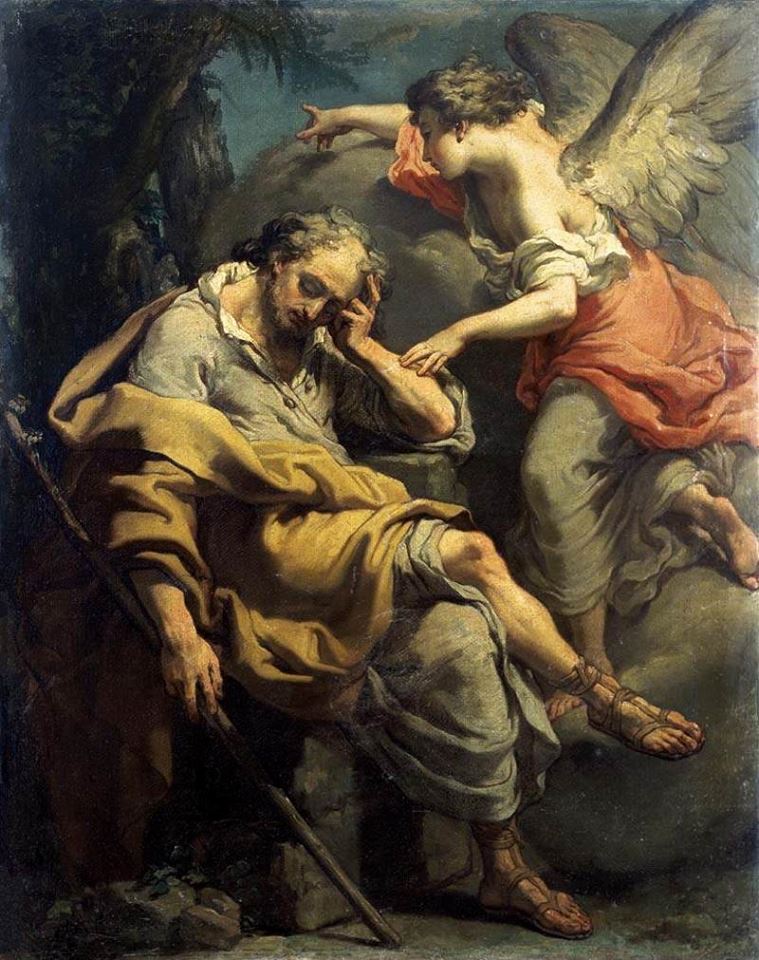
And, for those difficult and troubling pregnancies, we have today’s gospel reading from Saint Matthew. Thank God for Matthew and his Christmas account which addresses the darker side of Christmas. In his Christmas account there’s certainly no baby shower, John doesn’t leap in his mother’s womb, and expectant mothers don’t break out in song. Instead, what Matthew sets before us is a difficult situation. Joseph and Mary are engaged. Joseph has been good; he hasn’t slept with Mary. He’s done his part. But, oh, the darkness. Mary’s pregnant. What now? You better believe that Joseph suffered through many sleepless nights of heartache and disappointment. Perhaps Mary wasn’t who he thought she was. The ideal family he hoped for might never be. The best he could do was send her off to live with a relative and cancel the wedding.

Joseph seems like a man who wanted to do the right thing. We don’t know how he and Mary became engaged. It was probably arranged by the respective families. We don’t know whether they were “in love” or not, but that’s a modern concept. People didn’t marry on the basis of romantic love in those days. Matthew tells us that Joseph was “a just man.” But he was also a reasonable and sane man. He knew that virgins don’t get pregnant. Joseph was a builder from Nazareth, a businessman who operated in a world of income and expenses, blueprints and tools, algebra and geometry. He wasn’t some superstitious country-bumpkin. He knew that virgins don’t conceive, no matter how religious-sounding their explanation might be.

Into Joseph’s despair and darkness the Word of God gets delivered by an angel of the Lord. It would take the Word of the Lord for Joseph to overrule his reason and his senses, not to mention his common sense: “Joseph, son of David, do not fear to take Mary as your wife, for that which is conceived in her is from the Holy Spirit. She will bear a son, and you shall call his name Jesus, for he will save his people from their sins.”

Yes, that’s why Jesus came—to save His people from their sins. Those sins threaten to separate us from God eternally. Those sins—our sins—are what dims this world into perpetual darkness. Sometimes our sins produce self-inflicted wounds. Sometimes those around us get sucked in. Sometimes innocent people suffer for what we’ve done or what we’ve failed to do. This ugliness of sin—this depressing darkness—is why Jesus came. He came to save us from our sin and its deadly wages. Jesus didn’t come to shine a twinkling star on a moonlit night, or to lead us in joyful song, or to be a good excuse to roast chestnuts on an open fire. He came to people in mourning—to people in dark and difficult situations—to sinners—to you—to save you from your sins. See how much God loves you!

Matthew makes it clear that the Lord’s plan to save you had been around for a long time. There was a prophecy buried deep under about 700 years of Israelite dust—the prophecy of Immanuel. As you heard in today’s OT reading, that prophecy was first spoken to faithless King Ahaz. And even though Ahaz didn’t want a sign from the Lord, the Lord gave him one anyway: “Behold, the virgin shall conceive and bear a son, and they shall call his name Immanuel (which means, God with us).” To make a long story short, Ahaz rejected the sign offered by the Lord. Ahaz didn’t trust the Word of the Lord. And Ahaz went down to swift destruction.

That prophecy of Immanuel laid dormant for centuries, like a forgotten seed planted in the soil. But when God speaks—when God makes a promise—He never forgets it. And one marvelous day a smiling angel appeared to a young virgin named Mary, who was betrothed to Joseph. And the angel said, “Guess what, Mary? You’re it. The Lord is with you. Immanuel!” God is with us. The Word has become flesh in the womb of a virgin. His name shall be Jesus. He will save his people from their sins.

Mary believed it; and Joseph believed it too. That’s the real Christmas miracle! Joseph believed; and Joseph acted according to what he believed. As you may know, there isn’t a single syllable from Joseph’s mouth recorded in the Bible. Joseph is silent in the Scriptures. Mary sings her Magnificat, but Joseph has no song. He shows his faith by what he does. His actions speak louder than words. “He did as the angel of the Lord commanded him.” He took this pregnant teenager home as his wife. He gave the child the name Jesus, as directed by the angel. He raised that child as his very own. Joseph is a picture of faith in action. When God’s Word and his own “common sense” didn’t agree, Joseph trusted the Word. He believed it. He did what it says.

You also have the Word of the Lord delivered to you—applied to your life—by a messenger sent from God. I’m no angel; and this is no dream. But I am a messenger sent by God to you. Today the Word of God comes to you, calling you to do what Joseph did—to live in the obedience of faith—to live in the light of your baptism—to say “no” to all sin and ungodliness. In Matthew’s version of Christmas, things are messy and complicated because of sin. So will your Christmas be this year—messy, complicated, corrupted by your sin and its wages.

But the Word of the Lord is at work in you. That Word intrudes, it inconveniences, it rearranges things, it forgives sin. A virgin bears a Son. That Son, Jesus, dies and rises from the dead, bearing your sins away. With God—and with His Word—nothing is impossible. Sinners are forgiven. And the dying depart this life in peace to be with Christ—awaiting the resurrection of the body. Nothing is impossible with God.

Jesus comes. He is “Immanuel,” God with us. He comes in the water of your baptism. He comes in the bread and wine of His holy supper. He comes to save you from your sin. Mary actually was a Virgin. But our Lord also comes for those who aren’t—those who have made sinful and selfish choices. That story isn’t so pretty; nor does it inspire singing or decorations. But this is the Christmas Saint Matthew gives us. This is the Christ who comes even when pregnancy is not good news. This is the Christ who comes into a world where Herod and his allies still slaughter little babies. The Christ was born to die—precisely for the likes of us. He didn’t come so that people would put up fake, plastic trees, but He did come to hang upon a tree that was stained with His own sweat and His own blood. He came to bring genuine good news into a bad news world.

Saint Luke—he gives us the Christmas we want—where Mary sings for joy and where angels fill the sky and where shepherds marvel at the manger. We love it and we’ll hear about it this afternoon from the children. But Saint Matthew—he gives us the Christmas we need. And even in our darkest days, we can still say, “Thank you” and “Alleluia.” Amen.