Saturday, December 25, 2021

The View from the Top

Jesu Juva

St. Luke 2:1-20                                                             

December 24, 2021

Christmas Eve                                              

Dear saints of our Savior,

          It’s probably been twenty years since I last rode a Ferris wheel.  But there’s nothing quite like it.  That smooth ascent up into the sky—followed by the downward drift back to earth—it’s a remarkable journey that ultimately deposits you right where you started.  The Ferris wheel is one wheel that takes you nowhere.  Just a 360 degree round trip.

          Every round trip begins at the bottom—on terra firma.  And whether you’re at the county fair or the amusement park, the sounds and smells at ground level are almost always the same:  loud carnival music in your ears, with the odors of cotton candy, grease, sweat, and manure wafting through the air.

          But then, before you know it, you are off and away, up into the sky, into the wild blue yonder.  The breeze is fresh.  The sun is warm.  The sounds of the earth fade away to silence.  But the view—the view from the top is simply spectacular—always amazing.  The earth with her sins and sorrows shrinks beneath our eyes.  As we rise above it all to see the bigger picture, problems and pains—trials and temptations—fade away.  At the top of the Ferris wheel we find clarity.  We see the big picture.

          Beloved in the Lord, Christmas Eve takes us right to the top of the Ferris wheel.  Christmas Eve is one of those rare moments in life where God give us that same clarity—grace to see the big picture.  On Christmas Eve we can temporarily take in the view from the top—as we hear the message of the angels and follow the shepherds to Bethlehem, and marvel at the manger.  Here tonight (in a darkened church, no less) we see things as they really are—with Christmas clarity.

          On this holy night we take in the view from the top.  Tonight we see with clarity the loving plans and purposes of God.  Life at ground level can seem so rough and random at times.  Nothing goes according to plan.  We struggle to find purpose in this world.  This was no less true for Mary and Joseph:  an unexpected, unprecedented pregnancy, an inconvenient and dangerous journey to Bethlehem, which concluded beneath the most famous “no vacancy” sign in the history of civilization.  But this—this was the plan of God.  Let that be a lesson for us.  When our best laid plans and purposes run aground, when life seems rough and random, God is at work on something better—something surprising—something prepared for you with love.  Can you see it?

          From the top of the Ferris wheel your view of the world is enlarged.  Your horizons expand.  You can take in the big picture.  And so it is on this holy night.  Tonight we can see the size and scope—the marvelous magnitude—of God’s redeeming grace in His Son.  Tonight we see just how much God loves us. 

Tonight, as we take in the view from the top, we are joined by angels—messengers from God.  And this multitude of the heavenly host explains everything.  The angels give us the interpretation of the incarnation.  They bring good tidings of great joy, which shall be to all people. 

          Did you catch those last two words?  All people.  God’s gift of His Son at Christmas is a gift for all people—people of all nations of all races and tribes and languages.  Our culture likes to put a fence around Christmas and label it a “Christian” holiday.  But God didn’t send His Son only for Christians, or only for Jews, or only for those who would eventually have the good sense to believe in Him.  In Jesus, God reconciles the whole world.  God so loved the world that He gave His one and only Son.  Joyful, all Ye nations rise, Join the triumph of the skies.   This is something big—good news, great joy, for all people.  Including you.  Can you see it?

          Ferris wheels are fun; but they are governed by the immutable laws of physics.  What goes up must come down.  And that downward trajectory is also a part of our Christmas clarity.  We can’t really fathom the size and scope of God’s redeeming love until we acknowledge our daily deep and steep descent into disobedience—that downward dive into depravity that none of us can escape until we are deposited six feet under.  By nature we are bottom dwellers.  By nature we reject God’s rules.  We rebel!  And just like our first parents in paradise, we hide ourselves from His searching, seeking love.  Unless you can confess this mess—unless you can acknowledge your sin and its wages—you will never know the marvel of this night, nor the wonders of His love. Can you see your sin—how it trips you up and entangles you and binds you to earth with a force greater than gravity?

          If so, I bring you good tidings of great joy, which shall be to all people.  For unto you is born this day in the city of David a Savior, which is Christ the Lord.  Unto you is born a Savior.  And that is the best of news.  A Savior is the perfect gift for every sinner.  God does not abandon you in your sin and shame.  You have a Savior, which is Christ the Lord.  He came down to earth from heaven to stand shoulder to shoulder with sinners.  For us men and for our salvation He came down from heaven—God of God, light of light, very God of very God, begotten not made, being of one substance with the Father—yet born of the Virgin Mary.  A steeper and deeper dive no man has ever made. 

          This Jesus entered our lowly world of blood, sweat and tears.  The first breaths He drew on earth were pungent with the smell of manure from lowing cattle, not to mention the foul smell of stinky shepherds.  This is the way it had to be—God lowering Himself to your level—God humbling Himself to bear your sins and be your Savior.  His crucifixion and resurrection—His humiliation and exaltation—this round trip from heaven to earth and back again—this is God’s great plan to save you from your sins—and to raise you up from death to life.  Can you see it?

          Beloved in the Lord, Christmas Eve takes us right to the top of the Ferris wheel.  Tonight we see the big picture of our salvation . . . and not just ours alone.  This is bigger than us.  On Christmas Eve our view from the top allows us to see just beyond the horizons of the earth—to get a glimpse of another shore and a greater light—where that multitude which no man can number, whose hope was in the Word made flesh—where all the saints of our Savior dwell in the peace of Jesus, evermore and evermore.  Some you know are already there.  Their place in the pew is empty tonight.  They will not gather with us around the table, tree or fireplace tonight.  But with the clarity of Christmas—with our view from the top—we see them with the Lord, believing that we will go where they have gone, all by the grace of God.  Can you see it?

          At some point in the next twelve days our ride to the top will come to an end.  The clarity of Christmas will give way to the thorns and thistles of life in a fallen world.  The Ferris wheel always takes you right back to where you started from.  We will step right back into the challenging work that God has set before us.  That’s what the shepherds did.  The shepherds returned to their sheep—to the unglamorous work of grazing livestock.  But they returned to their daily grind glorifying and praising God for all that they had heard and seen.  We too will go back to work and back to school—but with greater clarity—with our eyes opened wide to the wonders of God’s love.  Tonight’s view from the top only comes once a year.  So look and listen and ponder it all in your heart.  Merry Christmas!

          In the name of the Father and of the Son and of the Holy Spirit.  Amen.


Monday, December 20, 2021

Two Improbable Pregnancies


Jesu Juva

St. Luke 1:39-45                                                         

December 19, 2021

Advent 4C                                                   

Dear saints of our Savior~

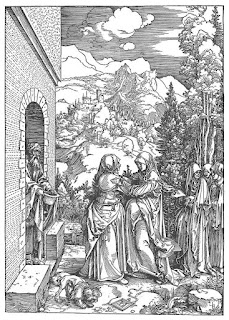
          Things are different this Sunday.  On this final Sunday of Advent, we shift away from the sound and fury of John the Baptizer to a softer and gentler scene.  Today we have the amazing meeting of two women in a little town in the Judean countryside.  Both women are expectant mothers.  But consider this:  one of the

women is in the third trimester of her pregnancy even though she’s in her golden years.  And the other woman has just recently begun her pregnancy . . . as a virgin.  Nothing is impossible with God.

          The Angel Gabriel had told Mary the news about her elderly relative, Elizabeth—after informing Mary that she herself would conceive the Son of God by the Holy Spirit.  Mary’s head must have been spinning.  Joseph was likely scratching his head at the news.  And, you can be sure, the local gossip mill was grinding away.  Sometimes it’s just best to get out of town for a while and take up with relatives who will understand.  And if anyone would understand, it was Elizabeth—about to deliver her son John.  They form quite an amazing picture, these two women—a pregnant virgin and an expectant mother old enough to be a great-grandmother. 

Nothing is impossible with God.  God doesn’t take the easy way or the expected way.  His ways are definitely not our ways.  And sometimes God’s way is simply bizarre.  We need to remember that when things take an unpredictable turn in our own lives.  What may seem random and bizarre to us is simply God’s gracious plan—a plan devised in love for us.

          Things get even more amazing between these two women as soon as Mary walks in the door.  At the sound of Mary’s voice, John leaps for joy in Elizabeth’s womb. Not just the usual kick but a leap of prophetic joy. John was already preaching in utero!  This demolishes the fiction that you aren’t fully human until you’re born, as though human life in the womb is something less than human. John is leaping with joy at the sound of the voice of His Lord’s mother. Don’t be sucked in by the rhetoric of those who would deny full humanity to the unborn. John will kick and leap in protest against that.

          And let’s be done finally with the notion that unborn children have no relationship with the Word, or that newborns and infants have no relationship with God.  John kicks against all who would deny faith to infants or deny them baptism into the death of Jesus, their Savior.

          John is preaching, prophesying, pointing to Jesus already even before he’s born. Behold the Lamb of God who takes away the sin of the world. Jesus is barely conceived, and yet John rejoices over Him. Mary is barely “showing” at this point, and yet the holy child she carries is fully Lord and Savior even now. These two mamas and their two babies tell us everything we need to know about the sanctity of life in the womb.  Let there be no doubt that life—real life—begins at conception.  Those whose business it is to end such life will be answerable to God.

          Filled with the Holy Spirit, Elizabeth blesses Mary:  Blessed are you among women, and blessed is the fruit of your womb!  Those of you who are familiar with Roman Catholic piety will immediately recognize those words as part of the “Hail Mary.”  But even Lutherans can gladly confess this part of the “Hail Mary,” for Mary is surely blessed.  Mary herself sings, “From this day all generations will call me blessed.”  It’s the second part of the “Hail Mary” that we can’t agree with, namely, the “pray for us sinners now and at the hour of our death” part.  At the hour of your death, the one you want praying for you and interceding for you is Jesus—not His mother, no matter how honored and how blessed she might be.

          Notice that Elizabeth doesn’t worship Mary or ask Mary for a blessing.  No, Elizabeth blesses Mary.  Why should Elizabeth bless Mary?  Because Mary succeeded where our first mother, Eve, failed.  Back in the beginning, Eve heard the devil’s temptations and she was deceived.  But Mary heard the Word of God from the angel, and she believed, and she conceived.  Mary’s Child would crush the head of Satan.  Her child would take away the curse of sin by becoming a curse for us.  Her child would destroy death by dying and rising.

          Things get even more amazing when Elizabeth calls Mary “the mother of my Lord.”  Why is this granted to me that the mother of my Lord should come to me?  That sentence alone ought to cause your heart to skip a beat and the hairs on the back of your neck to stand up.  It took Christianity nearly four centuries to carefully sort out what Elizabeth simply blurts out here with Spirit-filled joy.  This cousin of hers—a young woman, probably a teenager—she is the mother of the Lord.

          This takes us right to the heart of the mystery of Christmas—a great and mighty wonder!  The Lord of the universe . . . has a mommy!  The Word became flesh and dwelt among us—in diapers.  The infinite Son of God takes up residence in the finite flesh of a virgin’s womb.  The fullness of the deity dwells among us bodily.  When speaking of Jesus, God is man and man is God.  And Mary is rightly called the Mother of God—the one who bore God in her womb.

          Hypothetically speaking, Jesus could have appeared suddenly out of nowhere, as a fully grown man.  God can dwell among us in any way He chooses.  But if God had done it that way, then people might wonder:  Is He truly, fully, human, or does He just appear to be that way?  And if you start to question His humanity, then that leads you to question whether He’s truly your substitute—your stand-in—the sacrificial Lamb of God who takes your place.  If Jesus hadn’t had a human mother—if the incarnation hadn’t started out as an embryo in a mother’s womb, we would always be left to wonder.  If he had just plopped into the world as a thirty-year-old man He would have side-stepped many of the difficult and painful parts of being human—the trauma of childbirth, the helplessness of infancy, the bumps and bruises of toddlerhood, the awkwardness of adolescence.  He wouldn’t have known what it’s like to wear diapers, and to submit obediently to a mother and father.

          It had to be this way—God’s way—so that Jesus could literally be the Savior of all humanity.  We don’t have a Savior who is unable to sympathize with our weaknesses, but one who has been tempted just like us—yet without sin.  His humanity runs the gamut from a cluster of cells in a mother’s womb to the dying breath of a man on a cross.  Literally, from the womb to the tomb, Jesus became fully human.  God is man and man is God—in Jesus.

          But the most amazing thing of all in today’s Gospel is the reason why Mary is so blessed.  Elizabeth blessed Mary.  Why?  Because of her faith.  Blessed is she who believed that there would be a fulfillment of what was spoken to her from the Lord.    Mary believed the Word of God spoken to her by the angel Gabriel.  She believed that God would do what He promised no matter how unlikely or how unreasonable or how improbable or unprecedented it seemed.  A virgin giving birth?  God becoming man?  Mary likely didn’t understand it all.  She likely had a few concerns.  But Mary is blessed because Mary believed.  Mary is blessed because of her faith.

          And in the same way, you are blessed—because you believe.  You believe the Words and promises of God.  God has plans and promises for your life too.  And you are blessed for believing and trusting that God will brings those plans and promises to fulfillment in you.  Oh sure, you’ve got your moments.  You have doubts and questions and sins that so easily and so often entangle you and trip you up.  Luther was fond of saying that where the Gospel is, there, also, is the cross. There is great and profound truth in that—something that we may not want to hear in this joyful season. Where Christ is, there will always be the cross. Blessing and suffering go together. Mary is blessed, yet she must bear the cross of being a virgin mother with all the scandal and doubt that this entails. You too are blessed—a baptized child of God; yet you bear the cross of living in the light of Christ in a world that prefers darkness and death.  Blessing and suffering are always joined together as one for those with faith in Jesus.

          But at the end of the day, you together with Mary, can only say “Amen.”  “Let it be to me according to you word.”  God tells you that in this Son, Jesus Christ, you have life. You have forgiveness. You have peace.  You have a place of honor in the eternal kingdom of God; and you can’t help yourself but say together with Mary, “Yes.  Amen.  I believe it.”

          Mary is not our mother, as some say.  Mary is our sister—an honored and unique sister who was mother to the Son of God.  For that we bless her on this Fourth Sunday in Advent.  She is a wonderful reminder that with God nothing is impossible.  An elderly couple becomes first-time parents.  A young woman conceives in her virginity.  Sinners are justified. Heaven is opened.  With God nothing is impossible. 

          In the name of the Father and of the Son and of the Holy Spirit.  Amen.
Monday, December 13, 2021

Joy in Sorrow


Jesu Juva

Zephaniah 3:14-20                                                        

December 12, 2021

Advent 3C                                                    

 Dear saints of our Savior~

          I don’t know about you, but I haven’t been feeling much Christmas cheer this year.  Our tree and lights have been up for a while now.  I’ve been listening to my Christmas playlist.  I went for a run through the first snowfall of the season on Wednesday morning last week.  I’ve even done a fair share of Christmas shopping already.  But “bah humbug” is what I’m feeling. And I think I’ve figured out why. 

          It seems I’m suffering from Weltschmerz.  It’s a German word.  And those Germans have a precise word for nearly everything, including my malady:  Weltschmerz.  It literally means “world pain,” or “world weariness.”  Weltschmerz is the pessimism which results from comparing the actual state of the world with an ideal state.  When you compare the way things are with the way things should be in a more perfect world, well, you’re often left feeling a little glum.  And that glumness is what the Germans call Weltschmerz.

          I suspect a lot of people deal with this around Christmas.  For each of us there is a real Christmas, which includes a lot of struggles and sorrows.  And then there’s the ideal Christmas, filled with joy and peace and goodwill toward men.  We want the joy without the sorrow.  As if joy was the absence of sorrow.  We sometimes think we can’t celebrate Christmas until we get rid of all the sorrow in our lives—to make room for the joy.  But this isn’t how God would have us prepare for Christmas—getting rid of the sorrow in our lives so that we might have Christmas joy.  So during Advent, on this Sunday especially, God invites us into the Scriptures, to teach us a thing or two about joy. 

          The pink candle on the Advent wreath reminds us that this Third Sunday in Advent is a Sunday of joy.  In the Collect of the Day we pray that Jesus would “lighten the darkness of our hearts.”  Each of today’s readings illustrates joy in a different way.  Consider St. Paul who writes to the Philippians and tells them, Rejoice in the Lord always; again I will say, Rejoice!  Wonderful encouragement!  Perfect message for your Christmas cards!  That’s how Advent and Christmas should be—joyful! 

          But don’t dare forget the context of those words. Paul writes these words from prison.  Prison, for most people, would not be a place to be talking about joy.  If joy were the absence of sorrow, then there would be no joy in a letter from prison.  But even though Paul’s hands are chained, his heart is free in Christ.  Paul knows that joy isn’t the absence of sorrow.  Joy is found in the presence of the Lord—the Lord who is near us—the Lord who is with us, even in the midst of our sorrow.

          Or consider John the Baptizer, also suffering in prison, awaiting his execution.  He sends his disciples to Jesus with a question:  Are you the one?   But Jesus sends those same disciples right back to John with a song of joy on their lips from the prophet Isaiah: The blind see.  The lame walk. The dead are raised.  And good news is being preached.  If joy were the absence of sorrow, this would be a cruel joke.  While John is on death row, Jesus sends a message of joy!?  But Jesus is teaching us that joy is not the absence of sorrow.

          The same thing is happens in our Old Testament reading from Zephaniah.  Rejoice and exult with all your heart!  There doesn’t seem to be much sorrow in these words.  It seems to be all joy and praise and sunshine.  But these verses are only the concluding verses of Zephaniah’s prophecy.  The preceding portions of Zephaniah sound nothing like this text.  Devastating divine destruction, judgment, and overwhelming horror are the themes of Zephaniah’s prophecy.  Taken as a whole, Zephaniah (like all the rest of Scripture) is a strange mixture of sorrow together with joy.  But the joy is always found in the presence of the Lord who comes to us in the midst of our sorrow.

          Joy . . . together with . . . sorrow.  For the Christian, they actually go hand in hand.  Together, joy and sorrow tell the story of our salvation:   Christmas and crucifixion, sin and grace, death and resurrection, judgment and deliverance, joy and sorrow.

          The beating heart of all our joy is Jesus—Jesus, who bears the Father’s wrath for us—Jesus, who becomes the sacrifice that takes away our sin—Jesus, the presence of God (God with us) in the midst of our sorrow. Jesus’ suffering and death is the key to understanding how joy and suffering can be joined together.  The Son of God in joyful sorrow offers His life for you.  The Father, in sorrowful joy, receives you in grace because of His dying Son.  And when that Son rises from the dead and ascends into heaven and sits at the Father’s right hand, He still bears in His glorified body those wounds from His crucifixion.  And one day we will be privileged to see those wounds.  By those wounds we sinners are healed.  And in those wounds are mingled together terrible sorrow and great joy.

          This Jesus—wounded yet risen, crucified yet alive forevermore—this Jesus comes here to be with you.  The Lord is at hand.  Jesus comes to bring you joy—joy in the midst of sorrow and suffering.  This is what Zephaniah sings about in today’s reading—the presence of God together with His people in the midst of their suffering.  Zephaniah proclaims: The Lord your God is in your midst, a mighty one who will save; he will rejoice over you with gladness; he will quiet you by his love; he will exult over you with singing.

          As Christmas approaches and we prepare to sing “Joy to the world,” it’s important to understand the joy about which we sing.  This joy isn’t happiness, for happiness is just an emotion.  Happiness depends on the circumstances.  Nor is this joy always found in smiling faces.  This joy comes from Jesus—and this joy is always found together with sorrow.  We need to understand that—for ourselves and for those around us whose sorrow is great. 

          In my years as a pastor I’ve learned how difficult it can be for people with great sorrow to come to church.  I can think of parents who have lost a child—husbands and wives who have lost their spouse—good and faithful Christians—who found it difficult to come to church in sorrow.  They feel like they don’t fit in with their sorrow.  They feel like church is place for joy and praise and smiles and happy people; and they just don’t fit in.  We need to be careful as a congregation that we don’t celebrate joy as the absence of sorrow.  We do need to proclaim and show the joy of Jesus—Jesus who comes to us in our sorrow, who comforts us and brings us joy—joy together with sorrow.

          It’s for people like that—for people like us—that Jesus comes among us today.  Every time we gather here, there are joys we celebrate:  the birth of a child, a recovery from illness, a wedding anniversary or a birthday.  And, always, there are sorrows we mourn:  a death, a diagnosis, a loss of employment.  We bring all these joys and sorrows before God in prayer.  But in His Word, God brings us His Son.  In bread and wine, God brings us Jesus Christ.  And Jesus rejoices over you with gladness, and quiets you with His love.  This is the joy of Jesus.  And the joy that He brings—like the wounds He still bears—is a joy that will last forever. 

          In the name of the Father and of the Son and of the Holy Spirit.  Amen.