In Nomine Iesu
St. Matthew 20:1-16
September 24, 2017
Proper 20A
Dear brothers and sisters in Christ Jesus~
An hour’s pay for an hour’s work. You reap what you sow. You get out of it what you put into it. A day’s work equals a day’s wage. Those are the rules. And we expect God to operate by those same rules. We expect God to be fair—to recognize and reward our work.
But today we learn that God is not fair. He’s just. He’s gracious. But God is not fair. And that’s good because grace isn’t fair. Fair is the Law; grace is the Gospel. If it’s fair, that means the first come in first, the last come in last, survival to the fittest, and the kingdom to those who achieve it. But if it’s grace, then the first are last, and the kingdom goes to the least of all. But I’m getting ahead of myself. Let’s go to the parable, shall we?
A man had a vineyard and needed laborers to pick his grapes. He went to the union hall at 6AM and negotiated with the union bossfor some laborers at a denarius a day—about $120—and off they went. At 9AM he noticed he was still shorthanded. So he went to Home Depot and found some day laborers looking for work. He told them, “You go work in the vineyard too, and whatever is right I will give you.” (Note that: Whatever is right. Whatever is just. Not whatever is fair.)
He did exactly the same thing at noon and at 3PM—found some idlers hanging around and hired them for some unspecified, just wage. At 5PM the sun was beginning to set and there was still work to do, and he needed more help. So he went to the local tavern where some deadbeat losers had been hanging out all day, quaffing beers, because no one would hire them—understandably. “You go into my vineyard too,” he says, not even promising to pay them a dime. But they’re running low on funds for booze and weed, so off they go to work for one hour. How hard can it be?
Finally, at 6PM it’s Miller Time as they say in Milwaukee. The vineyard workers all head to the foreman to receive their wages. The owner has them line up in reverse order, from last-hired to first-hired, from the eleventh hour losers to the crack of dawn Grape Pickers Local 101. The first girl in line (one of the deadbeats from the tavern) opens her envelope expecting ten dollars at the most. But what’s she find instead? Six crisp twenties. And so it continues.
Pretty soon word filters back to the end of the line—back to the union guys hired first—that those who worked only one hour got $120. So they’re thinking, $120 per hour times 12 hours, that comes to $1,440. Cha-ching! Cha-ching! And so, one by one, they step up to the table, expecting the biggest payday of their grape-picking lives.
But in all their calculations they hadn’t figured on one thing. The payout from the vineyard owner is all based on his goodness and his promises, and not on their work. And in his infinite goodness, this guy gives out six crisp twenties to every single worker, regardless of how much or how little they worked. Each worker gets a denarius. “Not fair,” declare the sweaty, exhausted union guys who worked all day long. But the owner reminds them that he didn’t promise to be fair, but only to pay them a denarius. Promise kept. End of parable.
One of the toughest pills for religious superstars to swallow is the idea that God justifies the ungodly; and that our salvation at the world’s final Miller Time is not based on our works, our achievements and accomplishments, but on the sheer grace of God in Jesus Christ who doles out a denarius of salvation to all who believe, whether a lifelong Lutheran or a deathbed convert to Christ. The labor unions of religion howl in protest. It’s unfair to Commandment Keepers Local 101. But then grace wouldn’t be grace, would it? It would be bookkeeping. And if the world could have been saved by bookkeeping, it would have been saved by Moses with his commandments, and not by Jesus with His bloody cross.
A day’s wages for a day’s work. That’s fair. And that’s what we expect in this world, and that’s right. This world operates by the rule of law. That’s good and there’s no way around that. But Isaiah reminds us that God’s thoughts are not our thoughts. His ways are not ours. He deals with us not according to what’s fair, but according to His grace and His goodness. If you want God to be fair—to deal with you according to your works and your accomplishments—then you will be damned. That’s fair. That’s the Law. Hell is the one place where everybody gets what they deserve.
Many of us, in a sense, are like the workers hired first, or at least earlier in the day. We were baptized as babies. We grew up in the church. There’s never really been a conscious moment in our lives when we didn’t know Jesus as our Savior. We’ve worked in His vineyard our entire lives. We’re not quite sure what to make of those eleventh hour converts who benefit from everyone else’s hard work—those who “got away” with never tithing, never serving on a committee, never attending a long church meeting, never having to get up early on Sunday.
Whatever you make of them, for the love of God, don’t be jealous of them. But see God’s generosity in them and praise Jesus that it really is by grace alone, through faith alone, for the sake of Jesus Christ alone that sinners are made righteous. Praise be to Jesus, because if there’s room enough in the kingdom for eleventh hour losers and deadbeats—for hookers, and tax collectors, and all manner of notorious sinners—well, then, there is surely enough room in the kingdom for you and me.
Then again, let’s not overstate our position in the kingdom. We really aren’t the first workers hired, are we? Others have believed before us. Others have suffered before us—and much, much more than us. There have been workers in this vineyard for two thousand years: St. Matthew and St. Paul, St. Mary and St. Elizabeth, St. Polycarp and St. Augustine, Luther and Bach. There were countless, nameless believers who bore the heat of persecution, who defended the faith, who suffered and died trusting in Jesus, who have now departed this life to be with Christ (which is far better).
And now, in these last days, at the eleventh hour with the sun setting, with the fields still ripe and waiting for harvest, the Lord of the vineyard has been so kind and gracious to call YOU to work in this same vineyard. We are, really, the last and the least. We come to the scene when much of the work is already done. Yet, you get the same denarius—not six crisp twenties, but the same forgiveness of sins, the same salvation, the same resurrection life in Jesus. It’s not fair at all; but it’s oh, so gracious.
While we were yet sinners, Christ died for us. While we were still ungodly, He justified us. Before you so much as lifted a finger to work in His vineyard, He prepared an envelope with your name on it, containing “your” denarius. And even the work you’re doing now—the good you do each and every day out of love for your neighbor—it’s all really God’s doing in you and through you. And all this is what we call the “gospel.” Good news. Grace, not works. Gift given, not wages earned.
It’s outrageous! There’s no denying that. Whether first or last—whether we have worked hard, or little, or barely at all—there’s a generous payday coming. It was won for each of us by the death and resurrection of Jesus. He got the wages we deserve for our sins. We get His free gift of eternal life. That’s not fair . . . because God isn’t fair. But He is good. And He is gracious. Thanks be to God.
In the name of the Father and of the Son and of the Holy Spirit. Amen.
Sunday, September 24, 2017
Saturday, September 23, 2017
The Sinners' Hospital
In Nomine Iesu
St. Matthew 9:9-13
September 21, 2017
St. Matthew, Apostle & Evangelist
Dear brothers and sisters in Christ Jesus~
Do you ever dream about the ideal church? Or wish that your church could at least be more ideal? When I dream about the ideal church, I dream that all the members always attend every service—and that those faithful members always bring along with them some unchurched friends and neighbors. In the ideal church the Bible studies would always be well-attended, lively affairs that dig down deep into the Word of God. The people are super-friendly, caring, always praying for one another and serving one another. The services are reverent and meaningful, with music that always touches the heart. And, of course, when you dream of the ideal church, it always has an ideal pastor—a young man, of course, yet with 40 years of ministry experience under his belt. And children, too—lots and lots of children in the ideal church. It’s okay to dream, right?
Well, actually, no, it’s not. It’s wrong. It’s wrong to dream about the ideal church because it leads us to despise the realchurch—the actual church—the church that Jesus Christ founded—and the church that St. Matthew wrote about and proclaimed. God hates our dreaming about the ideal church. For such dreaming either makes us despondent and discouraged, or else it makes us proud and pretentious and judgmental—demanding that everybody else get their act together and get in line with my concept of the ideal church.
The Pharisees dreamed about and demanded a perfect religious community—an exclusive community of respectable commandment-keepers. Tax collectors and prostitutes and others who failed to keep the Law in spectacular ways—well, they need not apply.
Tax collectors like Matthew were considered the worst of the worst—notoriously dishonest and greedy. Bribery, extortion, money-laundering, and outright theft were all part of the typical tax collector’s tool box. And there’s no reason to presume that Matthew was any different from all the rest. Matthew was a sinner—the ideal sinner—who had no place in the ideal religious community of the Pharisees.
But as it turns out, Matthew did have a place with Jesus, and in the church Jesus came to build. And this church—to which you yourselves also belong—it isn’t built around some ideal concept of perfection. No, the church of Jesus begins with two little words: “Follow me.” Notice that Matthew didn’t record for us a single one of his own words. If Matthew gave some speech about leaving behind the tax collectors’ booth and pledging his sacred honor to following the Savior, he left us no record of that. Because it doesn’t matter. What mattered was the grace-filled invitation spoken by the Savior: “Follow me.” Those same words were spoken to you—combined with the water of your baptism. Jesus wants you—along with Matthew—to follow Him in faith.
And then—then we learn just what kind of a church the church really is. It happened at a meal at Matthew’s house, where Jesus and his disciples were on the guest list, along with a bunch of other tax collectors and sinners. The Pharisees, of course, objected to this less-than-ideal gathering: Why does your teacher eat with tax collectors and sinners? Jesus Himself provides the answer. And in His answer we learn that His church is not some ideal religious community. But rather, it’s a community of sinners, a hospital for those in need of healing for their sin-infected souls. Jesus said, “Those who are well have no need of a physician, but those who are sick. . . . I came not to call the righteous, but sinners.”
This means that the church is, properly speaking, a hospital—a hospital for people who are sick with sin—a place where diagnoses are made and where healing is applied. Now, I get to hospitals with some regularity as part of my job. And the kind of people you find in hospitals are—how shall I put this—less-than-ideal. They are hurting. They are scared. They are angry sometimes. They are confused. Their carefully crafted routine has come crashing down around them and they are helpless—utterly helpless to do anything about it—completely dependent on others. It’s not ideal.
Welcome to the church—the real church—the church Jesus Christ came to build and the church about which Matthew wrote. There is no ideal church. There’s just a place for people who recognize their need and their helplessness—for patients (if you will) whose lives are diseased and disordered by sin. In the church of Jesus—in this hospital for sinners—you’ll find people who are hurting, scared, angry and helpless—sinners with messy, conflicted lives who know that the wages of sin is death.
This is the church—a hospital for sinners—and only for sinners. Here we have the physician—the Great Physician, Jesus, who suffered and died so that you might have healing. By His wounds we are healed. And even at a simplified, streamlined service like this, we have the healing medicine that Jesus Christ died to secure for you. Tonight, here in this hospital, you get to receive medicine that money can’t buy—that insurance will not cover—medicine that heals you in body and soul. In fact, in the early church, the Lord’s Supper was known as the medicine of immortality—food and drink for this life, and for the life of the world to come.
Don’t dream about an ideal church; give thanks for the real church—the church into which Jesus has called you—the church that welcomes sinners and provides the healing of Jesus in Word and Sacrament. It’s all here for you. Amen.
Monday, September 18, 2017
Forgiven and Forgiving
In Nomine Iesu
St. Matthew 18:21-35
September 17, 2017
Proper 19A
Dear brothers and sisters in Christ Jesus~
‘Tis the season for sneezing, and some folks have been doing a lot of it lately. Sneezes are the body’s way of expelling things that you’re better off without—things like dust and pollen and mold. Did you know that the air you expel when you sneeze is traveling more than 100 miles per hour? Those are “category 2” hurricane force winds! It may just be an old wives’ tale, but some people believe that holding in your sneezes can be harmful. Why keep in the bad things that your body wants to get out?
Holding in a sneeze may or may not be harmful; but holding in forgiveness—refusing to share forgiveness with those who sinagainst you—that will definitely do you more harm than good. Refusing to forgive is like a cancer on the soul. It isolates and eats away at the one who refuses to let it go—to forgive. If hell is the place where no sins are ever forgiven, then refusing to forgive is truly hell on earth. Jesus comes today to rescue us from this hellish prison.
Last week we heard from earlier in Matthew 18 that sin—even among brothers and sisters in Christ—is unavoidable and inevitable. It is to be expected. We also learned that confronting sin is an act of love—that we should go to the one who sins against us with the goal of reconciliation. We should go to every length possible to forgive. We are to set no limits when it comes to forgiveness.
Peter, today, was looking for limits—and loopholes. We all do it. “Lord, how many times shall I forgive my brother when he sins against me?” How about seven times? When is enough enough? The rabbis of Jesus’ day said three times was enough. Peter’s suggestion of lucky number seven had a nice Biblical ring to it.
But just for a minute, imagine if Jesus had said, “Yes, the limit on forgiveness is seven times.” How many of our marriages would have ended long ago if Jesus had set the forgiveness quota at seven? How full would the pews be this morning if in this fellowship of believers we only had to extend forgiveness to one another seven times? Wouldn’t we all eventually be estranged from one another—brother against sister, husband against wife, elders against ushers, choir against organist? I imagine if someone sinned against you six times, you’d almost be hoping for just one more time so that you could be done with forgiving that person.
Forgiveness with limits is not real forgiveness. Forgiveness, the way Jesus defines it, has no limits, no tally sheets, no boundaries. Forgiveness “Jesus’ style” is outlandish and outrageous. “I tell you, not seven times, but seventy-seven times,” says the Savior. Jesus sees Peter’s seven and raises him seventy. And just about the time you start to lose count, you’re beginning to learn what it means to live under the Gospel instead of the Law.
To forgive literally means to “let go” of the sin committed against you; or to “send away” the offense to some other place where it’s no longer on your radar. To forgive means to go on as though the thing hadn’t happened. The sin has no power over you because you’ve let it go. You’ve sent it away—no ifs, ands, or buts, no contingencies and no quid pro quos. To forgive is to step into freedom—the freedom that is yours as a blood-bought child of God.
Forgiveness is so important that Jesus devotes an entire parable to it. A servant owed the king an astronomical amount of money. His house was probably mortgaged three times over, credit cards maxed out, dealing with the neighborhood loan shark, a chapter 13 nightmare. He begs for mercy from the king, tries to cut a deal: “Be patient with me and I will pay back everything.” Yeah, right. The king could have tossed this deadbeat into debtor’s prison—could have liquidated his every possession. But he didn’t. The king did an outrageous, crazy, reckless, insanely gospel thing. He forgave the entire debt. Let it go. Sent it away. Told the accountants to get out their erasers. And the servant walked away free and clear.
That forgiven servant went out in his freedom and found a fellow servant who owed him, basically, pocket change. But instead of forgiving him, he wrung his neck, began to choke him, and demanded payment on the spot. His fellow servant pleaded for leniency with the very same words the first servant had used with the king. But instead of forgiving him, he had the man thrown into prison. When the king heard about it, he threw a fit, called the servant back in and asked, “Shouldn’t you have had mercy on your fellow servant just as I had on you?” In anger the king handed the man over to the jailers to be tortured until he paid back his astronomical debt. There was hell to pay for his refusal to forgive as he had been forgiven.
When we refuse to forgive as we have been forgiven, we put ourselves in prison, we torture ourselves, and the King isn’t happy. Few things anger Him as much as our refusal to forgive as we have been forgiven. How many of us are already living in a kind of self-inflicted torture because we refuse to “let go” of all the slights and all the sins and all the insults and all the pain and abuse that people (and sometimes people we love) have inflicted upon us over the course of a lifetime? And don’t try to tell me that dragging around that load of filth every day is enjoyable or that it gives you pleasure. It’s a kind of torture and it’s killing you.
One thing’s for sure, that’s not the way of Jesus. That’s definitely not the kind of life that Jesus Christ hung on the cross to win for you. He’s the Lamb of God come to take away the sin of the whole world. Every sin committed against you is atoned for in His death. Every sinner is reconciled to God by His blood. When you look at that person who sinned against you—see that person as one for whom Jesus died. See that person as someone who is reconciled to God in the death of Jesus. Does he know that? Will he know that from you? He’ll never know it from you if you’ve got your hands wrapped around his neck. He’ll never know it from you if you keep throwing his sins right back in his face. But he may yet come to know it with your hands on his shoulder and with the words, “I forgive you.” When was the last time you said those three little words? I forgive you. Nothing is harder. Nothing is more powerful.
As for you, you leave here this morning debt free. Your sins are as far from you as the east is from the west. The books are closed. The debt is paid in full. The slate is wiped clean. All this thanks to Jesus who paid the debt, “not with gold or silver, but with His holy, precious blood and His innocent suffering and death.” You are forgiven. You are free. You are forgiven and forgiving.
That phrase, forgiven and forgiving, appears on the banner that you see pictured on the front of the bulletin today. That banner has hung right out here at the top of the stairs for as long as I can recall. I never paid much attention to it until one day many years ago when the lift was being installed. I was sitting in my office thinking deep thoughts one afternoon when a man who was working on the lift began swearing loudly. And I don’t mean one or two naughty words; he was letting the expletives fly. Now, I could’ve just let it go, but quite frankly I was concerned the man might’ve just severed his arm given the volume of profanity that was still echoing up to my office.
So I walked out of my office to the top of the stairs out here where the man’s blue streak was still continuing. “Are you okay?” I asked. Well, immediately the swearing stopped and the man sheepishly told me how he had removed a ceiling tile that he shouldn’t have removed. And then the man suddenly paused as if struck by an awful realization: “You’re not the pastor, are you?” he asked. Well, a ceaseless stream of profuse apologies began to come out of his mouth. The man truly felt lower than a snake’s belly at that point, and I was trying to comfort him when he spotted something on the wall behind me. It was that banner with a cross and the word “forgiven” in capital letters. Pointing at the banner he said, “I guess that’s me.” “Not just you,” I said. “That’s all of us—forgiven and forgiving.”
We forgive others—not to be forgiven by God—but because we already are forgiven by God in Christ. Whenever you forgive someone you—in a very real sense—become like Jesus. You become like Joseph who forgave his brothers the evil they had done, but with tears in his eyes said, “You meant it for evil, but God intended it for good.” Even when you get shafted by someone, God makes sure that everything works for your eternal good. You’re already ahead of the game. So why not let it go and forgive from the heart? Don’t pooh-pooh the power of forgiveness. It’s nothing to sneeze at. It’s Jesus Christ at work in you and through you. Amen.
Tuesday, September 5, 2017
The Christ & The Cross
In Nomine Iesu
St. Matt. 16:21-28
September 3, 2017
Proper 17A
Dear brothers and sisters in Christ Jesus~
Jesus said, “If anyone would come after me, let him deny himself and take up his cross and follow me.” There you have it. The theme of the day: Cross-bearing and Self-denial. Well, this is going to be a tough sell. We don’t naturally want to go down the road ofcross-bearing and self-denial. Our natural inclination is to do just what our first parents did in the beginning, in the Garden: Adam and Eve denied themselves nothing, seized what wasn’t given to them, and bit down hard on the notion that they knew better than God.
And we are the living proof that the apple doesn’t fall far from the tree. Self-denial isn’t just a tough sell; it’s a foreign concept to most Americans today. Self-denial? You must be joking. Our entire culture revolves around self-indulgence, self-absorption, self-gratification, self-glorification, not to mention selfies and selfie sticks. Narcissism is the name of the game.
But Jesus says, “Deny yourself. Take up your cross.” What Jesus says in this text is a major inconvenience to our aspirations of grandeur. So, naturally, we look for a way around what Jesus says in this text. Maybe all this talk about crosses and self-denial is only figurative or metaphorical or spiritual. Maybe Jesus is just exaggerating; He did that once in a while, you know. Maybe Jesus just has in mind Sunday mornings. You know? Carry on business as usual Monday through Saturday; but just deny yourself a little sleep on Sunday morning, show up for this sweet hour of prayer, then suffer through longs lines at the all-you-can-eat brunch buffet, and call it good. Self-denied; cross carried; boom! If you think that’s what Jesus means then ask yourself this: Where would we be if Jesus Himself had only taken up a figurative cross—a metaphorical cross—or a spiritual cross—instead of a real, wooden cross with nails? We wouldn’t be here—that’s for sure.
Today’s Holy Gospel is a turning point in Matthew. It records the moment when Jesus begins to make His decisive turn toward Jerusalem—and Calvary. Up to this point in our Lord’s earthly ministry, it’s been kind of fun to follow along—watching Him slap those demons around, healing scores of sick people, feeding thousands, stilling storms, walking on water, running circles around the scribes and Pharisees. Who wouldn’t want to follow Jesus? The crowds flocked to Jesus, and we would have been right there with them.
But no sooner had Peter proclaimed that Jesus was the Christ, the Son of the living God—than Jesus began to take a different tone. From that time Jesus began to show his disciples that he must go to Jerusalem, suffer, be killed, and rise again. From that time, Jesus explicitly began to tell them just what it meant that He was the Christ—the Son of God in human flesh. In a word: the cross.
Peter objected—immediately, forcefully, predictably. God forbid it, Lord. This shall never happen to you! Oh, Peter. There but for the grace of God go I . . . and you. One minute Peter could confess the divinely revealed truth about Jesus, and in the very next breath try to derail His death and resurrection. One minute Jesus could commend Peter, saying, “Blessed are you, Simon.” But in the next minute Jesus would rebuke Peter, saying, “Get behind me, Satan. You are a hindrance to me. You have in mind the things of man.” One minute Peter spoke divine truth. The next minute he was a spokesman for Satan. And Peter had no idea which was which.
Peter had no idea; and neither do we. So sneaky and slippery is our sinful nature that one minute we’re holding fast to what is good, but the next minute we’ve indulged ourselves in evil. One minute we’re generously donating to help anonymous hurricane victims, but the next minute we’re doing our best sloth impersonations when we ought to be serving and helping the members of our own family. With our lips we say, “I forgive you,” while in our hearts we plot and plan our carefully crafted vengeance. We’re jealous of those who rejoice and make a wide detour around those who weep. It’s a crying shame. With our tongues we bless . . . and we curse; we proclaim the truth . . . and we whisper demonic lies. And, most of the time, we don’t know which is which.
This is why the Christ and the cross go together. This is why Jesus said it was necessary—why Jesus said that He must go to Jerusalem, suffer many things, be killed and on the third day be raised. It wasn’t optional—not if our sin and death were to be definitively dealt with, once and for all. The cross was critical and crucial. The cross would be how God’s self-denying, self-giving, self-sacrificing love would be shown to the whole world.
This is why Satan tried to subvert the cross. The cross is the one thing the devil really fears. The cross is the devil’s downfall. The devil knew that the sacrifice of Jesus’ perfect human life on the cross would satisfy the demands of the Law. He knew that the death of the Son of God would cover the world’s sin completely—that sinners like us would be able to stand before God forgiven, righteous, and holy because Jesus would die and rise as our sacred, sin-bearing substitute. The devil knew that his accusations would be silenced, that sin would be atoned for, that death would be defeated, that his domain would be vanquished.
The Christ and the cross go together. This is why our Jewish neighbors are particularly offended by the cross. It’s why our Muslim neighbors are particularly offended by the cross. This is why, still today, the devil wants to distance you from the cross of Christ. He couldn’t stop Jesus, but maybe he can mess with you a little bit—get you to think that you have to earn your forgiveness—get you to think that your baptism means very little for your messed-up life—cleverly convince you that the Lord’s Supper is nothing more than a sentimental, symbolic reminder of what Jesus did on a hill far away. He’d love to get your eyes off of this crucifix so that you can focus more clearly on your own needs and narcissism.
Separating yourself from the cross is the first step toward gaining the whole world—and losing your own life. That’s dumb. Yet people do it all the time. If you’re doing it right now, stop. Repent! Set your mind on the things of God instead. Deny yourself as you do the work of your vocations with diligence and determination. Follow Jesus right here to where He shares the benefits and blessings of His holy cross with all who gather in faith around His blessed Word and His Holy Supper.
Jesus asked, “What shall a man give in exchange for his life?” The answer is nothing. You have nothing to give. We are all beggars. But here’s the glory of the cross: Jesus gave His life in exchange for your life. In fact, He gave His life in exchange for the life of the world. One holy, perfect, sinless, spotless life—for you, in your place. You are died for. You are loved.
Keep that in mind when the crosses you bear are heavy and painful. Keep that in mind when persecution comes your way. With the eyes of faith we can see right past our present sufferings to the resurrection glory that far outweighs them all. With faith in Jesus you literally have nothing to lose—nothing except your sin, your guilt, and your shame. That’s the way of the cross—the way on which Jesus invites you, simply saying, “Follow me.”
In the name of the Father and of the Son and of the Holy Spirit. Amen.
Monday, August 28, 2017
Who Do You Say I Am?
In Nomine Iesu
St. Matt. 16:13-20
August 27, 2017
Proper 16A
Dear brothers and sisters in Christ Jesus~
Who . . .is . . . Jesus? That’s the question of the day. But do we really need to be asking that question here? I mean, this is a Christian church after all—a congregation of the Lutheran Church-Missouri Synod. Christ crucified is literally the focal point of thissacred space. And yet, that question, Who is Jesus? Who do you say that I am? it has a way of getting our attention. There’s a lot riding on how you answer that question. That question is deeply personal (not private, but personal).
It’s easier to report on what other people think of Jesus. When Jesus asked, Who do the people say the Son of Man is? the answers He got were varied and predictable. Some say John the Baptizer, back from the dead. Some say Elijah, who was supposed to appear before the coming of the Messiah. Others say Jeremiah or one of the prophets. In so many words, a great man among religious men. Just like today when people say something complimentary about Jesus without confessing the big thing: He’s a great moral teacher. He’s an example on how to care for the poor and sick. He’s a true friend in times of trouble. That’s all very nice. But it’s not nearly enough.
But who do you say that I am? Now Jesus gets at the heart of the matter. Never mind what the polls say, what about you guys? Simon Peter speaks up, as he always does. Good old Simon Peter. He’s like that one annoying kid in the classroom who always has his hand up in the air—who always thinks he knows the answer—to whom attention must be paid. I always imagine the other eleven disciples trying not to roll their eyes as Peter cleared his throat and began to speak: You are the Christ, the Son of the living God.
But instead of the usual correction or condemnation from Jesus, Peter for once is commended! “Blessed are you, Simon bar-Jonah.” Peter got it right. Jesus IS the Christ, the Messiah, the very fulfillment of all God’s promises to Abraham, Isaac, and Jacob, Moses, David and all the prophets—the Son of the living God. You couldn’t get a more correct, orthodox answer than that.
Blessed are you, Simon . . . but. You didn’t think this up on your own. This confession of yours came straight from the Father in heaven. So, no gold star for Peter. No merit badge or trophy. To confess that Jesus is the Christ, the Son of the living God, is not something we can do by our own reason or strength or IQ or intelligence. No one can say “Jesus is Lord” except by the Holy Spirit. You, like Peter, can take no credit for confessing the divine truth about Jesus. All you can do is receive the blessing that comes from such a confession: Blessed are you!
Peter’s confession was rock solid. That’s why Jesus called him Petros, Peter, Rocky. Because on that rock-solid confession Jesus will build His church and the gates of hell will not prevail against it. This is important. Who builds the church? Jesus does! Who gives the church growth? Jesus does! And He does it all based on Peter’s rock-solid confession that Jesus is the Christ—not on the person of Peter. There’s nothing solid about the person of Peter at all. The church is not some personality cult of Peter or any other pastor. A church built on Peter would be on a slippery slope. The beauty of Peter’s confession is that he doesn’t point to himself, but to Jesus. And you can’t be more rock-solid than when you’re confessing a crucified and risen Christ. Even the gates of hell cannot compete with that!
This is the true, hidden strength of this (and every) congregation. Our strength lies not in the personality of our pastor, or in the beauty of our hymns, or in the simplicity of our sanctuary. Our strength is our foundation—the rock-solid confession that Jesus is the Christ, the Son of the living God—a truth we quietly and calmly assert before the whole world every time we unite our voices in the Creeds of the church.
Did Peter fully realize what his words meant that day? No, not fully—not yet. As we’ll hear next Sunday, the same Peter who could confess the Christ with clarity in one breath, could become a spokesman for Satan in the very next breath. Peter envisioned a conquering Christ, not a suffering servant.
But Peter came to learn what we also have come to know: To confess Jesus as Christ and Son of God is to confess Him as crucified and risen from the dead. There is no other Jesus—no other way to be the Christ than by dying and rising. This is how death is defeated. This is how our sin is atoned for. This is how all things will be made new—by Jesus’ death on a cross for the sins of the world. Those who would flatter Jesus by saying all sorts of nice things about Him, but refuse His bloody death and reject His resurrection—they are on very shaky ground.
Peter’s confession of Jesus also shows you the importance of your own confession of Christ. What you believe with your heart, you confess with your lips. In just a few minutes we will receive two new members into our fellowship—and we will receive them, not because they are very nice people who can bring a lot of good things to our life together. No, we receive them based upon their confession of the faith—a confession built squarely on the rock-solid foundation that Jesus is the Christ, the Son of God.
There’s really no middle ground where the Christ is concerned. Either He is Lord or He isn’t. Either He is the Messiah or He isn’t. Either He is the Son of God or He’s a lunatic. As C. S. Lewis famously wrote in Mere Christianity: Either this man was, and is, the Son of God; or else a madman or something worse. You can shut him up for a fool, you can spit at Him and kill Him as a demon; or you can fall at His feet and call Him Lord and God. But let us not come with any patronising nonsense about His being a great human teacher. He has not left that open to us. He did not intend to. (p.56)
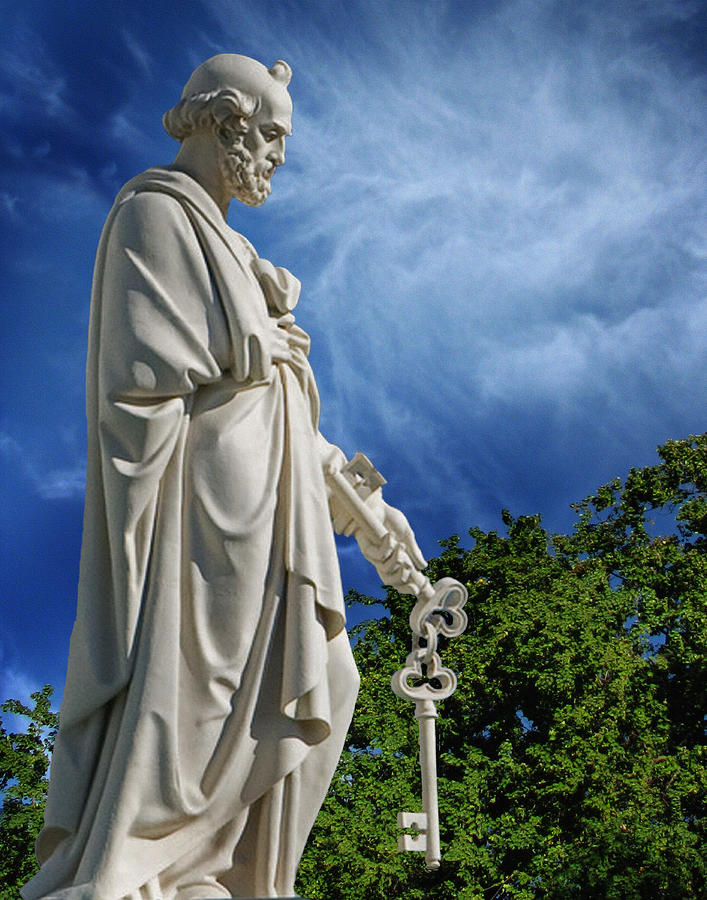
And we can’t forget the keys. Jesus said, “I will give you the keys of the kingdom of heaven, and whatever you bind on earth shall be bound in heaven, and whatever you loose on earth shall be loosed in heaven.” What does this mean? Keys equal authority—the authority to open and shut, to bind and to loose. It’s a huge thing to have keys. When I worked as a security guard in college I was entrusted with keys to everything on campus—women’s residence halls, faculty offices. I could use the college president’s private bathroom at three o’clock in the morning if the notion struck me.
But imagine having the keys of heaven. Jesus hands off those keys to Peter, and to His whole church. You don’t have to hunt for the keys to the kingdom of heaven like you do for your car keys sometimes. No, the keys of the kingdom of heaven are at work right here where Jesus Christ is confessed—right here where sins are confessed and absolved—right here where we preach Christ crucified. “The office of the keys is that special authority which Christ has given to His church on earth to forgive the sins of repentant sinners, but to withhold forgiveness from the unrepentant as long as they do not repent.” These keys are at work for you. Jesus gave them so that you might know for certain that heaven is open to you.
Jesus then warned Peter and the rest not to tell anyone that He was the Christ. But don’t worry. He’s not talking to you here. You can tell anyone and everyone that Jesus is the Christ, the Son of the living God. The disciples just had to wait until Jesus died and rose again. Then the world would have its rock solid proof—the hard evidence—that changes everything. Today it is our gift and our privilege to confess with Peter and with all the saints: Jesus is the Christ, the Son of the living God.
In the name of the Father and of the Son and of the Holy Spirit. Amen.
Monday, August 21, 2017
Man's Best Friend
In Nomine Iesu
St. Matthew 15:21-28
August 20, 2017
Proper 15A
Dear brothers and sisters in Christ Jesus~
It’s not right to take the children’s bread and throw it to the dogs. That’s one of the first and foremost rules of dogownership. You don’t take food from the table—pricey food, carefully prepared for human consumption—and hand it off to your little puppy. It’s not that your little puppy wouldn’t like what it is you’re eating. And it’s not that his little digestive tract might react unfavorably to your rich fare. No, the problem is that dogs fed from the table come to expect it—maybe even demand it. Sit down, say grace, pass the potatoes . . . but then prepare for the whining, the whimpering, the begging, the big sad eyes, and the little paw tapping you on the thigh. No, Jesus has definitely made the right call here. It’s not right to take the children’s bread and throw it to the dogs.
Of course, when Jesus first said this concerning canines, there wasn’t a single furry four-legged friend in sight. There was begging, and there was whining, along with big, sad eyes—but all that came not from a dog, but from a pesky Canaanite woman. She just wouldn’t take “no” for an answer. No matter what the Savior did or didn’t say, she just kept coming back like a bulldog. She latched onto the Lord like a terrier latches onto a soup bone. She pursued Jesus with a dogged faith that just wouldn’t let go no matter what. And even more amazing, she was an outsider—a gentile dog—a non-Israelite. But that’s what this text is ultimately all about: God’s grace to all people in Jesus Christ, the outsiders becoming insiders, and God’s house being a house of prayer for all nations. Oh, and there’s also a little something about man’s best friend.
Jesus was doing what a healthy percentage of our members are doing right now—He was taking time off up north. But “up north” for Jesus meant gentile country. One of the locals—a woman, no less—approached Jesus. Right away, she’s got two strikes against her: a woman didn’t approach a man in public, and a Canaanite wouldn’t dare approach a Jew—let alone a Rabbi. But this woman had good cause for her carelessness. She was desperate. Her little girl was being terrorized by a demon. And she was powerless to stop it. No one could help. For some unknown reason, this woman clearly knew and believed that Jesus was her last, best, and only hope.
What do you say? What do you pray when Jesus is your last and only hope? What words are the right words when you’re rendered helpless while demons have their way with your daughter—when life caves in, and crisis comes, and there’s not a doggone thing you can do about it? This woman found the perfect words to pray in her terrible time of trial: Lord, have mercy. Kyrie Eleison. For as long as Christians have been gathering together for worship, Christians have been praying those words—Lord, have mercy. To our ears it might not sound like much of a prayer. But those words speak volumes. Those words perfectly express our helplessness and our total dependence on the mercy of the Lord.
But as you probably noticed, even the perfect prayer is sometimes met with silence from the Savior. Jesus gave the woman no response at all—did not answer her a word. Jesus may have kept quiet but His disciples sure didn’t. Send her away, Lord. She won’t shut up. She keeps following us and begging. Get rid of her! Sound familiar? It’s the voice of exclusion—of prejudice, hatred, suspicion toward the outsider—an instinctive aversion for the unclean, the unwashed, the unsaved. It had been drilled into the disciples’ heads since they were little boys: “Don’t go near those people—those Canaanites. Don’t talk with them. Don’t eat with them. And for heaven’s sake, don’t marry them.”
Finally, Jesus says something, but not what you might expect. He reminds the woman that He was sent only to the lost sheep of Israel—reminds her that she’s not one of those sheep—that she’s just a dirty Canaanite dog. It’s not right to take the children’s bread and throw it to the dogs, He tells her. It was an insult to her ethnicity. Generally speaking, dogs in those days were not the pampered pets of today, but garbage-eating scavengers on the streets—beasts that had no business in the kitchen or at the table with the children. “Yes, Lord,” she said, “but even the dogs eat the crumbs that fall from their masters’ table.”
Wow! Beloved in the Lord, this is what faith sounds like and looks like. She refuses to be refused. She prays without ceasing. She endures the silence and sternness of the Savior. For her, crumbs from the Savior’s table are a feast for her famished soul and she won’t be denied. Oh, she may be a dirty Canaanite dog, but she clings in faith to Jesus, believing that His mercy is big enough to embrace even the likes of her. O woman, great is your faith! Be it done for you as you desire. And her daughter was healed instantly.
Boom! It’s a nice story, don’t you think? It doesn’t start out that way, but it ends in a happy place. A little girl is healed. A woman of great faith is praised. Jesus extends the mercy of God to include those who had always been excluded before. It must have left the disciples scratching their heads—wondering what on earth Jesus was up to. How can an outsider have even greater faith than insiders like them?
You and I have walked in those same sandals. We’ve done what the disciples did. We too have judged the outsider. We’ve excluded those who make us uncomfortable. We think we have a flair for figuring out who’s in good with God and who isn’t. O, we say and pray that Jesus is the Savior of the whole wide world. But we act differently. By our actions we too often say that Jesus is the Savior of the smart and salvageable—that He’s the redeemer of religious folks like us—the Shepherd of the special—the Lord of the Lutherans (make that the Lord of the conservative Lutherans!) But today Jesus shows us that He really is the Savior of the whole world—including the parts of the world and the people of the world that we aren’t particularly fond of.
We need to see just how inclusive our God really is—see Him as the one who welcomes even dirty dogs right into the kitchen for a feast from His table. Because if we can’t see that—that the grace of Jesus Christ is all-inclusive and designed for everyone—then we run the risk of taking pride in ourselves—pride in our purity, pride in our religion, our doctrine, our liturgy or whatever other credentials we think make us special and smart and (in some tiny way) deserving of God’s mercy.
But God’s mercy is the very thing that no one deserves. We’re all like that poor Canaanite woman. We don’t have single bargaining chip that we can lay on the table. We’re not purebreds. We have no pedigree. We’re all just mangy mutts—sorry scavengers who can offer God nothing greater than a simple prayer: Lord, have mercy. Kyrie Eleison. Each Sunday when we come here, the Lord’s liturgy puts us in the doghouse, as we confess, “I, a poor, miserable sinner.” The Law of God declares that we’re all dirty dogs. There are no tricks we can perform, and there are no treats we can earn with our good behavior. In fact, where the law of God is concerned, we’re not just dirty dogs, we’re dead dogs, cut off from the Master’s table.
But take heart. For with the Lord Jesus, dogs get the crumbs that fall generously from the Master’s table. And those crumbs for us turn out to be rich fare indeed: Take, eat; this is my body given for you. Drink of it all of you, this cup is the New Testament in my blood, shed for you for the forgiveness of sins. This is Jesus talking—the same Jesus who went to the dogs in His death on a hill outside Jerusalem. There on His crucifixion cross Jesus dealt with your sins and (yes) the sins of the whole wide world, once and for all. He was ostracized and crucified as an outsider; but the blood He shed that day is what makes all of us insiders—children of the heavenly Father, brothers and sisters in Christ. And three days later His resurrection brought life from the dead for all who follow Him in faith and hope.
It’s not right to take the children’s bread and throw it to the dogs. Because you know what will happen! Those dogs will keep coming back to the table—wagging their tails behind them—bellying up to the buffet—eager and excited to scarf down whatever the Master’s hands deliver in their direction. So picture yourself as one of those pooches. Place your paws on the path to the Master’s table. Come with the hope and expectation of a dog that gets fed right from the table. Whining and begging aren’t necessary. For the Lord is serving up something wonderful here at this table—the forgiveness of sins and life that lasts forever—and nothing would delight Him more than to share it with you. This is why! This is why the Son of Man . . . is man’s best friend.
In the name of the Father and of the Son and of the Holy Spirit. Amen.
Monday, August 14, 2017
Doubting Peter
In Nomine Iesu
St. Matthew 14:22-33
August 13, 2017
Proper 14A
Dear brothers and sisters in Christ Jesus~
It was one small step for man; but one giant leap for mankind. When Peter stepped out of the boat and set foot on the surface of the Sea of Galilee, he was boldly going where no man had gone before. Peter did what no mortal had done before or since. Peter walked on the water.
But that excursion on the H2O was a demonstration of foolishness, not faith. The moral of this account isn’t that we should all be bold and courageous like Peter. And I, for one, am glad. I’m glad that when it was all said and done, Jesus didn’t say, “Job well done,Peter.” I’m glad Jesus didn’t say, “Way to show off your bold and courageous leadership skills to the other disciples—way to take the initiative and step out of your comfort zone—way to set an example of outside-the-box (boat) thinking for my other followers to emulate.” No, Jesus didn’t commend Peter. He condemned Peter: O you of little faith, why did you doubt? It’s not bold Peter. It’s not faithful Peter. It’s doubting Peter.
Jesus is the one who set into motion all the remarkable events that transpired that night on the sea. Jesus is in control of everything. Jesus had been trying to get some solitude for the entire day. He wanted time to pray—that’s all. Instead, He ended up healing hundreds and feeding a multitude of thousands. Finally, at the end of that long day, Jesus started giving orders. He “compelled” His disciples to get into the boat and head to the other side of the lake without Him. Meanwhile, Jesus dismissed the crowds and sent them all home. Finally, Jesus was able to pray alone.
Meanwhile, the disciples were out on the lake rowing their boat. But what should have been a nice sunset cruise had quickly turned into a dark night of struggle. A strong headwind suddenly picked up. White caps and choppy seas made progress nearly impossible. They were getting nowhere. The harder they dug in the oars and pulled, the more they seemed stuck in the same place. Ever feel that way about your life as a follower of Jesus? You’re trying to do the right thing—trying to lead a holy life—trying to do the very things that Jesus has compelled you to do—but the harder you try, the less progress you make.
Fatigue and exhaustion began to set in. Hands began to blister. Midnight turned into 1AM, then 2AM, then it’s three o’clock in the morning—the fourth watch of the night—when suddenly a figure—a phantom!—an apparition!—appears on the surface of the water softly illuminated by the moonlight. Now, these men were rational and sane. But under the stress of the situation, they assumed the worst.
But what they got was the best: Take heart; it is I. Stop being afraid. It was Jesus, walking on the water. But even better, it was Jesus speaking on the water—Jesus and His Word. And this should have changed everything. When you’ve got Jesus and His Word, doubt gives way to faith, and fear gives way to hope. As we heard from Romans chapter ten this morning, faith comes by hearing. And what the disciples were hearing was the voice of Jesus: “Take heart; it is I.”
Jesus said, “It is I,” but Peter said, “IF it is you, Lord, command me to come to you on the water.” Jesus speaks. And Peter doubts. Those words from Jesus should have been enough. But Jesus is patient. Jesus gives Peter one more word: Come. Even in the original Greek it’s just one word spoken into the ears of Peter: Come. But this one word is no ordinary word. It’s a Word from the Word made flesh. It is a Word from Him who laid the foundation of the earth and prescribed the limits for the sea. Faith comes by hearing. Faith came to Peter because He heard this one Word from Jesus, “Come.” And Peter proceeded to walk on the water. Witness the power of the Word!
The Word of God is powerful and faith-creating and faith-enlivening. The Word creates something out of nothing. The Word equips us to do the very things that Jesus commands. Jesus says the word, “Come” to Peter, and this doubtful disciple defies all the laws of hydrology and buoyancy and physics and actually walks on top of the water just like Jesus! And he did this not by his own will-power—not by the power of positive thinking—but in the power of a single word that had proceeded from the mouth of Jesus: Come. Faith comes by hearing, and hearing through the Word of Christ.
Beloved in the Lord, we don’t give the Word of Christ nearly enough credit. We don’t hear it for what it is. The Word of God isn’t just a historical report which we believe to be accurate. It’s not just a text to be discussed over coffee like the latest volume from the book-of-the-month club. The Word of God is faith-creating. It is sin-forgiving. It gives eternal life. If we really believed that then there would be next to nothing that would keep us from hearing that Word of God preached and proclaimed right here every Lord’s Day. There would be standing room only here today. If we really believed that about the Word then we would be reading and studying the Word every day of the week. But we close our ears and we shut our eyes. Jesus comes to us in the Word saying, “Take heart; it is I. Stop being afraid.” But we prefer the futility of our own words and thoughts. We prefer our own efforts at rowing in the dark and getting nowhere. We simply don’t believe that faith comes by hearing. Like Peter, we have our doubts.
O you of little faith. Repent, and look to the object of your faith. You don’t just have faith. Faith always has an object. You have faith in something. You trust in something. Peter didn’t walk on the water solely by the power of his faith. He walked on the water by faith in the Word of Jesus. It was that word “Come” that kept him afloat. And only when Peter allowed that word to be drowned out by the noise of the wind and the waves did he start to sink.
See what happens when you turn down the volume on God’s Word? See what happens when you let other priorities stop and silence your hearing of God’s Word? See what happens when you stake your life—not on the Word of God—but on the word of man? You sink. You sink into death itself. Faith weakens. Faith withers. Faith dies. As a pastor I see it happening all the time. And there’s nothing more tragic. Families who take the summer off from worship and the Word. Baptized Christians who just walk away from Christ and His church and His Word. And behind all the excuses and all the rationales, they are slipping away from real life—sinking into death—separated from Christ.
Keep your ears and eyes tuned into Jesus. That’s where Peter’s ears and eyes needed to be—on Jesus, not on the wind and waves. Nothing but Jesus. The same goes for you. Train your attention on the world—on the culture—look inside yourself, and doubts will take over. Fear will grow. You’ll sink like stone. That’s why we’re here every Sunday to hear the Word—to receive the Supper. If you lose this—if you walk away from this—when you tune out Jesus’ Words and starve yourself of His holy Supper—you will sink and drown. You will drown in despair, in guilt, in fear. We drown in our skepticisms, our failings and weaknesses. We drown in sin and death.
It’s worth remembering that you already died in the water once before. Like Peter, you too had your moment in the water with Jesus—when you were baptized. You didn’t walk on the water of your baptism; but you did die and rise to new life in that water. You were born again in that water. You became a child of God in that water. Your sins were forgiven in that water. In that water all the blessings and benefits of Jesus’ death and resurrection were applied to you. In that water the Lord placed His Word in your ears and into your heart. In that water Jesus said, “Come to me, and follow me.” Everything changed for you in the water of Holy Baptism.
Baptism leads us to pray with Peter, “Lord, save me.” When Peter began to be overwhelmed by the wind and waves, he started to sink. He prayed the same prayer that each of us has at our disposal: Lord, save me. It’s a prayer of faith. At that moment, Jesus was all that Peter had. And Jesus was all that Peter needed to save him. Peter’s prayer is our prayer too. Lord, save me. When we can’t tread water any longer and we’re about to go under. Because we are baptized we can pray: Lord, save me. St. Matthew tells us that “immediately” Jesus reached out His hand and took hold of Peter. In that split second Peter is sinking and praying, while Jesus is grabbing a hold and lifting Peter. Whose grip matters more at that moment? In whose grip does our salvation rest?
Beloved in the Lord, those sure, strong, nail-scarred hands are no less holding onto you. When your sin is pulling your down into the depths—when you are drowning in a sin-filled mess of your own making, there is one person who will save you. When your faith is little, Jesus will save you. You can trust Him. Don’t trust Jesus because He walked on the water. Trust Him because He walked right out of His own tomb—because He has defeated death for you. Stop doubting and believe.
This account ends with worship—with all of Jesus’ followers gathered around Him in the boat. In this hour we join them. We gather in the presence of Jesus who comes to us in His Word, and in His body and blood. As you receive this meal today hear the Savior say to you: Take heart, it is I. Stop being afraid. To this we can only confess: Truly, you are the Son of God. Lord, save me.
In the name of the Father and of the Son and of the Holy Spirit. Amen.
Subscribe to:
Posts (Atom)


