Monday, December 19, 2016

A Bad News Christmas

In Nomine Iesu
St. Matthew 1:18-25
December 18, 2016
Advent 4A

Dear brothers and sisters in Christ Jesus~

Pregnancy, as we know it, is usually greeted as good news. Those nine months are precious times—usually filled with
excitement, anticipation, and even a few baby showers. Back in the day, baby showers were purely feminine affairs. Men were not invited and were thankful not to be. The delicate desserts, the dainty decorations, the silly games—it’s not the kind of afternoon that most men aspire to. Let the dad assemble the crib or rip out the carpeting in the new nursery and he’ll be happy with that. Because most pregnancies are meant to be happy occasions in life.

But not every pregnancy is a happy occasion in life—or so it seems. Not every child conceived seems like good news, at first. Your teenage son or daughter manages to master the skill of making a baby—even though they haven’t managed to acquire a high school diploma quite yet, and marriage is out of the question. When children have children—when abortion comes to be seen as an attractive option—when grandparents start to wonder if they will have to adopt their own grandchild—well, those kinds of pregnancies and those kinds of babies can be discouraging and hard to bear.

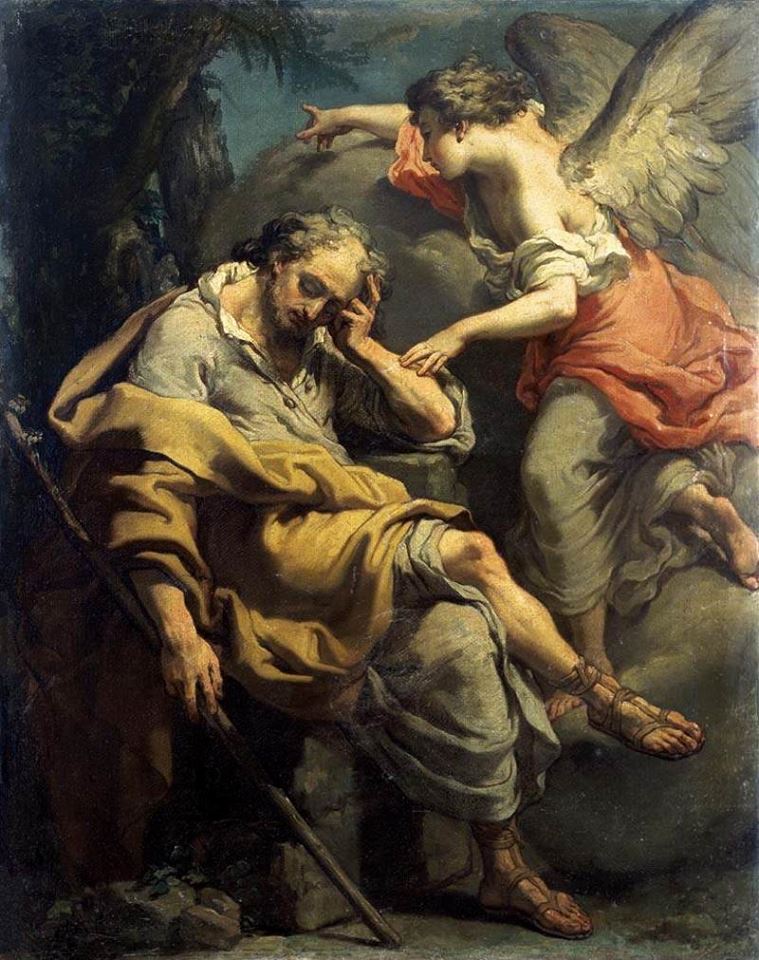
And, for those difficult and troubling pregnancies, we have today’s gospel reading from Saint Matthew. Thank God for Matthew and his Christmas account which addresses the darker side of Christmas. In his Christmas account there’s certainly no baby shower, John doesn’t leap in his mother’s womb, and expectant mothers don’t break out in song. Instead, what Matthew sets before us is a difficult situation. Joseph and Mary are engaged. Joseph has been good; he hasn’t slept with Mary. He’s done his part. But, oh, the darkness. Mary’s pregnant. What now? You better believe that Joseph suffered through many sleepless nights of heartache and disappointment. Perhaps Mary wasn’t who he thought she was. The ideal family he hoped for might never be. The best he could do was send her off to live with a relative and cancel the wedding.

Joseph seems like a man who wanted to do the right thing. We don’t know how he and Mary became engaged. It was probably arranged by the respective families. We don’t know whether they were “in love” or not, but that’s a modern concept. People didn’t marry on the basis of romantic love in those days. Matthew tells us that Joseph was “a just man.” But he was also a reasonable and sane man. He knew that virgins don’t get pregnant. Joseph was a builder from Nazareth, a businessman who operated in a world of income and expenses, blueprints and tools, algebra and geometry. He wasn’t some superstitious country-bumpkin. He knew that virgins don’t conceive, no matter how religious-sounding their explanation might be.

Into Joseph’s despair and darkness the Word of God gets delivered by an angel of the Lord. It would take the Word of the Lord for Joseph to overrule his reason and his senses, not to mention his common sense: “Joseph, son of David, do not fear to take Mary as your wife, for that which is conceived in her is from the Holy Spirit. She will bear a son, and you shall call his name Jesus, for he will save his people from their sins.”

Yes, that’s why Jesus came—to save His people from their sins. Those sins threaten to separate us from God eternally. Those sins—our sins—are what dims this world into perpetual darkness. Sometimes our sins produce self-inflicted wounds. Sometimes those around us get sucked in. Sometimes innocent people suffer for what we’ve done or what we’ve failed to do. This ugliness of sin—this depressing darkness—is why Jesus came. He came to save us from our sin and its deadly wages. Jesus didn’t come to shine a twinkling star on a moonlit night, or to lead us in joyful song, or to be a good excuse to roast chestnuts on an open fire. He came to people in mourning—to people in dark and difficult situations—to sinners—to you—to save you from your sins. See how much God loves you!

Matthew makes it clear that the Lord’s plan to save you had been around for a long time. There was a prophecy buried deep under about 700 years of Israelite dust—the prophecy of Immanuel. As you heard in today’s OT reading, that prophecy was first spoken to faithless King Ahaz. And even though Ahaz didn’t want a sign from the Lord, the Lord gave him one anyway: “Behold, the virgin shall conceive and bear a son, and they shall call his name Immanuel (which means, God with us).” To make a long story short, Ahaz rejected the sign offered by the Lord. Ahaz didn’t trust the Word of the Lord. And Ahaz went down to swift destruction.

That prophecy of Immanuel laid dormant for centuries, like a forgotten seed planted in the soil. But when God speaks—when God makes a promise—He never forgets it. And one marvelous day a smiling angel appeared to a young virgin named Mary, who was betrothed to Joseph. And the angel said, “Guess what, Mary? You’re it. The Lord is with you. Immanuel!” God is with us. The Word has become flesh in the womb of a virgin. His name shall be Jesus. He will save his people from their sins.

Mary believed it; and Joseph believed it too. That’s the real Christmas miracle! Joseph believed; and Joseph acted according to what he believed. As you may know, there isn’t a single syllable from Joseph’s mouth recorded in the Bible. Joseph is silent in the Scriptures. Mary sings her Magnificat, but Joseph has no song. He shows his faith by what he does. His actions speak louder than words. “He did as the angel of the Lord commanded him.” He took this pregnant teenager home as his wife. He gave the child the name Jesus, as directed by the angel. He raised that child as his very own. Joseph is a picture of faith in action. When God’s Word and his own “common sense” didn’t agree, Joseph trusted the Word. He believed it. He did what it says.

You also have the Word of the Lord delivered to you—applied to your life—by a messenger sent from God. I’m no angel; and this is no dream. But I am a messenger sent by God to you. Today the Word of God comes to you, calling you to do what Joseph did—to live in the obedience of faith—to live in the light of your baptism—to say “no” to all sin and ungodliness. In Matthew’s version of Christmas, things are messy and complicated because of sin. So will your Christmas be this year—messy, complicated, corrupted by your sin and its wages.

But the Word of the Lord is at work in you. That Word intrudes, it inconveniences, it rearranges things, it forgives sin. A virgin bears a Son. That Son, Jesus, dies and rises from the dead, bearing your sins away. With God—and with His Word—nothing is impossible. Sinners are forgiven. And the dying depart this life in peace to be with Christ—awaiting the resurrection of the body. Nothing is impossible with God.

Jesus comes. He is “Immanuel,” God with us. He comes in the water of your baptism. He comes in the bread and wine of His holy supper. He comes to save you from your sin. Mary actually was a Virgin. But our Lord also comes for those who aren’t—those who have made sinful and selfish choices. That story isn’t so pretty; nor does it inspire singing or decorations. But this is the Christmas Saint Matthew gives us. This is the Christ who comes even when pregnancy is not good news. This is the Christ who comes into a world where Herod and his allies still slaughter little babies. The Christ was born to die—precisely for the likes of us. He didn’t come so that people would put up fake, plastic trees, but He did come to hang upon a tree that was stained with His own sweat and His own blood. He came to bring genuine good news into a bad news world.

Saint Luke—he gives us the Christmas we want—where Mary sings for joy and where angels fill the sky and where shepherds marvel at the manger. We love it and we’ll hear about it this afternoon from the children. But Saint Matthew—he gives us the Christmas we need. And even in our darkest days, we can still say, “Thank you” and “Alleluia.” Amen.

Monday, December 5, 2016

Beasts Made Beautiful

In Nomine Iesu
Isaiah 11:1-10
December 4, 2016
Advent 2A
Dear brothers and sisters in Christ Jesus~

In the earliest years of my childhood there were two television programs that I watched regularly. One, of course, was Sesame Street. The other was Mutual of Omaha’s Wild Kingdom. These two programs were very different. One program featured creatures like Big Bird and Snuffolufogas learning to live together peacefully on the streets of an urban neighborhood. Whereas Wild Kingdom featured creatures like leopards and lions hungrily feasting on the bloody entrails of some unlucky zebra or gazelle, somewhere in the African Serengeti. The contrast between these two shows couldn’t have been starker.

What I didn’t realize at the time was that Marlin Perkins was actually teaching me more about the real world than Grover and Cookie Monster ever could. Sesame Street never mentioned anything about sin. For that matter, Marlin Perkins never said the word either. But every time I saw a wolf pack ripping some little bunny to shreds—every time I saw the crimson face of a lion snacking on the innards of a baby water buffalo—every time I saw a cobra sink its fangs into some cute, fuzzy mammal and then swallow the mammal whole—what I was seeing was the unmistakable evidence of the fall into sin.

Originally, in the beginning, before the fall into sin, these beasts were harmless and posed no threat whatsoever to Adam and Eve. Even the biggest and fiercest creatures were ruled and dominated by our first parents in Paradise. Predator and prey were terms you would not find in the dictionary of the Garden of Eden. But since that fateful day in Genesis chapter three, wolves, bears and lions are largely untamed. They are wild—outside of our control and dominion. If you get attacked by a bear, it’s nothing personal. Don’t be offended. Bears and other predators live by instinct, not by conscience. They prey on the weak. They fight to survive. It’s what they do. Back them into a corner or, say, threaten their offspring, and prepare to have claws and jaws aimed at your throat. The theme of this fallen creation is not “live and let live,” but rather, “kill to live.”

Sadly, the laws of the jungle don’t only apply to the predators and prey of the planet, but also to the people of the planet. For what the wolf does to the lamb and what the lion does to the fattened calf is also what we do to those around us. We don’t do it with fangs and claws, mind you, but with our words and actions. It really doesn’t take much provoking for us to rip apart the lives of others. We regularly sink our fangs into those who get in our way and inconvenience us. We chomp down on the bones of those who dare to cross our paths. For what the cat does to the mouse is what we do to those around us on a regular basis—friends, family members, innocent bystanders, it matters not. As we view the world through the lenses of our sinful nature, it’s clear: I’m always right, and everybody else is always in the wrong place at the wrong time, fully deserving all the puncture wounds we can inflict with our words and deeds.

The painful truth is that we’re much worse than the animals. Isaiah makes that clear in chapter one where he writes, “The ox knows his master, the donkey his owner’s manger, but Israel does not know, my people do not understand” (v.3). The ox and ass have things figured out. The wild animals are wise compared to us. To describe our behavior as beastly is actually an insult to the beasts! At least nature’s carnivores kill for their own survival. In the human world, unborn babies can be brutally murdered for nearly any reason at nearly any time of development. In the human world, we rip apart reputations just to make ourselves look good by comparison. In the human world, we bear our fangs purely for reasons of revenge and retribution. The “human” world is actually much less “humane” than the wild kingdom. Inside each of us is a wild, beastly, sinful creature. It cannot be domesticated, placated, or tamed. It must be killed.

This is what Advent is all about—killing the beast within. This is what John the Baptist meant when he preached repentance, calling the scribes and Pharisees a brood of vipers when they came after him with their fangs in full view. Advent is about Jesus—about the Son of God coming right into this hellish God-forsaking zoo of a world—stepping right into the lions’ den—right into this wild kingdom. Jesus came precisely for wild and untamed sinners like us. Jesus came to seek and save us beasts, to give us the beauty of His own righteousness.

When Isaiah first preached about the Messiah coming into our wild, wild world, it must have seemed pretty unlikely; in fact, darn near impossible. Isaiah preached that the coming Savior would be like “a shoot from the stump of Jesse.” You remember Jesse, don’t you? Jesse, the father of King David? God had promised David that his kingdom and his throne would be established forever (2 Sam. 7:16). But right about the time Mary and Joseph were encountering all those “no vacancy” signs in Bethlehem, David’s throne had been unoccupied and gathering dust for nearly five centuries. David’s kingdom had long ago been mowed down by the Babylonian chain saw wielded by Nebuchadnezzar; and only a dead stump remained. But from the remains of that dead stump sprouted David’s greater Son—David’s greatest Son—the Son of God—the Son of Mary—our Savior.

Isaiah said that the Savior would come to judge. But He doesn’t judge by what He sees with His eyes or hears with His ears. He judges you, Isaiah says, with righteousness. And even though you are guilty, for your sake He takes the blame. For your sake, the rod of punishment leaves welts and bloody furrows on His back. The belt of righteousness around His waist, the belt of faithfulness around His loins—these He removes from Himself and lovingly wraps them around you. You through faith become what He is; as He becomes what you are. You switch places, so that all the good He has becomes yours; and all the bad you have becomes His. As Isaiah looked ahead to Good Friday, he expressed the Savior’s work like this: He was wounded for our transgressions; he was crushed for our iniquities . . . and with His stripes we are healed.

This great exchange—this sacred substitution—transpires here in His church. Here in the church of Jesus Christ there’s always more than meets the eye. For as my eyes scan the pews this morning, I see sinful beasts—lions and tigers and bears (oh, my). Yet at the same time, I see something glorious: baptized beasts—sinners defanged and declawed by confession and absolution—souls redeemed by Christ the crucified—living together, loving together, serving and sacrificing together, witnessing as one. Here in the church, already today, the wolf dwells with the lamb, the leopard with the goat, the cow and the bear, the lion and ox, all of them hanging out together without fear of harm or destruction—led by the little child born in Bethlehem, David’s Son and David’s Lord.

Ultimately, of course, this life we share together in the church is a preview of heaven—the life of the world to come. And that heavenly life is less about harps and halos, and more about a return to Paradise—a restoration of what Adam and Eve enjoyed before they sinned and died. In paradise there will be no predators and no prey. No sin and no death. Just the good company of the Creator and His creatures, living in perfect harmony.

But between now and then, of course, you have to head back out into that wild kingdom we call planet earth. It’s a dog-eat-dog world out there. But as you head out, remember this: the Lord Jesus has chosen you (of all creatures) to be His own, to bless you with His blood-bought forgiveness and His resurrection life. He has washed you and welcomed you into His holy family. He has fed you and clothed you with the beauty of His own righteousness. You are a beast made beautiful by the Lord Jesus Christ. Amen.

Saturday, December 3, 2016

Witness with Andrew

In Nomine Iesu
St. John 1:35-42a
November 30, 2016
Midweek Advent 1

Dear brothers and sisters in Christ Jesus~

You’ve probably never heard a sermon centering on Saint Andrew. I’ve never preached such a sermon. His feast day—today
—falls at a time of year when our focus is firmly fixed on other things. Frankly, there’s not a lot of biblical material to work with where Andrew is concerned. When I opened my Anchor Bible Dictionary to the entry on Andrew, I found a one-page article; and the first sentence was this: “The NT shows little interest in Andrew.” That sounded a bit harsh. But the article went on to explain that while Andrew is mentioned a dozen times in the NT, most of those times he’s simply listed along with the other apostles. He speaks two sentences. One of them you just heard: “We have found the Messiah.” The other line comes in John 6 where Andrew mentions how five barley loaves and two fish won’t be nearly enough to feed a crowd of thousands. It’s true—the NT shows little interest in Andrew.

By contrast, the NT is very, very interested in Andrew’s brother, Peter. Peter’s escapades are splashed across page after page—not to mention First and Second Peter, the two epistles written by Peter. It was Andrew’s impetuous brother, Peter, who walked on water at the invitation of Jesus. It was Peter who confessed that Jesus was the Christ, the Son of the Living God. It was Peter who beheld Jesus in the glory of His transfiguration and then offered to set up tents for Jesus, Moses, and Elijah. It was Peter who cut off the ear of the High Priest’s servant, Peter who denied Jesus three times, Peter to whom Jesus said, “Feed my sheep,” Peter who preached a Pentecost sermon after which three thousand were baptized and added to the church of Jesus Christ. Andrew, it would seem, pales in comparison to his brother, Peter.

Or so it seems, unless you take seriously our text tonight. For there we learn that Andrew had been one of John the Baptist’s disciples, along with some unnamed, anonymous guy. And when these two saw John the Baptist point his prophetic finger at Jesus and declare, “Behold, the Lamb of God,” Andrew and the other guy followed Jesus. Andrew and the other guy spent a day with Jesus. And at the end of that day Andrew tracked down his brother, Peter, and said to him, “We have found the Messiah.” And immediately Andrew brought his brother to Jesus. Andrew was the first of Jesus’ disciples. Andrew was the first missionary—the first person to bear witness to Jesus as he brought along his brother to see and hear the Savior.

What if he hadn’t? What if Andrew had never gone to Peter and said, “We have found the Messiah?” What if Andrew had never brought brother Peter into the presence of Jesus? Perhaps Peter would never have been an apostle. It’s speculation, of course, but if Andrew had kept his brother in the dark concerning the Light of the World, there would have been no Peter walking on water, no Peter on whose rock solid confession of Christ the church would be built, no Peter proclaiming Jesus as the crucified and risen Messiah on the Day of Pentecost. Without the witness of Andrew, the New Testament would be a very different document.

Will you witness with Andrew? Remember how there was another anonymous, unnamed disciple together with Andrew? There’s lots of speculation about who that other guy was—lots of interesting theories. But I, personally, like to think that that unnamed partner of Andrew is unnamed for a reason—that the Holy Spirit wants you to see yourself as a partner of Andrew—a partner in discipleship, and a partner in bearing witness to Jesus, the Messiah.

When Andrew looked Peter in the eye and said, “We have found the Messiah,” he had no idea of the fruit that those words would bear. When Andrew ushered Peter into the presence of Jesus, there’s no way he could have fathomed how that simple act of witness would impact the history of the world and the church. But then again, that’s how it is every time you bear witness to Jesus—every time you speak of the hope that you have in Jesus—every time that you invite someone to come with you here into the Savior’s presence. You never know what the results might be. The results aren’t something you can control. The results of your witness depend primarily upon the work of the Holy Spirit; and not upon you.

Will you witness with Andrew? Most of us would object that we’re not knowledgeable enough about Jesus to bear witness about Him to others. But you know a lot more than Andrew did! What did Andrew know about Jesus? He heard John call Him the Lamb of God, and Andrew had spent less than 24 hours with Jesus. Andrew hadn’t seen even one miracle performed by Jesus. Andrew’s concept of “Messiah” probably had more to do with political victory than it did with suffering, shame, and crucifixion for the sins of the world. Witnessing doesn’t depend on having an answer for every question or having a PhD in theology. Andrew himself likely had more questions than answers; but that didn’t stop him from telling his brother, “We have found the Messiah,” and then bringing his brother to that Messiah.

Will you witness with Andrew? If so, to whom will you witness? Thank about that. Andrew went to a family member—a brother he knew better than anyone. Who do you know and love that has distanced themselves from Jesus and His church? The odds are that you have no shortage of family and friends who are not receiving what Jesus wants to give them. Far better to aim your witness at those you know than to go out ringing random doorbells. You probably wouldn’t say what Andrew said, “We have found the Messiah.” But you might say that Jesus has found you, and loved you, and made all the difference in your life—that He has given your life meaning, direction, hope, comfort, and eternal significance . . . or whatever seems right to you.

And then you bring them to Jesus—you invite them to come here with you. By my count there are something like 10 services happening here between now and January 1st. Invite someone to the children’s Christmas program. Invite someone to Evening Prayer. Because, when you witness with Andrew, the results don’t depend on you. What are you afraid of? What’s stopping you? What do you have to lose? Whose life might you change—forever—with a simple invitation?

You have found the Messiah, the Lamb of God. Or, more accurately, He has found you and forgiven you—named you and claimed you in the cleansing splash of your baptism. He took on our human flesh and was born of the Virgin Mary. By His death on the cross all of our sin has been answered for. And by His resurrection from the dead we know that our present sufferings don’t even begin to compare with the glory that will be revealed in us. Sharing the hope that you have—witnessing with Andrew—you don’t know the results and you won’t know the results . . . not until you stand with all the redeemed around the throne of the Lamb—together with Peter and Andrew and all the other saints like you—valuable, precious, died-for, and loved. Amen.

Monday, November 28, 2016

Advent Epistle 2016

Monday of Advent 1
November 28, 2016

Dear Saints of Our Savior,

Another Thanksgiving has come and gone—and the crush of the rush to Christmas is now underway.

But in the church’s reckoning of time, it’s not yet Christmas; it’s Advent. Advent is the antidote to the crush and rush of cultural Christmas. Advent is the season for pondering the promises of our gracious God. Advent is when we stop rushing and start reflecting on where we have been and where we are headed—all by the mercies of Christ, our Savior.

This year our congregation is offering four special midweek opportunities to do just that. Each Wednesday during Advent we will gather at 6:30 p.m. for Evening Prayer. Because nearly each of these Wednesdays aligns with a minor festival this year, we will take our cues from these “minor” saints who bore witness to Christ in “major” ways. We will briefly examine their lives through the lens of Advent—drawing direction and definition for our own lives as Christ’s holy people.

November 30 ~ Saint Andrew, Apostle Witness with Andrew
December 7 ~ Saint Ambrose of Milan, Pastor & Hymnwriter Sing with Ambrose
December 14 ~ Saint Lucia, Martyr (observed) Die and Live with Lucia
December 21 ~ Saint Thomas, Apostle Believe with Thomas

Each of these midweek services will be preceded by a meal in the fellowship hall, beginning at 5:30 p.m. You are invited to bring a side dish, salad, or dessert to share—although no culinary contribution is required. Just come and enjoy the good company of other “ordinary saints,” drawn to the light of Christ during the darkness of December.

Jesus Christ is the light of the world—the light no darkness can overcome.

Thanksgiving in the Midst of the Mess

In Nomine Iesu
Ephesians 5:3-5
November 24, 2016
Thanksgiving Day

Dear brothers and sisters in Christ Jesus~

Today’s sermon text is comprised of three brief verses from Ephesians chapter 5:

But sexual immorality and all impurity or covetousness must not even be named among you, as is proper among saints. Let there be no filthiness nor foolish talk nor crude joking, which are out of place, but instead let there be thanksgiving. For you may be sure of this, that everyone who is sexually immoral or impure, or who is covetous . . . has no inheritance in the kingdom of Christ and God (v.3-5).

Sounds like a strange text for Thanksgiving, doesn’t it? If it’s your custom to show up here on the fourth Thursday of November, then there are certain things you’ve come to expect. You can be confident that we will sing “Now Thank We All Our God.” There will be a bountiful display of fruits, veggies and grains adorning the chancel. And Jesus will heal ten lepers; but only one will return to give thanks. That you expected and that you have received.

It’s also customary around here on Thanksgiving to be reminded of God’s First Article gifts, the daily bread that our heavenly Father provides: clothing and shoes, food and drink, house and home, wife and children. And those First Article gifts ultimately point us to the Second Article gifts: the forgiveness of sins, life, and salvation that our Savior won for us by His suffering, death, and resurrection. Those are gifts that money can’t buy—undeserved gifts that come to us by the grace of God. Giving thanks for these gifts is what we Christians do—not just on this national holiday, but every day. And this is what you came here today expecting to hear.

What you probably didn’t expect to hear about today were sexual immorality, filthy talk, and crude joking. Yet, as St. Paul penned the verses you just heard, he plopped in the word “thanksgiving” right in the middle of a list of prohibitions and warnings about unholy words and actions: sexual immorality, impurity, crude joking, and the like. “Instead,” Paul writes, “let there be thanksgiving.” He gives us a warning, and—right in the middle of that warning—he gives us a prescription: “Let there be thanksgiving.” We need to heed both—both the warning and the prescription.

First of all, the warning: Good works don’t make you good or holy; only the good work done by Jesus, received through faith, can make you good and holy. Bad works, however, always undermine your faith in Jesus. Bad works like sexual immorality and filthy talk can eat away at your faith, like termites in your foundation—like cancer on healthy tissue and bone. Bad works can eventually cause you to lose your faith in Jesus! It’s not that sexual immorality and crude language are unforgiveable sins. But Paul is clear that these sins can weaken and undermine your faith over time, and leave you with no inheritance in the kingdom of Christ.

Most of the Christians at Ephesus had been converted from paganism. Much of their former lives had been spent entangled in various forms of idolatry and gross immorality. They were constantly being tempted and pulled back into their former way of life. Paul essentially tells them what he also tells us: That’s not who you are! You are pure. You are holy. You are saints redeemed by the blood of the Lamb. Have nothing to do with the filth of the culture which surrounds you on every side. That’s the warning.

Then comes the prescription: Instead let there be thanksgiving. Right in the middle of this listing of filthy deeds and words comes this one holy word and deed: Thanksgiving. As you sit here this morning surrounded by a culture that lives and breathes sexual immorality—as you sit here this morning pulled and tempted and seduced to sample from that smorgasbord of impurity—the simple prescription is thanksgiving.

But this word, thanksgiving, doesn’t merely refer to the act of being thankful. It means more than that; it has to. I mean, anybody can be thankful. Think about it: Meth dealers can be thankful for brisk sales of their product. Greedy misers can be thankful as they count up their coins. Abortionists can be thankful for ridding the world of unwanted babies. Being thankful isn’t an exclusively Christian concept.

But by the time Paul wrote to the Ephesians, the word translated “thanksgiving” had begun to take on a bigger meaning. The actual Greek word is eucharisto—from which we get “Eucharist,” another name for Holy Communion. A little later in the same chapter Paul uses the same word (giving thanks) to describe what goes on in the Divine Service, as we sing and make melody to the Lord with Psalms, hymns, and spiritual songs (v.19-20). In other words, when Paul prescribes “thanksgiving,” what he means is the thanksgiving that takes place here. When he writes, “Let there be thanksgiving,” what that means is, “let there be worship.” His prescription is praise and hymn-singing and promise-hearing, and, yes, even the Eucharist itself—the body and blood of Jesus for the forgiveness of our sins.

Thanksgiving, therefore, isn’t just a thankful feeling for all that’s good in our lives. No, thanksgiving is what we do because Jesus has rescued and delivered us from all that’s bad in our lives. THIS is Thanksgiving! Singing God’s praises and receiving His gifts, including, especially, the Eucharist—the bread that is His body and the wine that is His blood. Are you surrounded by immorality? Let there be thanksgiving! Are you tortured by temptation? Let there be thanksgiving! Have you failed to lead a sexually pure and decent life? Let there be thanksgiving . . . because thanksgiving is worship.

Thanksgiving is when the Lord Jesus plants and plops Himself right in the middle of your sinful, sorry life and gives you His gifts of healing and hope and joy in His salvation. He loves to be here among you as you gather in His name. He comes specifically to save sinners. And on the cross He stood-in as the substitute for every sinner—taking your place, and giving you His place as a child of God.

It’s likely that Paul knew the Christians at Ephesus better than he knew any other congregation. Paul had spent nearly three years living among them—much more time than he spent with any other church. He had taught them and catechized them. He had absolved them. He had preached to them. He had presided at their altar and served them with the Eucharist—the body and blood of Jesus. Paul was a pastor to them. He knew how Satan was targeting them and tempting them. He knew their vulnerabilities and weaknesses. This is why Paul didn’t merely tell them to “count their blessings.” There’s nothing wrong with that; but they needed more, and so do we.

Paul said this: “Let there be thanksgiving.” Surrounded by sin and its wages, let there be thanksgiving. Let there be worship. For where there is worship, there is Jesus. Only Jesus can pull you out of the immorality that surrounds you. Only Jesus can cleanse you and purify you from the filth of your own sin. And Jesus doesn’t do partial-purifying. He doesn’t forgive halfway and then say, “Now you earn the rest.” His cleansing is complete. His forgiveness is full. His absolution . . . is absolute.

Perhaps Paul’s warning against immorality, and his prescription for thanksgiving, are best understood in terms of feasting. After all, today is a day of feasting. More calories will touch your lips today than on most days. Paul’s warning is not to sully and soil our lips and bodies with sexual sins and filthy language. Those things will bring death to you. Instead let there be thanksgiving. Instead, let your lips and bodies be purified with the cleansing body and blood of Jesus in the feast of the Eucharist. For when these gifts touch your tongue, that is thanksgiving. That is Jesus for you. And His feast—the feast of the Lamb—is a feast that has no end—as you will see for yourself soon enough. So let there be thanksgiving!

In the name of the Father and of the Son and of the Holy Spirit. Amen.

Wednesday, November 23, 2016

With Jesus, in Paradise

In Nomine Iesu
St. Luke 23:33, 39-43
November 21, 2016
Robert Schulz Funeral

Dear family and friends of Bob Schulz,
Dear brothers and sisters in Christ Jesus,

Robert Schulz was born into this world on October 26, 1939. Later that same year he was born again in the waters of Holy Baptism at Pilgrim Congregational Church in Milwaukee. He made public confession of his faith on the day of his confirmation in 1953. Ten years later he was married to Karen Wilke—on June 8, 1963, right here in this very sanctuary. That holy union was blessed with four children and ten grandchildren. Bob departed this life to be with Christ on Tuesday, November 15th. Today we feebly struggle; he in glory shines.

Bob departed this life at a time of transitions here in the church. Yesterday was the last Sunday of the Church Year. On Thursday we will celebrate Thanksgiving. And already on Sunday the Advent wreath will be hanging, sporting one lit candle. For us Christians, all of time—all of history—hinges on what happened on Good Friday and Easter Sunday. The gospel reading you heard a few minutes ago took us there. Much of what happened on Good Friday is hard to hear.

But in the midst of all the “bad” things connected with the Passion of our Lord, we hear of one very good thing. Tucked away in St. Luke’s gospel is one little exchange filled with good news for us, for Bob, for every follower of Jesus. You heard it just a few minutes ago—that conversation at the cross—the exchange between Jesus and the repentant criminal crucified next to him. That dying man made a request of Jesus—an amazing, faith-filled request: “Jesus,” he said, “remember me when you come into your kingdom.”

That dying man’s request teaches us what it means to walk by faith, and not by sight. When that criminal looked at Jesus, he saw one thing with his eyes; but he saw something quite different by faith. With his eyes he saw a bleeding man, a dying victim, a powerless casualty of Roman brutality. But by faith he saw Jesus as a powerful king and a mighty redeemer. He trusted Jesus so much that he placed himself in the Savior’s keeping: “Jesus, remember me when you come into your kingdom.” That is faith.

That’s also the faith that resided in the heart of Bob Schulz. The Lord showered Bob’s earthly life with so many good gifts and blessings—so many good years. A spirited wife in Karen, lively children and grandchildren, playful canine companions, a place on Green Lake, friends, co-workers, and a church family here at Our Savior. But as wonderful as all these gifts were, faith in Jesus was still the greater gift. In the waters of Holy Baptism, God gave Bob that gift of faith. By faith Bob knew that this life isn’t all there is—that in all things God was working for his eternal good—that the sufferings of this present time aren’t even worth comparing to the glory that will be revealed in us. When Karen died five years ago, it seemed like a part of Bob died too. But even that loss only focused Bob’s faith with more clarity upon Jesus—the Savior of sinners.

I was surprised to get the message last week that Bob had died; and yet, I wasn’t surprised either. It seemed like Bob had been on his last leg for a very long time. Bad knees, bad heart, bad lungs—the medical problems just seemed to snowball. There was one bad diagnosis after another, but very few remedies. Bob knew with more certainty than most of us that his days on earth were numbered. Like that criminal crucified with Jesus, Bob could see the end coming. Like that criminal, Bob regularly confessed his guilt to Jesus here in this room with the words, “I, a poor, miserable sinner.” And like that criminal, Bob placed himself in the Savior’s care: “Jesus, remember me when you come into your kingdom.” Jesus can’t help but respond to that kind of faith. Even as Jesus was crowned with thorns and pierced by nails, He spoke a wonderful word of promise to all who die with faith in him: “Truly I say to you, today you will be with me in paradise.” By faith we believe those words. By faith Bob believed in the promised paradise that Jesus earned for him.

From this conversation on the cross we learn how God’s power is made perfect in our weakness, and how His glory is revealed in the midst of shame. By faith we know that God does His best work in us when we are at our worst. When we are weak, when we are powerless, when we are helpless, when we are most like that crucified criminal—then and there Jesus is most powerful. His grace is sufficient. His power is made perfect in our weakness. Bob came to know this when he lost Karen, and in subsequent years when health difficulties made everything a challenge. Nothing was easy anymore. But in the midst of that burden, God was at work in Bob’s life—strengthening his faith, forgiving his sin, reminding him that Jesus had prepared a place for him in paradise.

I’m so glad that we’re gathered here at Our Savior tonight. This was Bob’s church home for many decades. Certainly there are bigger and more beautiful churches than this one. But it’s good to be here tonight because this is the sacred space where God did His best work in Bob’s life. It was right here in the Divine Service, decade after decade, that all the blessings Jesus earned on the cross were poured out into Bob’s life. Here he heard the promises of paradise preached and proclaimed. From this altar he received the body and blood of Jesus, bringing forgiveness, life and salvation. Here Bob was able both to taste and see and hear that the Lord is good, that His mercy endures forever. Here Bob came to know and believe that one day he would be with Jesus in paradise.

Through faith in Jesus, that promise is also for you. What happened to that repentant criminal will also happen to all who repent and trust in Jesus. When we depart this life—at that very moment—we are with Jesus in Paradise. Last Tuesday Bob was escorted through the valley of the shadow of death and—in an instant—he was with Jesus in paradise. No wait. No line. No limbo. No purgatory. No paperwork to complete. No ghostly existence. No soul sleep. Just with Jesus, in paradise—awaiting the day of resurrection. And that is everything.

I don’t know how or where the Schulz family usually celebrates Thanksgiving. But I do know that this Thursday there will be an empty place at the table, and also an empty place in your hearts. Here at Our Savior on Thursday there will be an empty spot back in the back corner. Bob won’t be with us. But despite all that—despite our loss and sadness—there is every reason for thanksgiving this year—every reason to give thanks to God. He’s the one who gave Bob to us—to know and love as a companion on this earthly pilgrimage. He’s the one who gave Bob the gift of faith. And with deep thanksgiving we will not forget—Bob is already where we all long to be: with Jesus, in paradise.

In the name of the Father and of the Son and of the Holy Spirit. Amen.

Monday, November 14, 2016

The End Is Near!

In Nomine Iesu
St. Luke 21:5-28
November 13, 2016
Proper 28C

Dear brothers and sisters in Christ Jesus~

The end is near! Or at least, the end of the church year is near. One week from today we will wrap up another year of grace in the church of Jesus Christ. But the end of the church year also brings to mind the end of time—the end of the world as we know it—Judgment Day.

But something tells me that when you got up this morning you probably weren’t thinking about those things, were you? It’s more likely you were thinking about plans for Thanksgiving, or getting the last of your leaves raked, or wondering whether the Packers can turn their season around today. Most people with good mental health don’t spend a lot of time thinking about the end of the world. (Although, as the election results came in last week, I know a few people who probably began to wonder!)

But this is exactly why we have a church year, and a church calendar, and a lectionary—because it forces us think about
things we might not normally consider. For, as we just sang, the day is surely drawing near when Jesus will come again to judge the living and the dead. That day will inevitably come—burning like a blazing oven—a day of fire and wrath—a day when the faithless and arrogant evildoers will be reduced to stubble. The heavens will be shaken. The seas will roar. The perfectly predictable sun and moon and stars will fail. The earthquakes and hurricanes that make headlines today will seem like nothing by comparison. We simply can’t begin to imagine it. Cosmic destruction is really beyond our grasp. But that doesn’t mean it won’t happen.

The people of Jesus’ day couldn’t begin to imagine that Jerusalem would be destroyed. They thought Jerusalem was indestructible. After all, it was God’s city, the City of David, the place of His holy temple, Mount Zion, God’s dwelling place on earth. Yet Jesus predicted that it would all be destroyed within the time of His own generation. And by 70 AD invading gentile armies had leveled it all. And yet, because of what we heard from Jesus today, His followers were prepared. His followers—those who remembered His words—they knew to flee to the mountains when the armies of Rome appeared. They knew to flee instead of fight. Jesus was preparing His disciples for a coming destruction that no one would have conceived as even remotely possible.

As Jesus spoke the words of today’s Holy Gospel, the temple in Jerusalem was being rebuilt by Herod. It was a massive public works project which spared no expense. Enormous stones had to be quarried and moved. All sorts of craftsmen and laborers were employed to make the temple into something grand and glorious that would last forever. So, it sounded like total nonsense when Jesus looked at the construction site and said, “there will not remain here one stone upon another.” That was crazy-talk—like someone saying today that the United States won’t exist as a nation forty years from now, or that Chicago will be burned to the ground in a nuclear explosion. The FBI might show up at your doorstep for talking like that; but no one will take you seriously.

If talk about the end of the world makes you apprehensive or uneasy, it should! Jesus warned His disciples that they wouldn’t escape from the coming chaos. He told them that they would be persecuted, betrayed, arrested, imprisoned, and put on trial. Jesus didn’t tell them that they would be spared from persecution; only that He would see them through it—that He would even supply them with words and wisdom so that they could bear witness to Him. There is no notion in the Scriptures of believers being spared the tribulations of the end. And there’s no concept whatsoever of a “rapture” in which all true believers get whisked away before the distress of the end times descends. Christians don’t get a free pass. We already see Christians being targeted for their beliefs—being hated for the truth they confess. Don’t be surprised. Jesus said it would be this way. In fact, looking back at the history of Christianity, it’s when the church is most powerful and most popular that things go terribly wrong.

The Christian faith has a cross at its center—Jesus Christ and Him crucified. Gathered around the cross of Christ, you can expect suffering, hardship, loss, and persecution. As the world hated Jesus, so it will hate His followers. Jesus even told them, “Some of you they will put to death.” And yet, notice the very next sentence, “But not a hair of your head will perish. By your endurance you will gain your lives.” It sounds like a contradiction. Which is it? Will the followers of Jesus be put to death, or will not a hair on their heads perish? The answer is “yes.” Yes, death will come to those who follow Jesus—maybe even martyrdom; and “yes” again, you will live. Not a hair on your head will perish.

It’s not a contradiction; it’s not double-talk; it’s the way of the gospel—death giving way to life. That’s the hidden comfort on these last Sundays of the church year, as we ponder the end of the world. The end is also the beginning. The destruction of the old brings the revelation of the new. “We are looking forward to a new heaven and a new earth, the home of righteousness.” Imagine the scaffolding that surrounds new construction. That scaffolding hides the work going on inside. But when the work’s done and the building’s complete, the scaffolding comes down to reveal something entirely new.

Jerusalem was like that scaffolding. It served an important purpose in God’s plan of salvation. The temple there was God’s dwelling place . . . until the coming of the Christ—until the Son of God took on human flesh and dwelt among us. And then the temple was no longer needed. The scaffolding could come down. The temple was destroyed because God now dwells among us in Jesus the Christ. It’s true for the things of our world today. It’s all just a temporary scaffolding—nations, institutions, stadiums and skyscrapers—they are all just temporary. They will all eventually give way to reveal the permanent, eternal kingdom of God—the New Jerusalem.

And so it is for you—for each of us. Hidden behind this sinful scaffolding there is a new person—a new creation—a saint who will be unveiled on the day of resurrection. The sinner must die in order for the saint to be revealed. As in Adam all die, so in Christ will all be made alive. The flesh of the old Adam must be torn down so that the new creation in Christ can be revealed. God tears down what is temporary in order to reveal what is eternal. New heavens. New earth. New you.

Jesus is telling you now, ahead of time, so that you won’t be caught off guard when things begin to unravel. You are precious to Him. Even the hairs of your head are numbered. In His death your sin has been answered for. And by His resurrection He shows us that death is a defeated enemy.

On the Last Day your faith will be vindicated. Every promise made by Jesus will be fulfilled. Then you will see with your own two eyes what today you can only hear about and believe. The end is near; but Jesus is nearer. Already today Jesus is near—in His Word preached and proclaimed, in His Baptism, and in His Holy Supper. And sooner than you might think, you will see Him face to face. Amen.